
Mapa mental
The Weimar republic
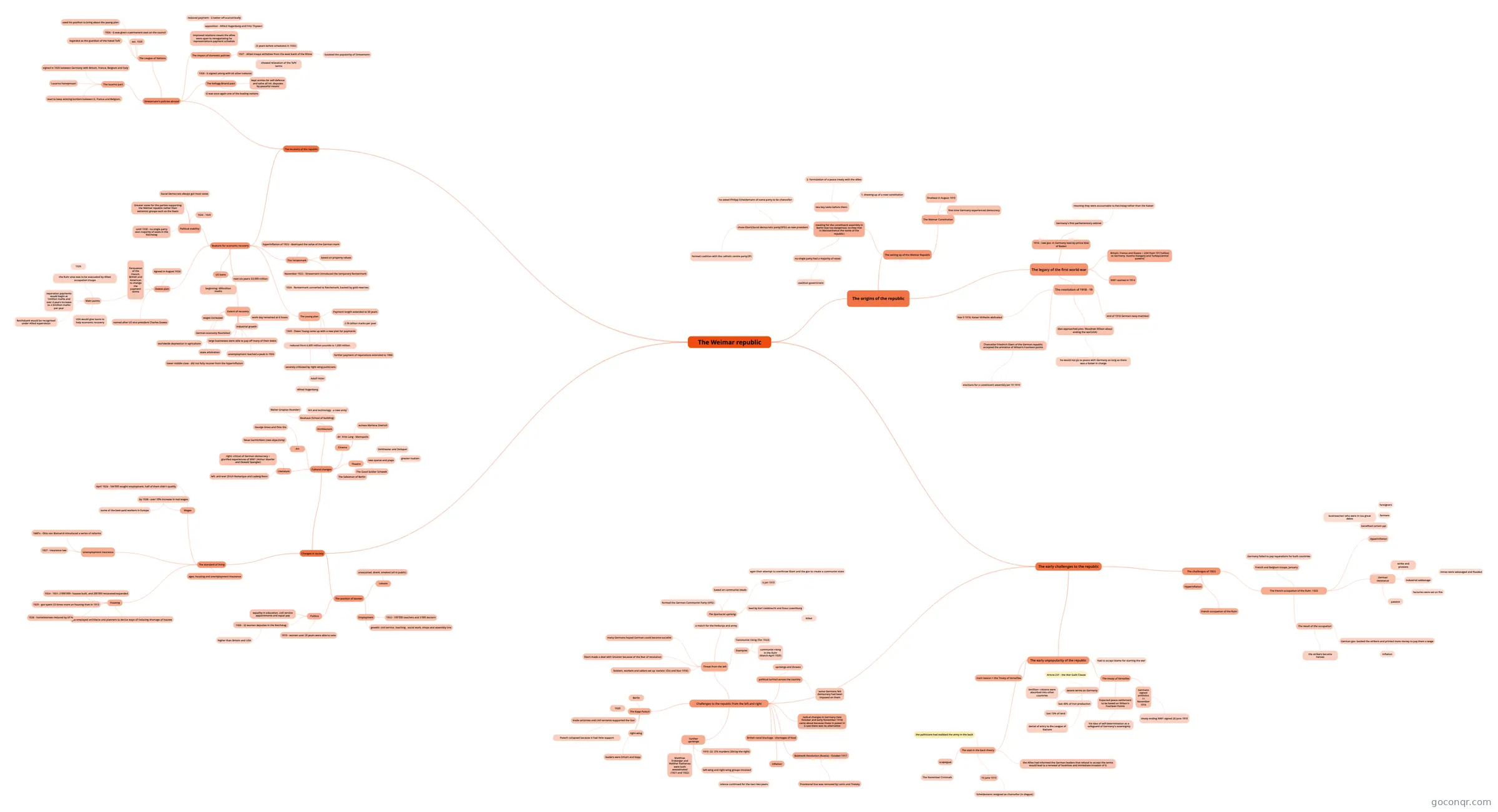
Mind map: The Weimar republic
Conteúdo do mapa
The Weimar republic
The origins of the republic
- The setting up of the Weimar Republic
- The Weimar Constitution
- finalised in August 1919
- first time Germany experienced democracy
- meeting for the constituent assembly in Berlin was too dangerous, so they met in Weimar(hence the name of the republic)
- no single party had a majority of votes
- coalition government
- chose Ebert(Social democratic party(SPD)) as new president
- he asked Philipp Echeidemann of same party to be chancellor
- formed coalition with the catholic centre party(ZP)
- two key tasks before them:
- 1. drawing up of a new constitution
- 2. formulation of a peace treaty with the allies
- no single party had a majority of votes
- The Weimar Constitution
- The legacy of the first world war
- The revolution of 1918 - 19
- Max approached pres. Woodrow Wilson about ending the war(USA)
- he would not go to peace with Germany as long as there was a Kaiser in charge
- end of 1918 German navy mutinied
- Nov 9 1918; Kaiser Wilhelm abdicated
- Chancellor Friedrich Ebert of the German republic accepted the armistice of Wilson's Fourteen points
- elections for a constituent assembly Jan 19 1919
- Max approached pres. Woodrow Wilson about ending the war(USA)
- WW1 started in 1914
- Britain, France and Russia + USA from 1917(allies) vs Germany, Austria-Hungary and Turkey(central powers)
- 1918 - new gov. in Germany lead by prince Max of Baden
- Germany's first parliamentary cabinet
- meaning they were accountable to Reichstag rather than the Kaiser
- Germany's first parliamentary cabinet
- The revolution of 1918 - 19
- The setting up of the Weimar Republic
The early challenges to the republic
- The early unpopularity of the republic
- The treaty of Versailles
- Germans signed armistice 11 November 1918
- treaty ending WW1 signed 28 June 1919
- Expected peace settlement to be based on Wilson's Fourteen Points
- his idea of self-determination as a safeguard of Germany's sovereignty
- severe terms on Germany
- lost 13% of land
- lost 48% of iron production
- 6million+ citizens were absorbed into other countries
- Article 231 - the War Guilt Clause
- had to accept blame for starting the war
- denial of entry to the League of Nations
- Germans signed armistice 11 November 1918
- The stab in the back theory
- scapegoat
- The November Criminals
- 19 June 1919
- Scheidemann resigned as chancellor (in disgust)
- the Allies had informed the German leaders that refusal to accept the terms would lead to a renewal of hostilites and immediate invasion of G
- the politicians had stabbed the army in the back
- scapegoat
- main reason = the Treaty of Versailles
- The treaty of Versailles
- Challenges to the republic from the left and right
- Threat from the left
- The Spartacist uprising
- based on communist ideals
- lead by Karl Liebknecht and Rosa Luxemburg
- killed
- formed the German Communist Party (KPD)
- 6 Jan 1919
- egan their attempt to overthrow Ebert and the gov to create a communist state
- o match for the freikorps and army
- many Germans hoped German could become socialist
- Soldiers, workers and sailors set up 'soviets' (Oct and Nov 1918)
- Ebert made a deal with Groener because of the fear of revolution
- Examples
- Communist rising (Oct 1923)
- communist rising in the Ruhr (March-April 1920)
- The Spartacist uprising
- The Kapp Putsch
- right-wing
- trade unionists and civil servants supported the Gov
- Putsch collapsed because it had little support
- 1920
- Berlin
- leaders were Erhart and Kapp
- Further uprisings
- left-wing and right-wing groups involved
- iolence continued for the nect two years
- 1919 -22: 376 murders (354 by the right)
- Matthias Erzberger and Walther Rathenau were both assassinated (1921 and 1922)
- left-wing and right-wing groups involved
- political turmoil across the country
- uprisings and threats
- some Germans felt democracy had been imposed on them
- radical changes in Germany (late October and early November 1918) came about because those in power in G saw there was no alternative
- British naval blockage - shortages of food
- inflation
- Bolshevik Revolution (Russia) - October 1917
- Provisional Gov was removed by Lenin and Trotsky
- Threat from the left
- The challenges of 1923
- The French occupation of the Ruhr, 1923
- German resistance
- passive
- industrial sabbotage
- factories were set on fire
- mines were sabotaged and flooded
- strike and protests
- The result of the occupation
- the strikers became heroes
- German gov. backed the strikers and printed more money to pay them a wage
- inflation
- Hyperinflation
- benefited certain ppl
- businessmen who were in too great debts
- farmers
- foreigners
- benefited certain ppl
- French and Belgium troops, January
- Germany failed to pay reparations for both countries
- German resistance
- French occupation of the Ruhr
- Hyperinflation
- The French occupation of the Ruhr, 1923
- The early unpopularity of the republic
The recovery of the republic
- Reasons for economic recovery
- Dawes plan
- Persuasion of the French, British and American to change the payment terms
- Agreed in August 1924
- named after US vice president Charles Dawes
- Main points
- reparation payments would begin at 1million marks and over 4 years increase to 2.5million marks per year
- the Ruhr area was to be evacuated by Allied occupation troops
- 1925
- Reichsbank would be recognised under Allied supervision
- USA would give loans to help economic recovery
- US loans
- beginning: 800million marks
- next six years: $3,000 million
- The rentenmark
- hyperinflation of 1923 - destroyed the value of the German mark
- November 1923 - Stresemann introduced the temporary Rentenmark
- 1924 - Rentenmark converted to Reichsmark, backed by gold reserves
- based on property values
- The young plan
- 1929 - Owen Young came up with a new plan for payments
- reduced from 6,600 million pounds to 1,850 million.
- Payment length extended to 59 years
- 2.05 billion marks per year
- severely critisised by right-wing politicians
- Alfred Hugenberg
- Adolf Hitler
- further payment of reparations extended to 1988
- 1929 - Owen Young came up with a new plan for payments
- Political stability
- 1924 - 1929
- until 1930 - no single party won majority of seats in the Reichstag
- Social Democrats always got most votes
- Greater votes for the parties supporting the Weimar republic rather than extremist groups such as the Nazis
- Extent of recovery
- German economy flourished
- large businesses were able to pay off many of their debts
- Industrial growth
- wages increased
- work day remained at 8 hours
- state arbitration
- unemployment reached a peak in 1926
- worldwide depression in agriculture
- lower middle class - did not fully recover from the hyperinflation
- Dawes plan
- Stresemann's policies abroad
- The locarno pact
- signed in 1925 between Germany with Britain, France, Belgium and Italy
- reed to keep existing borders between G, France and Belgium.
- 'Locarno honeymoon'
- The League of Nations
- est. 1920
- 1926 - G was given a permanent seat on the council
- regarded as the guardian of the hated TofV
- used his position to bring about the young plan
- The Kellogg-Briand pact
- 1928 - G signed (along with 64 other nations)
- kept armies for self-defence and solve all int. disputes 'by peaceful means'
- G was once again one of the leading nations
- The impact of domestic policies
- improved relations meant the allies were open to renegotiating he representations payment schedule
- reduced payment - G better off economically
- opposition - Alfred Hugenberg and Fritz Thyssen
- 1927 - Allied troops withdrew from the west bank of the Rhine
- (5 years before scheduled in 1933)
- showed relaxation of the TofV terms
- boosted the popularity of Stresemann
- improved relations meant the allies were open to renegotiating he representations payment schedule
- The locarno pact
- Reasons for economic recovery
Changes in society
- The standard of living
- Wages
- by 1928 - over 10% increase in real wages
- some of the best-paid workers in Europe
- April 1928 - 184'000 sought employment, half of them didn't qualify
- by 1928 - over 10% increase in real wages
- Housing
- gov employed architects and planners to device ways of reducing shortage of houses
- 1924 - 1931: 2'000'000+ houses built, and 200'000 renovated/expanded
- 1929 - gov spent 33 times more on housing than in 1913
- 1928 - homelessness reduced by 60 %
- Unemployment insurance
- 1880's - Otto von Bismarck introduced a series of reforms
- 1927 - insurance law
- ages, housing and unemployment insurance
- Wages
- The position of women
- Politics
- 1919 - women over 20 years were able to vote
- equality in education, civil service appointments and equal pay
- 1926 - 32 women deputies in the Reichstag
- higher than Britain and USA
- Employment
- growth: civil service, teaching , social work, shops and assembly line
- 1933 - 100'000 teachers and 3'000 doctors
- Leisure
- unescorted, drank, smoked (all in public)
- Politics
- Cultural changes
- Art
- Neue Sachlichkeit (new objectivity)
- George Grosz and Otto Dix
- Architecture
- Bauhaus (School of building)
- 'Art and technology - a new unity'
- Walter Gropius (founder)
- Bauhaus (School of building)
- Cinema
- dir. Fritz Lang - Metropolis
- actress Marlene Dietrich
- Literature
- right: critical of German democracy + glorified experiences of WW1 (Arthur Moeller and Oswald Spengler)
- left: anti-war (Erich Remarque and Ludwig Renn
- Theatre
- new operas and plays
- Zeittheater and Zeitoper
- greater realism
- The Good Soldier Schweik
- The Salesman of Berlin
- new operas and plays
- Art
- The standard of living
Informações
- Descrição
- GSCE History Mapa Mental sobre The Weimar republic, criado por h g em 25-03-2018.
- Criado por
- h g
- Visualizações
- 99
- Tags
- Avaliação
Mais sobre Weimar Republic and the Treaty of Versailles