
Mapa mental
Relationships
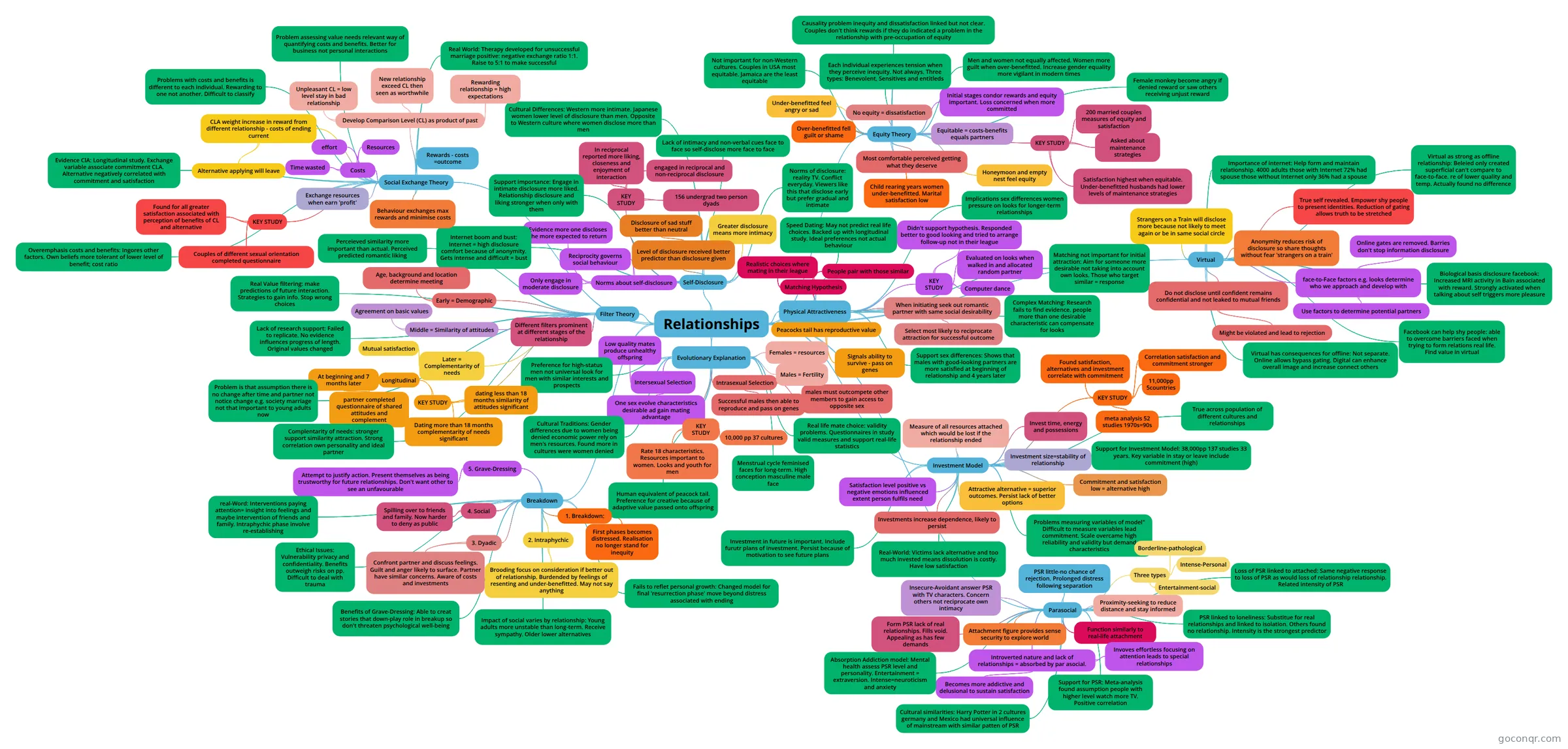
Mind map: Relationships psychology
Conteúdo do mapa
Relationships
Evolutionary Explanation
- Intrasexual Selection
- males must outcompete other members to gain access to opposite sex
- Successful males then able to reproduce and pass on genes
- Intersexual Selection
- One sex evolve characteristics desirable ad gain mating advantage
- Low quality mates produce unhealthy offspring
- Females = resources
- Males = Fertility
- KEY STUDY
- 10,000 pp 37 cultures
- Rate 18 characteristics. Resources important to women. Looks and youth for men
- Cultural Traditions: Gender differences due to women being denied economic power rely on men's resources. Found more in cultures were women denied
- Preference for high-status men not universal look for men with similar interests and prospects
- Real life mate choice: validity problems. Questionnaires in study valid measures and support real-life statistics
- Menstrual cycle feminised faces for long-term. High conception masculine male face
- Human equivalent of peacock tail. Preference for creative because of adaptive value passed onto offspring
- Intrasexual Selection
Physical Attractiveness
- Peacocks tail has reproductive value
- Signals ability to survive - pass on genes
- When initiating seek out romantic partner with same social desirability
- Select most likely to reciprocate attraction for successful outcome
- Matching Hypothesis
- People pair with those similar
- Realistic choices where mating in their league
- KEY STUDY
- Computer dance
- Evaluated on looks when walked in and allocated random partner
- Didn't support hypothesis. Responded better to good looking and tried to arrange follow-up not in their league
- Speed Dating: May not predict real life choices. Backed up with longitudinal study. Ideal preferences not actual behaviour
- Complex Matching: Research fails to find evidence. people more than one desirable characteristic can compensate for looks
- Support sex differences: Shows that males with good-looking partners are more satisfied at beginning of relationship and 4 years later
- Matching not important for initial attraction: Aim for someone more desirable not taking into account own looks. Those who target similar = response
- Implications sex differences women pressure on looks for longer-term relationships
- Peacocks tail has reproductive value
Self-Disclosure
- Greater disclosure means more intimacy
- Level of disclosure received better predictor than disclosure given
- Disclosure of sad stuff better than neutral
- Norms about self-disclosure
- Only engage in moderate disclosure
- Reciprocity governs social behaviour
- Evidence more one discloses the more expected to return
- KEY STUDY
- 156 undergrad two person dyads
- engaged in reciprocal and non-reciprocal disclosure
- In reciprocal reported more liking, closeness and enjoyment of interaction
- Support importance: Engage in intimate disclosure more liked. Relationship disclosure and liking stronger when only with them
- Internet boom and bust: Internet = high disclosure comfort because of anonymity. Gets intense and difficult = bust
- Norms of disclosure: reality TV. Conflict everyday. Viewers like this that disclose early but prefer gradual and intimate
- Lack of intimacy and non-verbal cues face to face so self-disclose more face to face
- Cultural Differences: Western more intimate. Japanese women lower level of disclosure than men. Opposite to Western culture where women disclose more than men
Filter Theory
- Different filters prominent at different stages of the relationship
- Early = Demographic
- Age, background and location determine meeting
- Middle = Similarity of attitudes
- Agreement on basic values
- Later = Complementarity of needs
- Mutual satisfaction
- KEY STUDY
- Longitudinal
- partner completed questionnaire of shared attitudes and complement
- At beginning and 7 months later
- partner completed questionnaire of shared attitudes and complement
- dating less than 18 months similarity of attitudes significant
- Dating more than 18 months complementarity of needs significant
- Longitudinal
- Lack of research support: Failed to replicate. No evidence influences progress of length. Original values changed
- Real Value filtering: make predictions of future interaction. Strategies to gain info. Stop wrong choices
- Perceieved similarity more important than actual. Perceived predicted romantic liking
- Complentarity of needs: stronger support similarity attraction. Strong correlation own personality and ideal partner
- Problem is that assumption there is no change after time and partner not notice change e.g. society marriage not that important to young adults now
Social Exchange Theory
- Behaviour exchanges max rewards and minimise costs
- Exchange resources when earn 'profit'
- Costs
- Time wasted
- effort
- Resources
- Rewards - costs =outcome
- Develop Comparison Level (CL) as product of past
- New relationship exceed CL then seen as worthwhile
- Unpleasant CL = low level stay in bad relationship
- Rewarding relationship = high expectations
- CLA weight increase in reward from different relationship - costs of ending current
- Alternative applying will leave
- KEY STUDY
- Couples of different sexual orientation completed questionnaire
- Found for all greater satisfaction associated with perception of benefits of CL and alternative
- Evidence ClA: Longitudinal study. Exchange variable associate commitment CLA. Alternative negatively correlated with commitment and satisfaction
- Problems with costs and benefits is different to each individual. Rewarding to one not another. Difficult to classify
- Problem assessing value needs relevant way of quantifying costs and benefits. Better for business not personal interactions
- Overemphasis costs and benefits: Ingores other factors. Own beliefs more tolerant of lower level of benefit; cost ratio
- Real World: Therapy developed for unsuccessful marriage positive: negative exchange ratio 1:1. Raise to 5:1 to make successful
Equity Theory
- Most comfortable perceived getting what they deserve
- Equitable = costs-benefits equals partners
- No equity = dissatisfaction
- Over-benefitted fell guilt or shame
- Under-benefitted feel angry or sad
- Child rearing years women under-benefitted. Marital satisfaction low
- Honeymoon and empty nest feel equity
- Initial stages condor rewards and equity important. Loss concerned when more committed
- KEY STUDY
- 200 married couples measures of equity and satisfaction
- Asked about maintenance strategies
- Satisfaction highest when equitable. Under-benefitted husbands had lower levels of maintenance strategies
- Each individual experiences tension when they perceive inequity. Not always. Three types: Benevolent, Sensitives and entitleds
- Men and women not equally affected. Women more guilt when over-benefitted. Increase gender equality more vigilant in modern times
- Not important for non-Western cultures. Couples in USA most equitable. Jamaica are the least equitable
- Female monkey become angry if denied reward or saw others receiving unjust reward
- Causality problem inequity and dissatisfaction linked but not clear. Couples don't think rewards if they do indicated a problem in the relationship with pre-occupation of equity
Investment Model
- Satisfaction level positive vs negative emotions influenced extent person fulfils need
- Attractive alternative = superior outcomes. Persist lack of better options
- Investment size=stability of relationship
- Measure of all resources attached which would be lost if the relationship ended
- Invest time, energy and possessions
- Investments increase dependence, likely to persist
- Commitment and satisfaction low = alternative high
- KEY STUDY
- meta analysis 52 studies 1970s=90s
- 11,000pp 5countries
- Found satisfaction, alternatives and investment correlate with commitment
- Correlation satisfaction and commitment stronger
- Support for Investment Model: 38,000pp 137 studies 33 years. Key variable in stay or leave include commitment (high)
- Problems measuring variables of model" Difficult to measure variables lead commitment. Scale overcame high reliability and validity but demand characteristics
- Real-World: Victims lack alternative and too much invested means dissolution is costly. Have low satisfaction
- Investment in future is important. Include furutr plans of investment. Persist because of motivation to see future plans
- True across population of different cultures and relationships
Breakdown
- 1. Breakdown:
- First phases becomes distressed. Realisation no longer stand for inequity
- 2. Intraphychic
- Brooding focus on consideration if better out of relationship. Burdended by feelings of resenting and under-benefitted. May not say anything
- 3. Dyadic
- Confront partner and discuss feelings. Guilt and anger likely to surface. Partner have similar concerns. Aware of costs and investments
- 4. Social
- Spilling over to friends and family. Now harder to deny as public
- 5. Grave-Dressing
- Attempt to justify action. Present themselves as being trustworthy for future relationships. Don't want other to see an unfavourable
- Fails to reflet personal growth: Changed model for final 'resurrection phase' move beyond distress associated with ending
- Impact of social varies by relationship: Young adults more unstable than long-term. Receive sympathy. Older lower alternatives
- Benefits of Grave-Dressing: Able to creat stories that down-play role in breakup so don't threaten psychological well-being
- Ethical Issues: Vulnerability privacy and confidentiality. Benefits outweigh risks on pp. Difficult to deal with trauma
- real-Word: Interventions paying attention= insight into feelings and maybe intervention of friends and family. Intraphychic phase involve re-establishing
- 1. Breakdown:
Virtual
- Do not disclose until confident remains confidential and not leaked to mutual friends
- Might be violated and lead to rejection
- Anonymity reduces risk of disclosure so share thoughts without fear 'strangers on a train'
- Strangers on a Train will disclose more because not likely to meet again or be in same social circle
- face-to-Face factors e.g. looks determine who we approach and develop with
- Use factors to determine potential partners
- Online gates are removed. Barries don't stop information disclosure
- True self revealed. Empower shy people to present identities. Reduction of gating allows truth to be stretched
- Importance of internet: Help form and maintain relationship. 4000 adults those with Internet 72% had spouse those without Internet only 36% had a spouse
- Virtual as strong as offline relationship: Beleied only created superficial can't compare to face-to-face. re of lower quality and temp. Actually found no difference
- Biological basis disclosure facebook: Increased MRI activity in Bain associated with reward. Strongly activated when talking about self triggers more pleasure
- Facebook can help shy people: able to overcome barriers faced when trying to form relations real life. Find value in virtual
- Virtual has consequences for offline: Not separate. Online allows bypass gating. Digital can enhance overall image and increase connect others
- Do not disclose until confident remains confidential and not leaked to mutual friends
Parasocial
- Function similarly to real-life attachment
- Proximity-seeking to reduce distance and stay informed
- Attachment figure provides sense security to explore world
- PSR little-no chance of rejection. Prolonged distress following separation
- Insecure-Avoidant answer PSR with TV characters. Concern others not reciprocate own intimacy
- Form PSR lack of real relationships. Fills void. Appealing as has few demands
- Three types
- Entertainment-social
- Intense-Personal
- Borderline-pathological
- Introverted nature and lack of relationships = absorbed by par asocial.
- Invoves effortless focusing on attention leads to special relationships
- Becomes more addictive and delusional to sustain satisfaction
- Support for PSR: Meta-analysis found assumption people with higher level watch more TV. Positive correlation
- PSR linked to loneliness: Substitue for real relationships and linked to isolation. Others found no relationship. Intensity is the strongest predictor
- Absorption Addiction model: Mental health assess PSR level and personality. Entertainment = extraversion. Intense=neuroticism and anxiety
- Loss of PSR linked to attached: Same negative response to loss of PSR as would loss of relationship relationship. Related intensity of PSR
- Cultural similarities: Harry Potter in 2 cultures germany and Mexico had universal influence of mainstream with similar patten of PSR
Informações
- Descrição
- A level Psychology Mapa Mental sobre Relationships, criado por Emilia Leydon em 31-05-2018.
- Criado por
- Emilia Leydon
- Visualizações
- 5
- Avaliação
Mais sobre Relationship formation and attraction