
Mapa mental
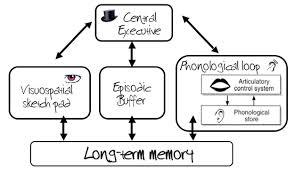
Working Memory Model
Conteúdo do mapa
Working Memory Model
Made up of four components
- Episodic buffer
- General store
- Deals with information that relates to both visual and auditory
- No storage capacity
- (2000)
- General store
- Phonological loop
- Deals with auditory information
- Limited capacity
- Subdivided into...
- Phonological store (inner ear)
- Articulatory process (inner voice)
- Central executive
- Limited capacity
- Determines how resources are allocated to tasks
- Visuo-spatial sketchpad
- Logie (1995) suggested it can be divided into...
- Visual cache (store)
- Inner scribe
- Deals with visual and spatial information
- Logie (1995) suggested it can be divided into...
- Episodic buffer
Presented by Baddeley and Hitch (1974)
- They felt that STM wasn't just one store
- When two tasks are performed at the same time, one auditory and one visual, they are done as well as they would have if done separately.
- When two tasks are performed at the same time, both either auditory or visual, they are done less well than if they had been done separately.
- When two tasks are performed at the same time, one auditory and one visual, they are done as well as they would have if done separately.
- They felt that STM wasn't just one store
Evidence from brain-damaged patients
- Supports WMM
- Study of KF
- Shallice and Warrington (1970)
- Shows that STM works independently of LTM
- Study of SC
- Study of LH
- Study of KF
- Limits WMM
- Brain injuries are traumatic and therefore can change behaviour
- No 'before and after' comparisons can be made
- Supports WMM
Imagens e arquivos do mapa
Informações
- Descrição
- Description of working memory model
- Criado por
- Jessica Phillips
- Visualizações
- 874
- Tags
- Avaliação