
Mapa mental
CHILD DEVELOPMENT
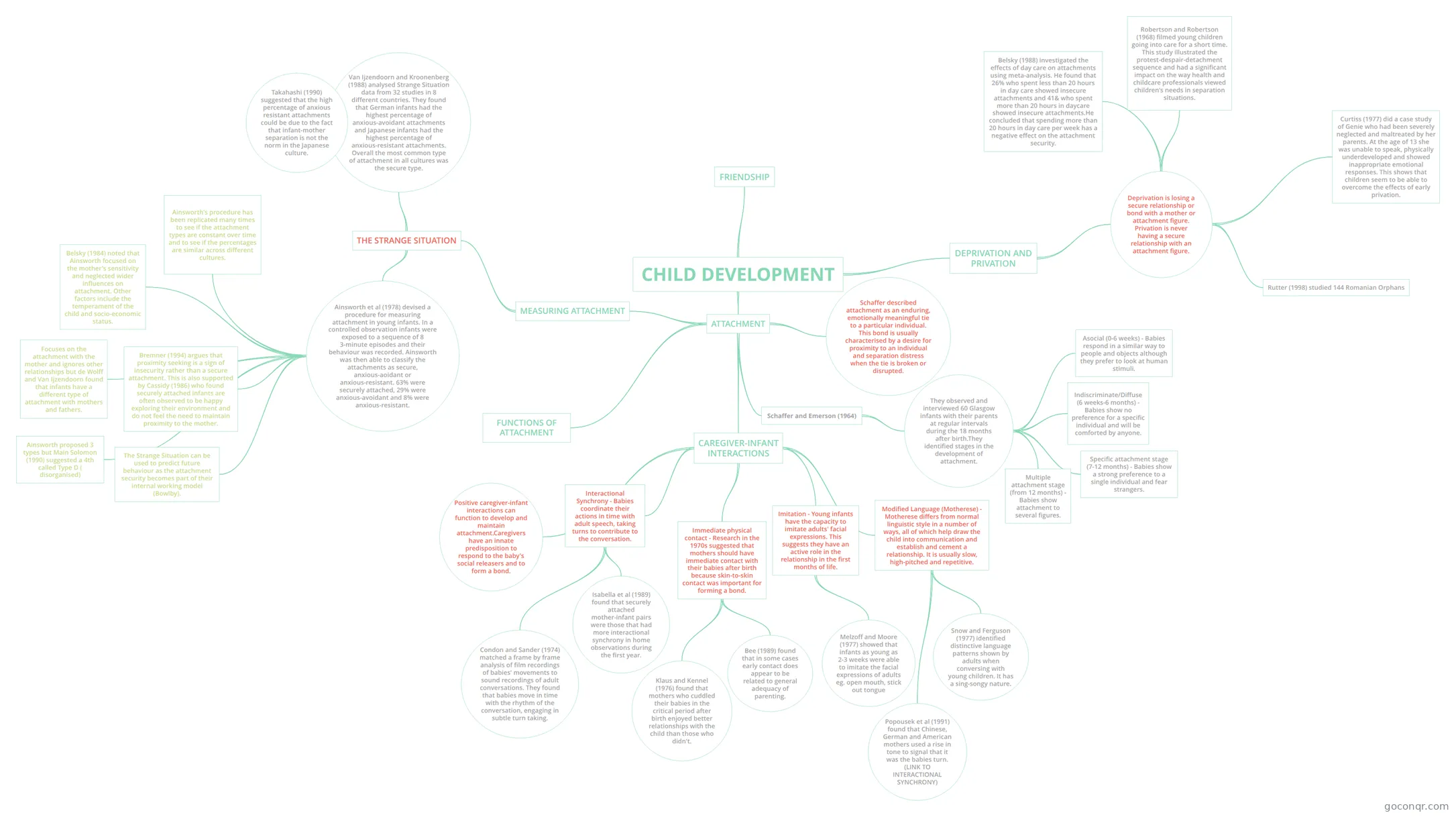
Mind map: child development attachment
Conteúdo do mapa
CHILD DEVELOPMENT
ATTACHMENT
- Schaffer described attachment as an enduring, emotionally meaningful tie to a particular individual. This bond is usually characterised by a desire for proximity to an individual and separation distress when the tie is broken or disrupted.
- Schaffer and Emerson (1964)
- They observed and interviewed 60 Glasgow infants with their parents at regular intervals during the 18 months after birth.They identified stages in the development of attachment.
- Asocial (0-6 weeks) - Babies respond in a similar way to people and objects although they prefer to look at human stimuli.
- Indiscriminate/Diffuse (6 weeks-6 months) - Babies show no preference for a specific individual and will be comforted by anyone.
- Specific attachment stage (7-12 months) - Babies show a strong preference to a single individual and fear strangers.
- Multiple attachment stage (from 12 months) - Babies show attachment to several figures.
- They observed and interviewed 60 Glasgow infants with their parents at regular intervals during the 18 months after birth.They identified stages in the development of attachment.
- CAREGIVER-INFANT INTERACTIONS
- Positive caregiver-infant interactions can function to develop and maintain attachment.Caregivers have an innate predisposition to respond to the baby's social releasers and to form a bond.
- Immediate physical contact - Research in the 1970s suggested that mothers should have immediate contact with their babies after birth because skin-to-skin contact was important for forming a bond.
- Klaus and Kennel (1976) found that mothers who cuddled their babies in the critical period after birth enjoyed better relationships with the child than those who didn't.
- Bee (1989) found that in some cases early contact does appear to be related to general adequacy of parenting.
- Imitation - Young infants have the capacity to imitate adults' facial expressions. This suggests they have an active role in the relationship in the first months of life.
- Melzoff and Moore (1977) showed that infants as young as 2-3 weeks were able to imitate the facial expressions of adults eg. open mouth, stick out tongue
- Interactional Synchrony - Babies coordinate their actions in time with adult speech, taking turns to contribute to the conversation.
- Condon and Sander (1974) matched a frame by frame analysis of film recordings of babies' movements to sound recordings of adult conversations. They found that babies move in time with the rhythm of the conversation, engaging in subtle turn taking.
- Isabella et al (1989) found that securely attached mother-infant pairs were those that had more interactional synchrony in home observations during the first year.
- Modified Language (Motherese) - Motherese differs from normal linguistic style in a number of ways, all of which help draw the child into communication and establish and cement a relationship. It is usually slow, high-pitched and repetitive.
- Snow and Ferguson (1977) identified distinctive language patterns shown by adults when conversing with young children. It has a sing-songy nature.
- Popousek et al (1991) found that Chinese, German and American mothers used a rise in tone to signal that it was the babies turn. (LINK TO INTERACTIONAL SYNCHRONY)
- FUNCTIONS OF ATTACHMENT
- MEASURING ATTACHMENT
- THE STRANGE SITUATION
- Ainsworth et al (1978) devised a procedure for measuring attachment in young infants. In a controlled observation infants were exposed to a sequence of 8 3-minute episodes and their behaviour was recorded. Ainsworth was then able to classify the attachments as secure, anxious-aoidant or anxious-resistant. 63% were securely attached, 29% were anxious-avoidant and 8% were anxious-resistant.
- Ainsworth's procedure has been replicated many times to see if the attachment types are constant over time and to see if the percentages are similar across different cultures.
- Bremner (1994) argues that proximity seeking is a sign of insecurity rather than a secure attachment. This is also supported by Cassidy (1986) who found securely attached infants are often observed to be happy exploring their environment and do not feel the need to maintain proximity to the mother.
- Belsky (1984) noted that Ainsworth focused on the mother's sensitivity and neglected wider influences on attachment. Other factors include the temperament of the child and socio-economic status.
- The Strange Situation can be used to predict future behaviour as the attachment security becomes part of their internal working model (Bowlby).
- Focuses on the attachment with the mother and ignores other relationships but de Wolff and Van Ijzendoorn found that infants have a different type of attachment with mothers and fathers.
- Ainsworth proposed 3 types but Main Solomon (1990) suggested a 4th called Type D ( disorganised)
- Van Ijzendoorn and Kroonenberg (1988) analysed Strange Situation data from 32 studies in 8 different countries. They found that German infants had the highest percentage of anxious-avoidant attachments and Japanese infants had the highest percentage of anxious-resistant attachments. Overall the most common type of attachment in all cultures was the secure type.
- Takahashi (1990) suggested that the high percentage of anxious resistant attachments could be due to the fact that infant-mother separation is not the norm in the Japanese culture.
- Ainsworth et al (1978) devised a procedure for measuring attachment in young infants. In a controlled observation infants were exposed to a sequence of 8 3-minute episodes and their behaviour was recorded. Ainsworth was then able to classify the attachments as secure, anxious-aoidant or anxious-resistant. 63% were securely attached, 29% were anxious-avoidant and 8% were anxious-resistant.
- THE STRANGE SITUATION
FRIENDSHIP
DEPRIVATION AND PRIVATION
- Deprivation is losing a secure relationship or bond with a mother or attachment figure. Privation is never having a secure relationship with an attachment figure.
- Robertson and Robertson (1968) filmed young children going into care for a short time. This study illustrated the protest-despair-detachment sequence and had a significant impact on the way health and childcare professionals viewed children's needs in separation situations.
- Belsky (1988) investigated the effects of day care on attachments using meta-analysis. He found that 26% who spent less than 20 hours in day care showed insecure attachments and 41& who spent more than 20 hours in daycare showed insecure attachments.He concluded that spending more than 20 hours in day care per week has a negative effect on the attachment security.
- Curtiss (1977) did a case study of Genie who had been severely neglected and maltreated by her parents. At the age of 13 she was unable to speak, physically underdeveloped and showed inappropriate emotional responses. This shows that children seem to be able to overcome the effects of early privation.
- Rutter (1998) studied 144 Romanian Orphans
- Deprivation is losing a secure relationship or bond with a mother or attachment figure. Privation is never having a secure relationship with an attachment figure.
Informações
- Descrição
- Mapa Mental sobre CHILD DEVELOPMENT, criado por Chinwe Anumba em 18-11-2014.
- Criado por
- Chinwe Anumba
- Visualizações
- 25
- Avaliação