
Mapa mental
Psychology - Eating Behaviour
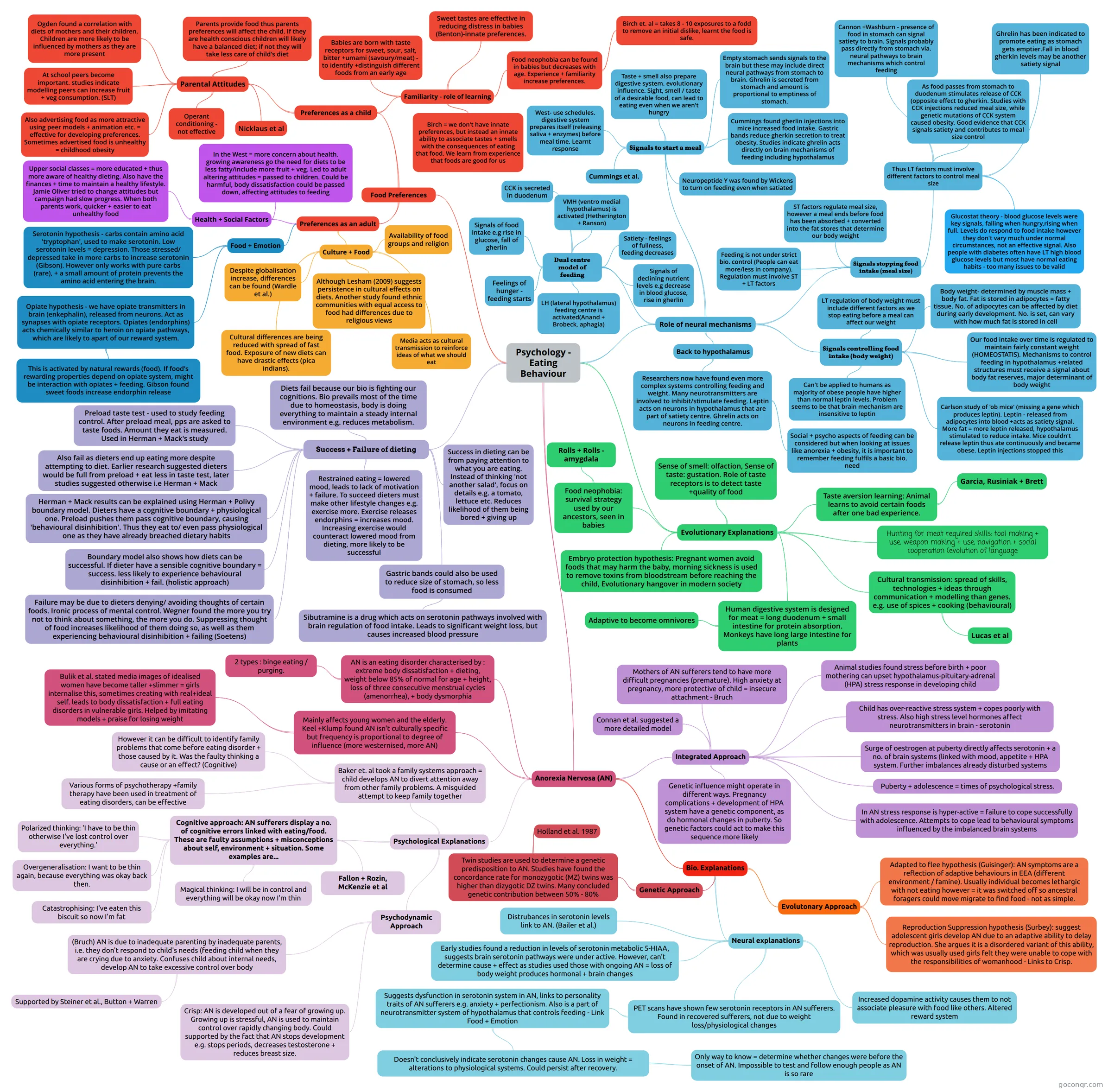
Mind map: Psychology eating behaviour
Conteúdo do mapa
Psychology - Eating Behaviour
Food Preferences
- Preferences as a child
- Parental Attitudes
- Parents provide food thus parents preferences will affect the child. If they are health conscious children will likely have a balanced diet; if not they will take less care of child's diet
- Ogden found a correlation with diets of mothers and their children. Children are more likely to be influenced by mothers as they are more present
- At school peers become important. studies indicate modelling peers can increase fruit + veg consumption. (SLT)
- Also advertising food as more attractive using peer models + animation etc. = effective for developing preferences. Sometimes advertised food is unhealthy = childhood obesity
- Nicklaus et al
- Operant conditioning - not effective
- Familiarity - role of learning
- Babies are born with taste receptors for sweet, sour, salt, bitter +umami (savoury/meat) - to identify +distinguish different foods from an early age
- Sweet tastes are effective in reducing distress in babies (Benton)-innate preferences.
- Food neophobia can be found in babies but decreases with age. Experience + familiarity increase preferences.
- Birch et. al = takes 8 - 10 exposures to a fodd to remove an initial dislike, learnt the food is safe.
- Birch = we don't have innate preferences, but instead an innate ability to associate tastes + smells with the consequences of eating that food. We learn from experience that foods are good for us
- Parental Attitudes
- Preferences as an adult
- Health + Social Factors
- In the West = more concern about health. growing awareness go the need for diets to be less fatty/include more fruit + veg. Led to adult altering attitudes = passed to children. Could be harmful, body dissatisfaction could be passed down, affecting attitudes to feeding
- Upper social classes = more educated + thus more aware of healthy dieting. Also have the finances + time to maintain a healthy lifestyle. Jamie Oliver tried to change attitudes but campaign had slow progress. When both parents work, quicker + easier to eat unhealthy food
- Food + Emotion
- Serotonin hypothesis - carbs contain amino acid 'tryptophan', used to make serotonin. Low serotonin levels = depression. Those stressed/ depressed take in more carbs to increase serotonin (Gibson). However only works with pure carbs (rare), + a small amount of protein prevents the amino acid entering the brain.
- Opiate hypothesis - we have opiate transmitters in brain (enkephalin), released from neurons. Act as synapses with opiate receptors. Opiates (endorphins) acts chemically similar to heroin on opiate pathways, which are likely to apart of our reward system.
- This is activated by natural rewards (food). If food's rewarding properties depend on opiate system, might be interaction with opiates + feeding. Gibson found sweet foods increase endorphin release
- Culture + Food
- Availability of food groups and religion
- Despite globalisation increase, differences can be found (Wardle et al.)
- Cultural differences are being reduced with spread of fast food. Exposure of new diets can have drastic effects (pica indians).
- Although Lesham (2009) suggests persistence in cultural effects on diets. Another study found ethnic communities with equal access to food had differences due to religious views
- Media acts as cultural transmission to reinforce ideas of what we should eat
- Health + Social Factors
- Preferences as a child
Role of neural mechanisms
- Dual centre model of feeding
- Signals of food intake e.g rise in glucose, fall of gherlin
- CCK is secreted in duodenum
- VMH (ventro medial hypothalamus) is activated (Hetherington + Ranson)
- Satiety - feelings of fullness, feeding decreases
- Signals of declining nutrient levels e.g decrease in blood glucose, rise in gherlin
- LH (lateral hypothalamus) feeding centre is activated(Anand + Brobeck, aphagia)
- Feelings of hunger - feeding starts
- Signals to start a meal
- West- use schedules. digestive system prepares itself (releasing saliva + enzymes) before meal time. Learnt response
- Taste + smell also prepare digestive system. evolutionary influence. Sight, smell / taste of a desirable food, can lead to eating even when we aren't hungry
- Empty stomach sends signals to the brain but these may include direct neural pathways from stomach to brain. Ghrelin is secreted from stomach and amount is proportional to emptiness of stomach.
- Cummings et al.
- Cummings found gherlin injections into mice increased food intake. Gastric bands reduce gherkin secretion to treat obesity. Studies indicate ghrelin acts directly on brain mechanisms of feeding including hypothalamus
- Neuropeptide Y was found by Wickens to turn on feeding even when satiated
- Signals stopping food intake (meal size)
- Feeding is not under strict bio. control (People can eat more/less in company). Regulation must involve ST + LT factors
- ST factors regulate meal size, however a meal ends before food has been absorbed + converted into the fat stores that determine our body weight
- Thus LT factors must involve different factors to control meal size
- Cannon +Washburn - presence of food in stomach can signal satiety to brain. Signals probably pass directly from stomach via. neural pathways to brain mechanisms which control feeding
- As food passes from stomach to duodenum stimulates release of CCK (opposite effect to gherkin. Studies with CCK injections reduced meal size, while genetic mutations of CCK system caused obesity. Good evidence that CCK signals satiety and contributes to meal size control
- Ghrelin has been indicated to promote eating as stomach gets emptier.Fall in blood gherkin levels may be another satiety signal
- Glucostat theory - blood glucose levels were key signals, falling when hungry,rising when full. Levels do respond to food intake however they don't vary much under normal circumstances, not an effective signal. Also people with diabetes often have LT high blood glucose levels but most have normal eating habits - too many issues to be valid
- Signals controlling food intake (body weight)
- LT regulation of body weight must include different factors as we stop eating before a meal can affect our weight
- Body weight- determined by muscle mass + body fat. Fat is stored in adipocytes = fatty tissue. No. of adipocytes can be affected by diet during early development. No. is set, can vary with how much fat is stored in cell
- Our food intake over time is regulated to maintain fairly constant weight (HOMEOSTATIS). Mechanisms to control feeding in hypothalamus +related structures must receive a signal about body fat reserves, major determinant of body weight
- Carlson study of 'ob mice' (missing a gene which produces leptin). Leptin - released from adipocytes into blood +acts as satiety signal. More fat = more leptin released, hypothalamus stimulated to reduce intake. Mice couldn't release leptin thus ate continuously and became obese. Leptin injections stopped this
- Can't be applied to humans as majority of obese people have higher than normal leptin levels. Problem seems to be that brain mechanism are insensitive to leptin
- Back to hypothalamus
- Researchers now have found even more complex systems controlling feeding and weight. Many neurotransmitters are involved to inhibit/stimulate feeding. Leptin acts on neurons in hypothalamus that are part of satiety centre. Ghrelin acts on neurons in feeding centre.
- Social + psycho aspects of feeding can be considered but when looking at issues like anorexia + obesity, it is important to remember feeding fulfils a basic bio. need
- Researchers now have found even more complex systems controlling feeding and weight. Many neurotransmitters are involved to inhibit/stimulate feeding. Leptin acts on neurons in hypothalamus that are part of satiety centre. Ghrelin acts on neurons in feeding centre.
- Dual centre model of feeding
Evolutionary Explanations
- Sense of smell: olfaction, Sense of taste: gustation. Role of taste receptors is to detect taste +quality of food
- Food neophobia: survival strategy used by our ancestors, seen in babies
- Rolls + Rolls - amygdala
- Taste aversion learning: Animal learns to avoid certain foods after one bad experience.
- Garcia, Rusiniak + Brett
- Cultural transmission: spread of skills, technologies + ideas through communication + modelling than genes. e.g. use of spices + cooking (behavioural)
- Lucas et al
- Hunting for meat required skills: tool making + use, weapon making + use, navigation + social cooperation (evolution of language
- Embryo protection hypothesis: Pregnant women avoid foods that may harm the baby, morning sickness is used to remove toxins from bloodstream before reaching the child, Evolutionary hangover in modern society
- Human digestive system is designed for meat = long duodenum + small intestine for protein absorption. Monkeys have long large intestine for plants
- Adaptive to become omnivores
Success + Failure of dieting
- Preload taste test - used to study feeding control. After preload meal, pps are asked to taste foods. Amount they eat is measured. Used in Herman + Mack's study
- Diets fail because our bio is fighting our cognitions. Bio prevails most of the time due to homeostasis, body is doing everything to maintain a steady internal environment e.g. reduces metabolism.
- Also fail as dieters end up eating more despite attempting to diet. Earlier research suggested dieters would be full from preload + eat less in taste test, later studies suggested otherwise i.e Herman + Mack
- Herman + Mack results can be explained using Herman + Polivy boundary model. Dieters have a cognitive boundary + physiological one. Preload pushes them pass cognitive boundary, causing 'behavioural disinhibition'. Thus they eat to/ even pass physiological one as they have already breached dietary habits
- Boundary model also shows how diets can be successful. If dieter have a sensible cognitive boundary = success. less likely to experience behavioural disinhibition + fail. (holistic approach)
- Failure may be due to dieters denying/ avoiding thoughts of certain foods. Ironic process of mental control. Wegner found the more you try not to think about something, the more you do. Suppressing thought of food increases likelihood of them doing so, as well as them experiencing behavioural disinhibition + failing (Soetens)
- Success in dieting can be from paying attention to what you are eating. Instead of thinking 'not another salad', focus on details e.g. a tomato, lettuce etc. Reduces likelihood of them being bored + giving up
- Restrained eating = lowered mood, leads to lack of motivation + failure. To succeed dieters must make other lifestyle changes e.g. exercise more. Exercise releases endorphins = increases mood. Increasing exercise would counteract lowered mood from dieting, more likely to be successful
- Gastric bands could also be used to reduce size of stomach, so less food is consumed
- Sibutramine is a drug which acts on serotonin pathways involved with brain regulation of food intake. Leads to significant weight loss, but causes increased blood pressure
Anorexia Nervosa (AN)
- AN is an eating disorder characterised by : extreme body dissatisfaction + dieting, weight below 85% of normal for age + height, loss of three consecutive menstrual cycles (amenorrhea), + body dysmorphia
- 2 types : binge eating / purging.
- Mainly affects young women and the elderly. Keel +Klump found AN isn't culturally specific but frequency is proportional to degree of influence (more westernised, more AN)
- Bulik et al. stated media images of idealised women have become taller +slimmer = girls internalise this, sometimes creating with real+ideal self. leads to body dissatisfaction + full eating disorders in vulnerable girls. Helped by imitating models + praise for losing weight
- Psychological Explanations
- Baker et. al took a family systems approach = child develops AN to divert attention away from other family problems. A misguided attempt to keep family together
- However it can be difficult to identify family problems that come before eating disorder + those caused by it. Was the faulty thinking a cause or an effect? (Cognitive)
- Various forms of psychotherapy +family therapy have been used in treatment of eating disorders, can be effective
- Cognitive approach: AN sufferers display a no. of cognitive errors linked with eating/food. These are faulty assumptions + misconceptions about self, environment + situation. Some examples are...
- Polarized thinking: 'I have to be thin otherwise I've lost control over everything.'
- Overgeneralisation: I want to be thin again, because everything was okay back then.
- Catastrophising: I've eaten this biscuit so now I'm fat
- Magical thinking: I will be in control and everything will be okay now I'm thin
- Fallon + Rozin, McKenzie et al
- Psychodynamic Approach
- (Bruch) AN is due to inadequate parenting by inadequate parents, i.e. they don't respond to child's needs (feeding child when they are crying due to anxiety. Confuses child about internal needs, develop AN to take excessive control over body
- Supported by Steiner et al., Button + Warren
- Crisp: AN is developed out of a fear of growing up. Growing up is stressful, AN is used to maintain control over rapidly changing body. Could supported by the fact that AN stops development e.g. stops periods, decreases testosterone + reduces breast size.
- (Bruch) AN is due to inadequate parenting by inadequate parents, i.e. they don't respond to child's needs (feeding child when they are crying due to anxiety. Confuses child about internal needs, develop AN to take excessive control over body
- Baker et. al took a family systems approach = child develops AN to divert attention away from other family problems. A misguided attempt to keep family together
- Bio. Explanations
- Neural explanations
- Distrubances in serotonin levels link to AN. (Bailer et al.)
- Increased dopamine activity causes them to not associate pleasure with food like others. Altered reward system
- Early studies found a reduction in levels of serotonin metabolic 5-HIAA, suggests brain serotonin pathways were under active. However, can't determine cause + effect as studies used those with ongoing AN = loss of body weight produces hormonal + brain changes
- PET scans have shown few serotonin receptors in AN sufferers. Found in recovered sufferers, not due to weight loss/physiological changes
- Suggests dysfunction in serotonin system in AN, links to personality traits of AN sufferers e.g. anxiety + perfectionism. Also is a part of neurotransmitter system of hypothalamus that controls feeding - Link Food + Emotion
- Doesn't conclusively indicate serotonin changes cause AN. Loss in weight = alterations to physiological systems. Could persist after recovery.
- Only way to know = determine whether changes were before the onset of AN. Impossible to test and follow enough people as AN is so rare
- Doesn't conclusively indicate serotonin changes cause AN. Loss in weight = alterations to physiological systems. Could persist after recovery.
- Suggests dysfunction in serotonin system in AN, links to personality traits of AN sufferers e.g. anxiety + perfectionism. Also is a part of neurotransmitter system of hypothalamus that controls feeding - Link Food + Emotion
- Evolutonary Approach
- Reproduction Suppression hypothesis (Surbey): suggest adolescent girls develop AN due to an adaptive ability to delay reproduction. She argues it is a disordered variant of this ability, which was usually used girls felt they were unable to cope with the responsibilities of womanhood - Links to Crisp.
- Adapted to flee hypothesis (Guisinger): AN symptoms are a reflection of adaptive behaviours in EEA (different environment / famine). Usually individual becomes lethargic with not eating however = it was switched off so ancestral foragers could move migrate to find food - not as simple.
- Genetic Approach
- Twin studies are used to determine a genetic predisposition to AN. Studies have found the concordance rate for monozygotic (MZ) twins was higher than dizygotic DZ twins. Many concluded genetic contribution between 50% - 80%
- Holland et al. 1987
- Twin studies are used to determine a genetic predisposition to AN. Studies have found the concordance rate for monozygotic (MZ) twins was higher than dizygotic DZ twins. Many concluded genetic contribution between 50% - 80%
- Neural explanations
- Integrated Approach
- Connan et al. suggested a more detailed model
- Mothers of AN sufferers tend to have more difficult pregnancies (premature). High anxiety at pregnancy, more protective of child = insecure attachment - Bruch
- Animal studies found stress before birth + poor mothering can upset hypothalamus-pituitary-adrenal (HPA) stress response in developing child
- Child has over-reactive stress system + copes poorly with stress. Also high stress level hormones affect neurotransmitters in brain - serotonin
- Surge of oestrogen at puberty directly affects serotonin + a no. of brain systems (linked with mood, appetite + HPA system. Further imbalances already disturbed systems
- Puberty + adolescence = times of psychological stress.
- In AN stress response is hyper-active = failure to cope successfully with adolescence. Attempts to cope lead to behavioural symptoms influenced by the imbalanced brain systems
- Genetic influence might operate in different ways. Pregnancy complications + development of HPA system have a genetic component, as do hormonal changes in puberty. So genetic factors could act to make this sequence more likely
- AN is an eating disorder characterised by : extreme body dissatisfaction + dieting, weight below 85% of normal for age + height, loss of three consecutive menstrual cycles (amenorrhea), + body dysmorphia
Informações
- Descrição
- A-Level Psychology Mapa Mental sobre Psychology - Eating Behaviour, criado por Rachel Pearce em 31-12-2014.
- Criado por
- Rachel Pearce
- Visualizações
- 52
- Tags
- Avaliação