
Mapa mental
Kohlberg's cognitive developmental theory
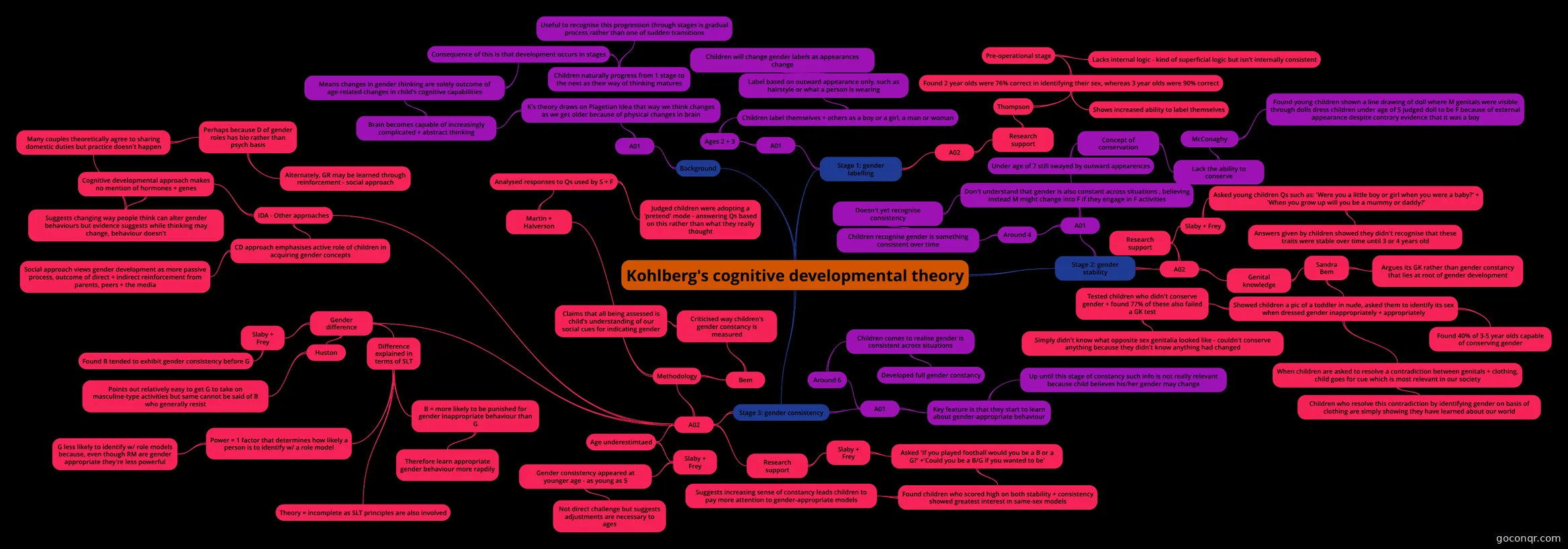
Mind map: Kohlberg's cognitive developmental theory
Conteúdo do mapa
Kohlberg's cognitive developmental theory
Background
- A01
- K's theory draws on Piagetian idea that way we think changes as we get older because of physical changes in brain
- Brain becomes capable of increasingly complicated + abstract thinking
- Means changes in gender thinking are solely outcome of age-related changes in child's cognitive capabilities
- Consequence of this is that development occurs in stages
- Children naturally progress from 1 stage to the next as their way of thinking matures
- Useful to recognise this progression through stages is gradual process rather than one of sudden transitions
- Children naturally progress from 1 stage to the next as their way of thinking matures
- Consequence of this is that development occurs in stages
- Means changes in gender thinking are solely outcome of age-related changes in child's cognitive capabilities
- Brain becomes capable of increasingly complicated + abstract thinking
- K's theory draws on Piagetian idea that way we think changes as we get older because of physical changes in brain
- A01
Stage 1: gender labelling
- A01
- Ages 2 + 3
- Children label themselves + others as a boy or a girl, a man or woman
- Label based on outward appearance only, such as hairstyle or what a person is wearing
- Children will change gender labels as appearances change
- Label based on outward appearance only, such as hairstyle or what a person is wearing
- Children label themselves + others as a boy or a girl, a man or woman
- Ages 2 + 3
- A02
- Research support
- Thompson
- Found 2 year olds were 76% correct in identifying their sex, whereas 3 year olds were 90% correct
- Shows increased ability to label themselves
- Pre-operational stage
- Lacks internal logic - kind of superficial logic but isn't internally consistent
- Found 2 year olds were 76% correct in identifying their sex, whereas 3 year olds were 90% correct
- Thompson
- Research support
- A01
Stage 2: gender stability
- A01
- Around 4
- Children recognise gender is something consistent over time
- Doesn't yet recognise consistency
- Don't understand that gender is also constant across situations , believing instead M might change into F if they engage in F activities
- Doesn't yet recognise consistency
- Children recognise gender is something consistent over time
- Under age of 7 still swayed by outward appearences
- Concept of conservation
- Lack the ability to conserve
- McConaghy
- Found young children shown a line drawing of doll where M genitals were visible through dolls dress children under age of 5 judged doll to be F because of external appearance despite contrary evidence that it was a boy
- McConaghy
- Lack the ability to conserve
- Concept of conservation
- Around 4
- A02
- Research support
- Slaby + Frey
- Asked young children Qs such as: 'Were you a little boy or girl when you were a baby?' + 'When you grow up will you be a mummy or daddy?'
- Answers given by children showed they didn't recognise that these traits were stable over time until 3 or 4 years old
- Asked young children Qs such as: 'Were you a little boy or girl when you were a baby?' + 'When you grow up will you be a mummy or daddy?'
- Slaby + Frey
- Genital knowledge
- Sandra Bem
- Argues its GK rather than gender constancy that lies at root of gender development
- Showed children a pic of a toddler in nude, asked them to identify its sex when dressed gender inappropriately + appropriately
- Found 40% of 3-5 year olds capable of conserving gender
- Tested children who didn't conserve gender + found 77% of these also failed a GK test
- Simply didn't know what opposite sex genitalia looked like - couldn't conserve anything because they didn't know anything had changed
- When children are asked to resolve a contradiction between genitals + clothing, child goes for cue which is most relevant in our society
- Children who resolve this contradiction by identifying gender on basis of clothing are simply showing they have learned about our world
- Sandra Bem
- Research support
- A01
Stage 3: gender consistency
- A01
- Around 6
- Children comes to realise gender is consistent across situations
- Developed full gender constancy
- Children comes to realise gender is consistent across situations
- Key feature is that they start to learn about gender-appropriate behaviour
- Up until this stage of constancy such info is not really relevant because child believes his/her gender may change
- Around 6
- A02
- Research support
- Slaby + Frey
- Asked 'If you played football would you be a B or a G?' +'Could you be a B/G if you wanted to be'
- Found children who scored high on both stability + consistency showed greatest interest in same-sex models
- Suggests increasing sense of constancy leads children to pay more attention to gender-appropriate models
- Found children who scored high on both stability + consistency showed greatest interest in same-sex models
- Asked 'If you played football would you be a B or a G?' +'Could you be a B/G if you wanted to be'
- Slaby + Frey
- Age underestimtaed
- Slaby + Frey
- Gender consistency appeared at younger age - as young as 5
- Not direct challenge but suggests adjustments are necessary to ages
- Gender consistency appeared at younger age - as young as 5
- Slaby + Frey
- Gender difference
- Slaby + Frey
- Found B tended to exhibit gender consistency before G
- Huston
- Points out relatively easy to get G to take on masculine-type activities but same cannot be said of B who generally resist
- Difference explained in terms of SLT
- Power = 1 factor that determines how likely a person is to identify w/ a role model
- G less likely to identify w/ role models because, even though RM are gender appropriate they're less powerful
- B = more likely to be punished for gender inappropriate behaviour than G
- Therefore learn appropriate gender behaviour more rapdily
- Theory = incomplete as SLT principles are also involved
- Power = 1 factor that determines how likely a person is to identify w/ a role model
- Slaby + Frey
- Methodology
- Bem
- Criticised way children's gender constancy is measured
- Claims that all being assessed is child's understanding of our social cues for indicating gender
- Criticised way children's gender constancy is measured
- Martin + Halverson
- Analysed responses to Qs used by S + F
- Judged children were adopting a 'pretend' mode - answering Qs based on this rather than what they really thought
- Analysed responses to Qs used by S + F
- Bem
- IDA - Other approaches
- Cognitive developmental approach makes no mention of hormones + genes
- Suggests changing way people think can alter gender behaviours but evidence suggests while thinking may change, behaviour doesn't
- Many couples theoretically agree to sharing domestic duties but practice doesn't happen
- Perhaps because D of gender roles has bio rather than psych basis
- Alternately, GR may be learned through reinforcement - social approach
- Perhaps because D of gender roles has bio rather than psych basis
- Many couples theoretically agree to sharing domestic duties but practice doesn't happen
- Suggests changing way people think can alter gender behaviours but evidence suggests while thinking may change, behaviour doesn't
- CD approach emphasises active role of children in acquiring gender concepts
- Social approach views gender development as more passive process, outcome of direct + indirect reinforcement from parents, peers + the media
- Cognitive developmental approach makes no mention of hormones + genes
- Research support
- A01
Informações
- Descrição
- A mind map outlining the A01 and A02 points for an essay
- Criado por
- bebe97
- Visualizações
- 20
- Avaliação