
Mapa mental
Memory
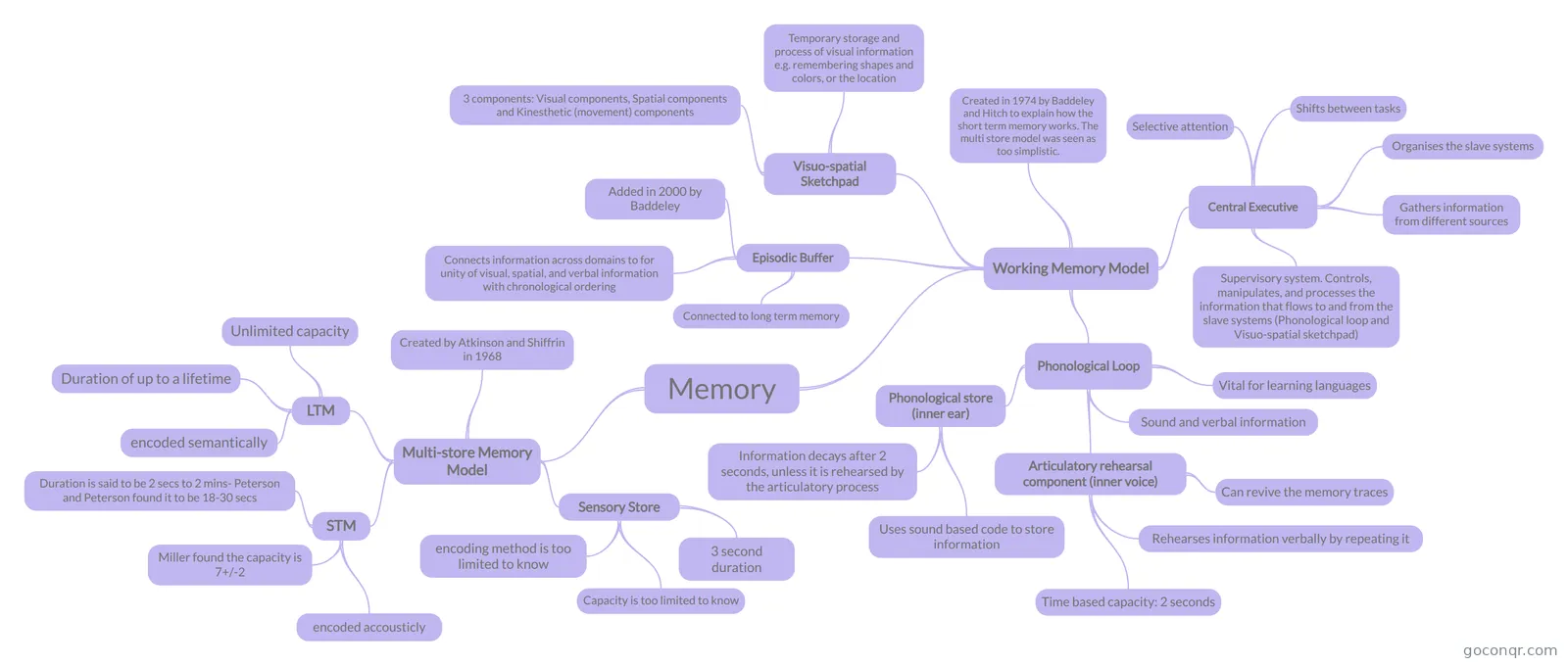
Mind map: Memory Models: Working and Multi-store
Conteúdo do mapa
Memory
Working Memory Model
- Created in 1974 by Baddeley and Hitch to explain how the short term memory works. The multi store model was seen as too simplistic.
- Central Executive
- Supervisory system. Controls, manipulates, and processes the information that flows to and from the slave systems (Phonological loop and Visuo-spatial sketchpad)
- Gathers information from different sources
- Organises the slave systems
- Shifts between tasks
- Selective attention
- Phonological Loop
- Sound and verbal information
- Vital for learning languages
- Phonological store (inner ear)
- Uses sound based code to store information
- Information decays after 2 seconds, unless it is rehearsed by the articulatory process
- Articulatory rehearsal component (inner voice)
- Can revive the memory traces
- Rehearses information verbally by repeating it
- Time based capacity: 2 seconds
- Visuo-spatial Sketchpad
- Temporary storage and process of visual information e.g. remembering shapes and colors, or the location
- 3 components: Visual components, Spatial components and Kinesthetic (movement) components
- Episodic Buffer
- Added in 2000 by Baddeley
- Connects information across domains to for unity of visual, spatial, and verbal information with chronological ordering
- Connected to long term memory
Multi-store Memory Model
- Created by Atkinson and Shiffrin in 1968
- Sensory Store
- Capacity is too limited to know
- 3 second duration
- encoding method is too limited to know
- STM
- Miller found the capacity is 7+/-2
- Duration is said to be 2 secs to 2 mins- Peterson and Peterson found it to be 18-30 secs
- encoded accousticly
- LTM
- Unlimited capacity
- Duration of up to a lifetime
- encoded semantically
Informações
- Descrição
- Mapa Mental sobre Memory, criado por cheyenne warwick em 22-04-2015.
- Criado por
- cheyenne warwick
- Visualizações
- 3
- Avaliação