
Mapa mental
Child Development
Conteúdo do mapa
Child Development
Weaning
- Stage 1-6 months
- Give pureed veg/fruit, baby rice, milk=most important food still.
- When
- A very tiny amount during or after a milk feed to start the transition of milk to solids
- NOT
- Cow's milk, citrus fruit, wheat, spices, spinach, eggs, nuts, salt, sugar, fat
- When
- Give pureed veg/fruit, baby rice, milk=most important food still.
- Stage 2 7-9 months
- Increase variety, pureed meat, fish, lentils, beans, wheat based foods.
- When
- At the end of a milk feed to introduce other foods when the child is hungry
- NOT
- Cow's milk (small quantitities only), chillies, egg whites, nuts, salt,sugar, fat
- When
- Increase variety, pureed meat, fish, lentils, beans, wheat based foods.
- Stage 3 9-12 months
- Cow's milk safely drank (12m), introduce lumpier foods eg pasta, pieces of meat, cheese, bread. Additional fluids eg unsweetened dilluted fruit juics & water. 3 regular meals as well as drinks.
- When
- At established mealtimes to encourage full independence
- NOT
- Whole nuts, salt, sugar, fatty food
- When
- Cow's milk safely drank (12m), introduce lumpier foods eg pasta, pieces of meat, cheese, bread. Additional fluids eg unsweetened dilluted fruit juics & water. 3 regular meals as well as drinks.
- Methods
- Sieving, mashing, hand blender
- Stage 1-6 months
Diet during Pregnancy
- Soft blue cheese, pate, prepared salads, ready-meals
- Why?
- Listeria found in prepared foods which aren't heated enough, Listeriosis (from listeria) can cause msscarriage, stillbirth, meningitis, pneumonia
- Why?
- Raw egg, unpasteurised milk
- Why?
- Salmonella could cause miscarriage, premature birth
- Why?
- Some types of fish eg. shark swordfish
- Why?
- High levels of mercury- cause delayed development in nervous system
- Why?
- Unwashed raw fruit, raw meat, unpasteuruised goat's milk
- Why?
- Toxoplasmosis can cause (for baby) eye damage, hydrocephalus, stillbirth, miscarriage
- Why?
- Liver and liver products
- Why?
- Too mucuh vitamin A-cause birth defects
- Why?
- Peanuts
- Why
- May reduce baby's chances of developing a peanut allergy
- Why
- Foods to eat
- Lean meat fish etc, atarch foods, citrus fruits (vitamin c), fruits & veg (fibre, vitamins, minerals, dairy products, fish with edible bones eg sardines (vital for making bones and teeth), margarine (vitamin D), taking fat-soluble vitamins, folic acid (vitB)-especially first 12 weeks
- Soft blue cheese, pate, prepared salads, ready-meals
Stages of Labour
- Stage 1
- Contractions make your cervix gradually open up (dilate)- longest stage
- Stage 2
- Contractions more frequent & stronger, cervix is fully open & you begin crowning then full birth. Part of labour where you help baby move through vagina by pushing during contractions
- Stage 3
- After birth, womb contracts & causes placenta to come out through the vagina
- Stage 1
Medical Proffesionals
- Midwife
- Registered nurse who has further training in care of women in labour. Work in hospitals clinics etc. deliver most babies in UK
- Obstetrician
- Doctors who've specialised in care of pregnant women & child birth. Most work in hospital maternity units caring for women who have complications in pregnancy/ need c-section/forceps
- General Practitioner (GP)
- Doctor taken further training in general practice
- Gynaecologist
- Doctor specialised in female reproductive system
- Paediatrician
- Doctor specialised in care of children <16, attend difficult births incase resuscitation
- Health Visitor
- Qualified nurse further training for care of people in community incl midwifery experience
- Midwife
Causes of infertility
- Low sperm count
- Your Hormones
- Genetics
- Mutation/Blockage of fallopian tubes
- Disease eg.Polycystic ovary syndrome, Endometriosis
- What can help fertility?
- Avoid STD/Is (take precaustions etc)
- Excercise
- Avoid stress
- No drugs/ small amnt alcohol
- Healthy balanced diet
- Don't smoke
- Lose trousers
- Keep testes cool
- Avoid being over/under weight
Stages of growth for a baby
- 4-5 weeks
- embryo=5mm, rudimentary heart started to beat, arms & legs=buds
- 6-7 weeks
- Embryo=8mm, limb buds=look real, heart seen beating on ultrasound
- 8-9 weeks
- unborn baby=foetus=2cm. Toes, fingers & major internal organs starting to form,
- 10-14 weeks
- foetus=7cm, organs complete. By 12 weeks baby=fully formed
- 15-22 weeks
- Mother feels movement. 22w=greasy, white protective film called VERNIX CASEOSA has begun to form. Foetus covered in fine, downy hair=LANUGO
- 23-30 weeks
- Covered in vernix, lanugo=dissapeared. 28w+ foetus=viable (good chance of survival if born)
- 31-40 weeks
- Becomes plumper, vernix & lanugo dissapear. Foetus= settles in head-down position
- 4-5 weeks
Reproductive organs
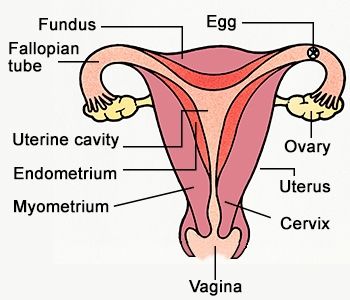
- Ovaries
- Controll production of oestrogen & progesterone which control menstural cycle, contain undreds of eggs
- Fallopian tube
- Connet ovaries to womb, lined with cilla-wafts egg along to uterus
- Uterus
- (womb) muscular bag w/soft lining, where baby develops
- Cervix
- Strong ring of muscle between lower end of uterus & vagina, keeps baby in place
- Vagina
- Muscular tube leads from cervix to outside
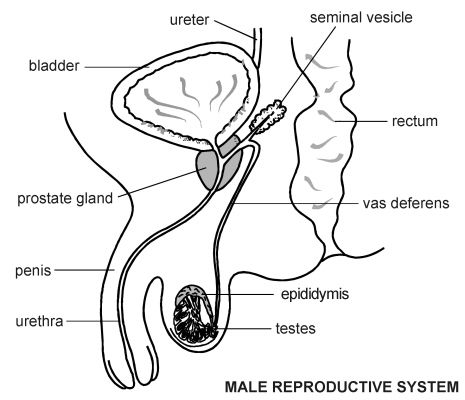
- Testes
- 2, make male hormone testosterone and produces sperm
- Scrotum
- Bag of skin which stores testes
- Sperm duct
- Where sperm passes through to mix with fluids that are produced by glands, fluid provides sperm cells w/nutrients. Mix of sperm & fluids=semen
- Urethra
- Tube inside penis that carries urine & semen, there's a ring of muscle that ensures the urine & semen don't mix
- Penis
- Pass urine & pass semen. Made of shaft & glans, shaft=main part, glans=tip at end=small slit to release urnine/semen
- Ovaries
Alternative conception
- IVF
- Woman's eggs collected and fertilised with partner's sperm in a lab, healthiest ones put back in womb
- GIFT (gamete intra-fallopian transfer)
- Similar to IVF, eggs & sperm collected and screened for healthiest. Then e&s mixed together and implanted back into fallopian tube for natural fertilisation.
- ICSI (intra-cytoplasmic sperm injection)
- Used in combination with IVF, injecting a single sperm into the centre of an egg. After fertilisatuion up to 3 embryos are replaced in uterus. ICSI oftern recommended to low sperm count.
- IVM (In vito maturation)
- Eggs are matured in lab berfore being fertilised by sperm. Difference between IVM & IVF= eggs are immature when they are cikkected=woman does not need to take many drugs before the eggs can be collected
- Surrogacy
- Another woman carries baby. Partial surrogacy: surrogate mother conceives baby using her own egg with other father's sperm. (artificial insemination-syringe), Full surrogacy: Surrogate mother carries intended parents' ngenetic child concieved through IVF
- IVF
Parts of growth for an embryo
- Ectopic pregnancy=mistakes happen in ovum & implantation occurs in wrong place-not sustainable
- Placenta=provides foetus with oxygen and nourishment
- Umbilical chord= removes foetal waste also a barrier to certain microorganisms
- Amniotic sac=filed with amniotic fluid provides protective cushion for foetus
Imagens e arquivos do mapa
Informações
- Descrição
- Mapa Mental sobre Child Development, criado por chelsea.bird3 em 05-05-2015.
- Criado por
- chelsea.bird3
- Visualizações
- 17
- Tags
- Histórico
-
- Criado por chloe.england10 · 5 mai 2015
- Copiado por chelsea.bird3 · 5 mai 2015
- Avaliação