
Mapa mental
Language Change Timeline
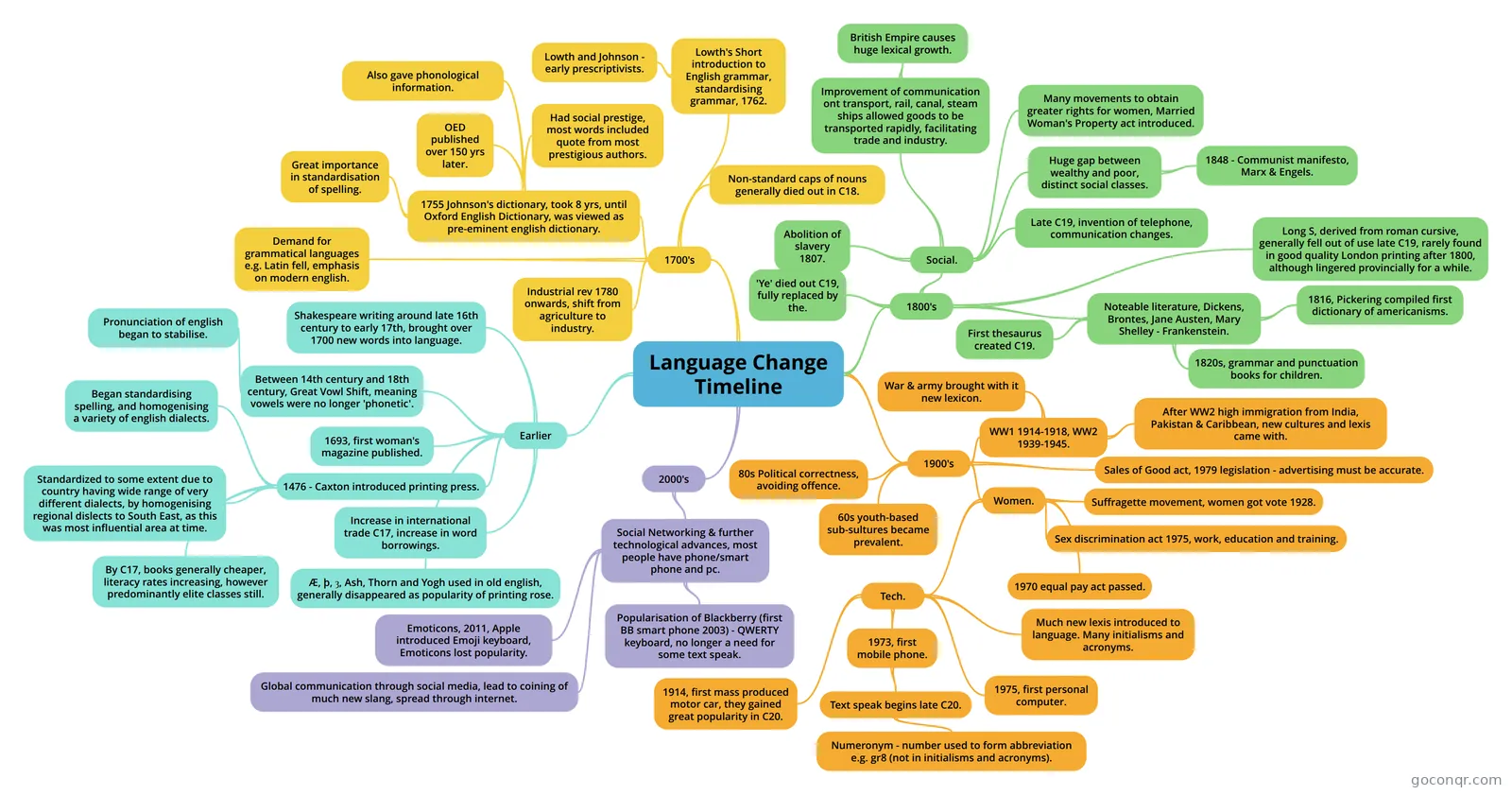
Mind map: Language change timeline
Conteúdo do mapa
Language Change Timeline
1700's
- Demand for grammatical languages e.g. Latin fell, emphasis on modern english.
- Industrial rev 1780 onwards, shift from agriculture to industry.
- 1755 Johnson's dictionary, took 8 yrs, until Oxford English Dictionary, was viewed as pre-eminent english dictionary.
- Great importance in standardisation of spelling.
- OED published over 150 yrs later.
- Also gave phonological information.
- Had social prestige, most words included quote from most prestigious authors.
- Non-standard caps of nouns generally died out in C18.
- Lowth's Short introduction to English grammar, standardising grammar, 1762.
- Lowth and Johnson - early prescriptivists.
1800's
- Long S, derived from roman cursive, generally fell out of use late C19, rarely found in good quality London printing after 1800, although lingered provincially for a while.
- 'Ye' died out C19, fully replaced by the.
- Social.
- Late C19, invention of telephone, communication changes.
- Abolition of slavery 1807.
- Huge gap between wealthy and poor, distinct social classes.
- 1848 - Communist manifesto, Marx & Engels.
- Improvement of communication ont transport, rail, canal, steam ships allowed goods to be transported rapidly, facilitating trade and industry.
- British Empire causes huge lexical growth.
- Many movements to obtain greater rights for women, Married Woman's Property act introduced.
- Noteable literature, Dickens, Brontes, Jane Austen, Mary Shelley - Frankenstein.
- 1816, Pickering compiled first dictionary of americanisms.
- First thesaurus created C19.
- 1820s, grammar and punctuation books for children.
1900's
- WW1 1914-1918, WW2 1939-1945.
- War & army brought with it new lexicon.
- After WW2 high immigration from India, Pakistan & Caribbean, new cultures and lexis came with.
- Women.
- Sex discrimination act 1975, work, education and training.
- Suffragette movement, women got vote 1928.
- 1970 equal pay act passed.
- Tech.
- 1914, first mass produced motor car, they gained great popularity in C20.
- 1973, first mobile phone.
- Text speak begins late C20.
- Numeronym - number used to form abbreviation e.g. gr8 (not in initialisms and acronyms).
- Text speak begins late C20.
- 1975, first personal computer.
- Much new lexis introduced to language. Many initialisms and acronyms.
- 60s youth-based sub-sultures became prevalent.
- 80s Political correctness, avoiding offence.
- Sales of Good act, 1979 legislation - advertising must be accurate.
- WW1 1914-1918, WW2 1939-1945.
2000's
- Social Networking & further technological advances, most people have phone/smart phone and pc.
- Global communication through social media, lead to coining of much new slang, spread through internet.
- Popularisation of Blackberry (first BB smart phone 2003) - QWERTY keyboard, no longer a need for some text speak.
- Emoticons, 2011, Apple introduced Emoji keyboard, Emoticons lost popularity.
- Social Networking & further technological advances, most people have phone/smart phone and pc.
Earlier
- 1476 - Caxton introduced printing press.
- Standardized to some extent due to country having wide range of very different dialects, by homogenising regional dislects to South East, as this was most influential area at time.
- Began standardising spelling, and homogenising a variety of english dialects.
- By C17, books generally cheaper, literacy rates increasing, however predominantly elite classes still.
- Between 14th century and 18th century, Great Vowl Shift, meaning vowels were no longer 'phonetic'.
- Pronunciation of english began to stabilise.
- Shakespeare writing around late 16th century to early 17th, brought over 1700 new words into language.
- 1693, first woman's magazine published.
- Increase in international trade C17, increase in word borrowings.
- Æ, þ, ȝ, Ash, Thorn and Yogh used in old english, generally disappeared as popularity of printing rose.
- 1476 - Caxton introduced printing press.
Informações
- Descrição
- English language change - contextual factors.
- Criado por
- r.struthers97
- Visualizações
- 152
- Tags
- Avaliação