
Mapa mental
relationships
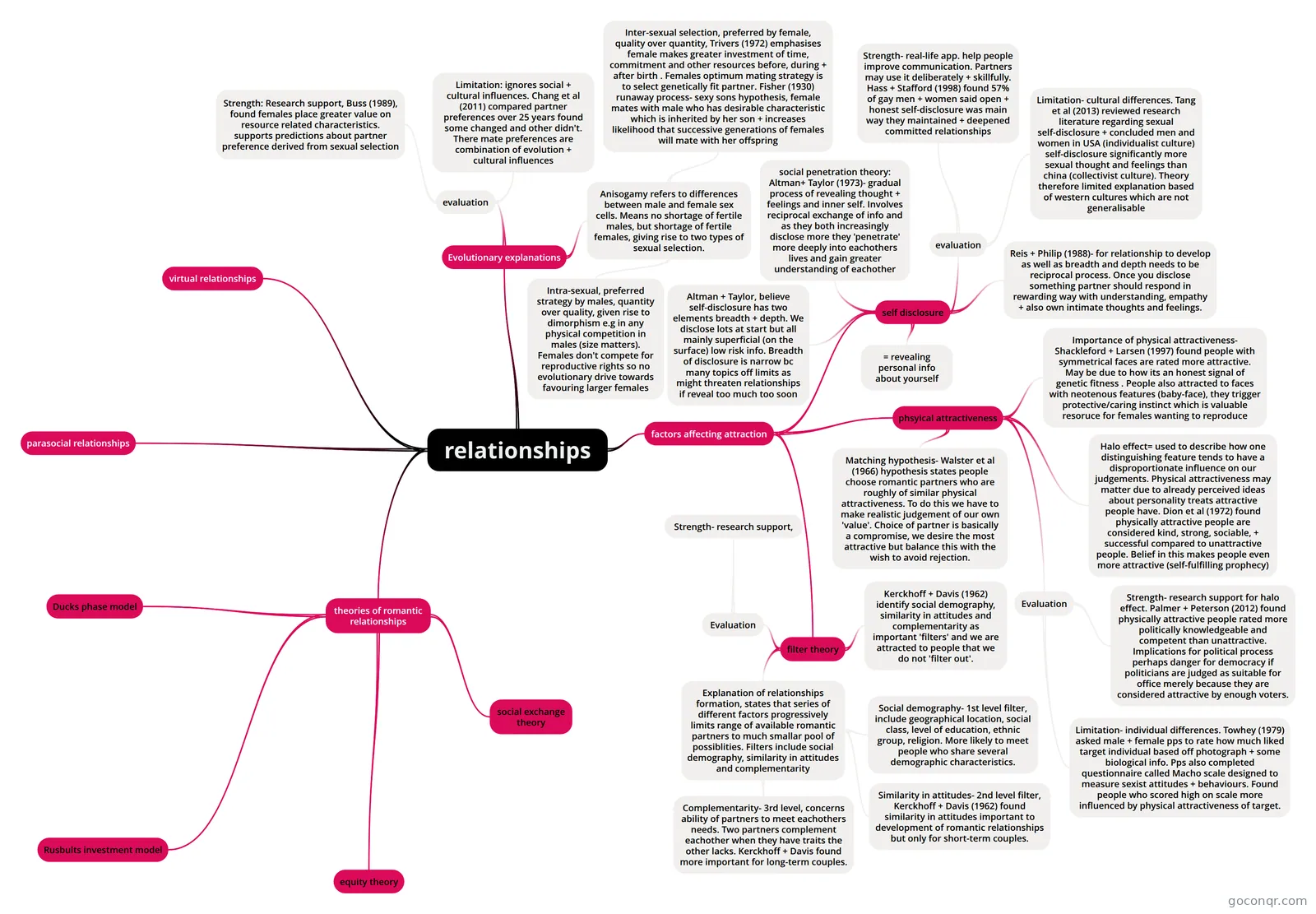
Mind map: relationships psychology
Conteúdo do mapa
relationships
Evolutionary explanations
- Anisogamy refers to differences between male and female sex cells. Means no shortage of fertile males, but shortage of fertile females, giving rise to two types of sexual selection.
- Intra-sexual, preferred strategy by males, quantity over quality, given rise to dimorphism e.g in any physical competition in males (size matters). Females don't compete for reproductive rights so no evolutionary drive towards favouring larger females
- Inter-sexual selection, preferred by female, quality over quantity, Trivers (1972) emphasises female makes greater investment of time, commitment and other resources before, during + after birth . Females optimum mating strategy is to select genetically fit partner. Fisher (1930) runaway process- sexy sons hypothesis, female mates with male who has desirable characteristic which is inherited by her son + increases likelihood that successive generations of females will mate with her offspring
- evaluation
- Limitation: ignores social + cultural influences. Chang et al (2011) compared partner preferences over 25 years found some changed and other didn't. There mate preferences are combination of evolution + cultural influences
- Strength: Research support, Buss (1989), found females place greater value on resource related characteristics. supports predictions about partner preference derived from sexual selection
- Anisogamy refers to differences between male and female sex cells. Means no shortage of fertile males, but shortage of fertile females, giving rise to two types of sexual selection.
factors affecting attraction
- self disclosure
- = revealing personal info about yourself
- social penetration theory: Altman+ Taylor (1973)- gradual process of revealing thought + feelings and inner self. Involves reciprocal exchange of info and as they both increasingly disclose more they 'penetrate' more deeply into eachothers lives and gain greater understanding of eachother
- evaluation
- Limitation- cultural differences. Tang et al (2013) reviewed research literature regarding sexual self-disclosure + concluded men and women in USA (individualist culture) self-disclosure significantly more sexual thought and feelings than china (collectivist culture). Theory therefore limited explanation based of western cultures which are not generalisable
- Strength- real-life app. help people improve communication. Partners may use it deliberately + skillfully. Hass + Stafford (1998) found 57% of gay men + women said open + honest self-disclosure was main way they maintained + deepened committed relationships
- Altman + Taylor, believe self-disclosure has two elements breadth + depth. We disclose lots at start but all mainly superficial (on the surface) low risk info. Breadth of disclosure is narrow bc many topics off limits as might threaten relationships if reveal too much too soon
- Reis + Philip (1988)- for relationship to develop as well as breadth and depth needs to be reciprocal process. Once you disclose something partner should respond in rewarding way with understanding, empathy + also own intimate thoughts and feelings.
- phsyical attractiveness
- Importance of physical attractiveness- Shackleford + Larsen (1997) found people with symmetrical faces are rated more attractive. May be due to how its an honest signal of genetic fitness . People also attracted to faces with neotenous features (baby-face), they trigger protective/caring instinct which is valuable resoruce for females wanting to reproduce
- Evaluation
- Strength- research support for halo effect. Palmer + Peterson (2012) found physically attractive people rated more politically knowledgeable and competent than unattractive. Implications for political process perhaps danger for democracy if politicians are judged as suitable for office merely because they are considered attractive by enough voters.
- Limitation- individual differences. Towhey (1979) asked male + female pps to rate how much liked target individual based off photograph + some biological info. Pps also completed questionnaire called Macho scale designed to measure sexist attitudes + behaviours. Found people who scored high on scale more influenced by physical attractiveness of target.
- Halo effect= used to describe how one distinguishing feature tends to have a disproportionate influence on our judgements. Physical attractiveness may matter due to already perceived ideas about personality treats attractive people have. Dion et al (1972) found physically attractive people are considered kind, strong, sociable, + successful compared to unattractive people. Belief in this makes people even more attractive (self-fulfilling prophecy)
- Matching hypothesis- Walster et al (1966) hypothesis states people choose romantic partners who are roughly of similar physical attractiveness. To do this we have to make realistic judgement of our own 'value'. Choice of partner is basically a compromise, we desire the most attractive but balance this with the wish to avoid rejection.
- filter theory
- Explanation of relationships formation, states that series of different factors progressively limits range of available romantic partners to much smallar pool of possiblities. Filters include social demography, similarity in attitudes and complementarity
- Social demography- 1st level filter, include geographical location, social class, level of education, ethnic group, religion. More likely to meet people who share several demographic characteristics.
- Similarity in attitudes- 2nd level filter, Kerckhoff + Davis (1962) found similarity in attitudes important to development of romantic relationships but only for short-term couples.
- Complementarity- 3rd level, concerns ability of partners to meet eachothers needs. Two partners complement eachother when they have traits the other lacks. Kerckhoff + Davis found more important for long-term couples.
- Kerckhoff + Davis (1962) identify social demography, similarity in attitudes and complementarity as important 'filters' and we are attracted to people that we do not 'filter out'.
- Evaluation
- Strength- research support,
- Explanation of relationships formation, states that series of different factors progressively limits range of available romantic partners to much smallar pool of possiblities. Filters include social demography, similarity in attitudes and complementarity
- self disclosure
theories of romantic relationships
- social exchange theory
- equity theory
- Rusbults investment model
- Ducks phase model
virtual relationships
parasocial relationships
Informações
- Descrição
- A level Psychology Mapa Mental sobre relationships, criado por Jodie Lenton em 05-04-2021.
- Criado por
- Jodie Lenton
- Visualizações
- 0
- Avaliação