
Mapa mental
Ecology
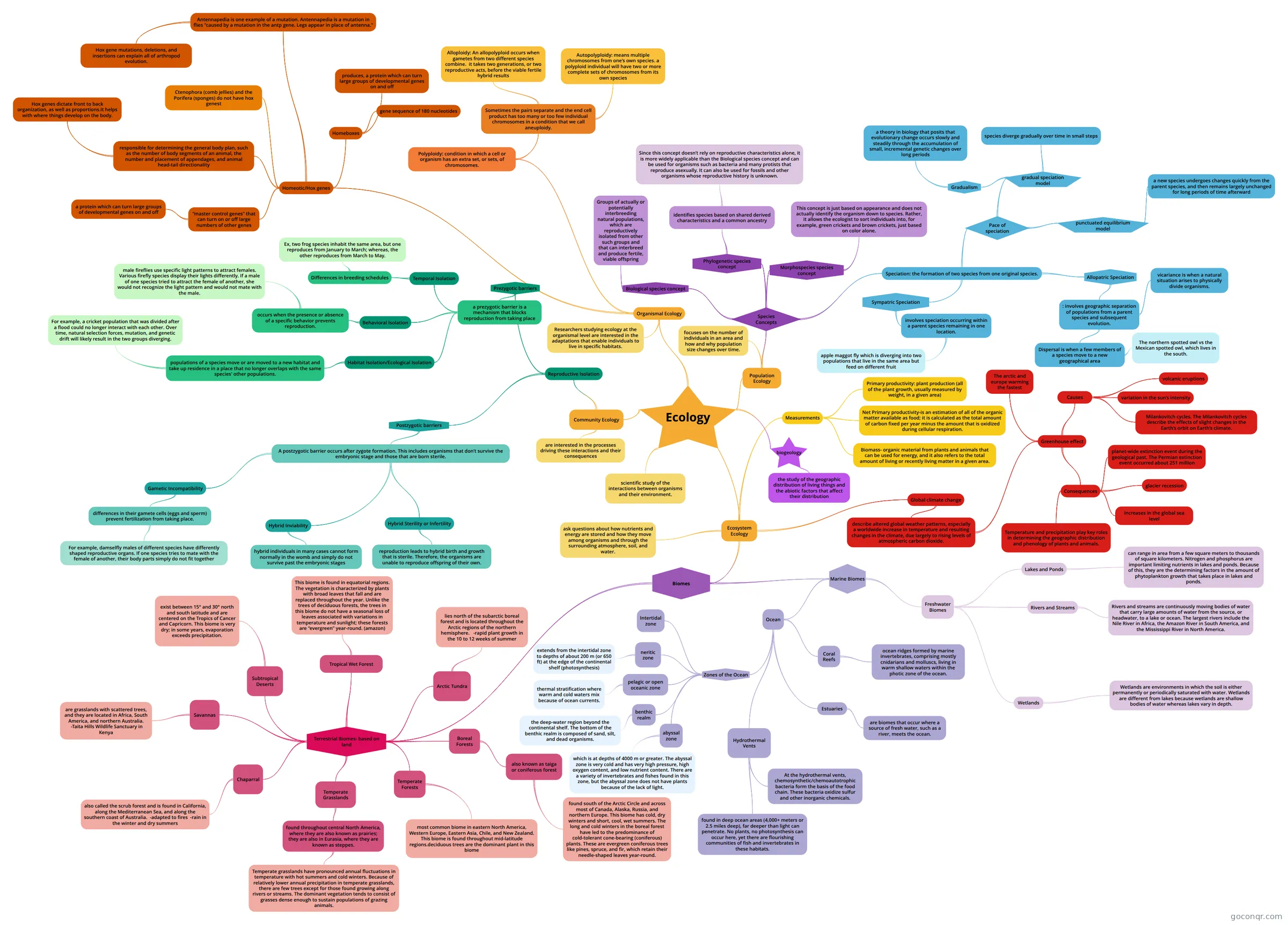
Mind map: Ecology
Conteúdo do mapa
Ecology
Organismal Ecology
- Polyploidy: condition in which a cell or organism has an extra set, or sets, of chromosomes.
- Sometimes the pairs separate and the end cell product has too many or too few individual chromosomes in a condition that we call aneuploidy.
- Autopolyploidy: means multiple chromosomes from one’s own species. a polyploid individual will have two or more complete sets of chromosomes from its own species
- Alloploidy: An allopolyploid occurs when gametes from two different species combine. it takes two generations, or two reproductive acts, before the viable fertile hybrid results
- Sometimes the pairs separate and the end cell product has too many or too few individual chromosomes in a condition that we call aneuploidy.
- Researchers studying ecology at the organismal level are interested in the adaptations that enable individuals to live in specific habitats.
- Homeotic/Hox genes
- “master control genes” that can turn on or off large numbers of other genes
- a protein which can turn large groups of developmental genes on and off
- responsible for determining the general body plan, such as the number of body segments of an animal, the number and placement of appendages, and animal head-tail directionality
- Hox genes dictate front to back organization, as well as proportions.It helps with where things develop on the body.
- Ctenophora (comb jellies) and the Porifera (sponges) do not have hox genest
- Homeboxes
- gene sequence of 180 nucleotides
- produces, a protein which can turn large groups of developmental genes on and off
- Antennapedia is one example of a mutation. Antennapedia is a mutation in flies "caused by a mutation in the antp gene. Legs appear in place of antenna."
- Hox gene mutations, deletions, and insertions can explain all of arthropod evolution.
- “master control genes” that can turn on or off large numbers of other genes
- Polyploidy: condition in which a cell or organism has an extra set, or sets, of chromosomes.
scientific study of the interactions between organisms and their environment.
Population Ecology
- Species Concepts
- Speciation: the formation of two species from one original species.
- Allopatric Speciation
- : involves geographic separation of populations from a parent species and subsequent evolution.
- Dispersal is when a few members of a species move to a new geographical area
- The northern spotted owl vs the Mexican spotted owl, which lives in the south.
- vicariance is when a natural situation arises to physically divide organisms.
- Dispersal is when a few members of a species move to a new geographical area
- : involves geographic separation of populations from a parent species and subsequent evolution.
- Sympatric Speciation
- involves speciation occurring within a parent species remaining in one location.
- apple maggot fly which is diverging into two populations that live in the same area but feed on different fruit
- involves speciation occurring within a parent species remaining in one location.
- Pace of speciation
- gradual speciation model
- species diverge gradually over time in small steps
- Gradualism
- a theory in biology that posits that evolutionary change occurs slowly and steadily through the accumulation of small, incremental genetic changes over long periods
- punctuated equilibrium model
- a new species undergoes changes quickly from the parent species, and then remains largely unchanged for long periods of time afterward
- gradual speciation model
- Allopatric Speciation
- Biological species concept
- Groups of actually or potentially interbreeding natural populations, which are reproductively isolated from other such groups and that can interbreed and produce fertile, viable offspring
- Phylogenetic species concept
- identifies species based on shared derived characteristics and a common ancestry
- Since this concept doesn’t rely on reproductive characteristics alone, it is more widely applicable than the Biological species concept and can be used for organisms such as bacteria and many protists that reproduce asexually. It can also be used for fossils and other organisms whose reproductive history is unknown.
- identifies species based on shared derived characteristics and a common ancestry
- Morphospecies species concept
- This concept is just based on appearance and does not actually identify the organism down to species. Rather, it allows the ecologist to sort individuals into, for example, green crickets and brown crickets, just based on color alone.
- Speciation: the formation of two species from one original species.
- focuses on the number of individuals in an area and how and why population size changes over time.
- Species Concepts
Community Ecology
- Reproductive Isolation
- Prezygotic barriers
- a prezygotic barrier is a mechanism that blocks reproduction from taking place
- Temporal Isolation
- Differences in breeding schedules
- Ex, two frog species inhabit the same area, but one reproduces from January to March; whereas, the other reproduces from March to May.
- Differences in breeding schedules
- Behavioral Isolation
- occurs when the presence or absence of a specific behavior prevents reproduction.
- male fireflies use specific light patterns to attract females. Various firefly species display their lights differently. If a male of one species tried to attract the female of another, she would not recognize the light pattern and would not mate with the male.
- occurs when the presence or absence of a specific behavior prevents reproduction.
- Habitat Isolation/Ecological Isolation
- populations of a species move or are moved to a new habitat and take up residence in a place that no longer overlaps with the same species' other populations.
- For example, a cricket population that was divided after a flood could no longer interact with each other. Over time, natural selection forces, mutation, and genetic drift will likely result in the two groups diverging.
- populations of a species move or are moved to a new habitat and take up residence in a place that no longer overlaps with the same species' other populations.
- Temporal Isolation
- a prezygotic barrier is a mechanism that blocks reproduction from taking place
- Postzygotic barriers
- A postzygotic barrier occurs after zygote formation. This includes organisms that don’t survive the embryonic stage and those that are born sterile.
- Gametic Incompatibility
- differences in their gamete cells (eggs and sperm) prevent fertilization from taking place.
- For example, damselfly males of different species have differently shaped reproductive organs. If one species tries to mate with the female of another, their body parts simply do not fit together
- differences in their gamete cells (eggs and sperm) prevent fertilization from taking place.
- Hybrid Inviability
- hybrid individuals in many cases cannot form normally in the womb and simply do not survive past the embryonic stages
- Hybrid Sterility or Infertility
- reproduction leads to hybrid birth and growth that is sterile. Therefore, the organisms are unable to reproduce offspring of their own.
- Gametic Incompatibility
- A postzygotic barrier occurs after zygote formation. This includes organisms that don’t survive the embryonic stage and those that are born sterile.
- Prezygotic barriers
- are interested in the processes driving these interactions and their consequences
- Reproductive Isolation
Ecosystem Ecology
- ask questions about how nutrients and energy are stored and how they move among organisms and through the surrounding atmosphere, soil, and water.
- Biomes
- Terrestrial Biomes- based on land
- Tropical Wet Forest
- This biome is found in equatorial regions. The vegetation is characterized by plants with broad leaves that fall and are replaced throughout the year. Unlike the trees of deciduous forests, the trees in this biome do not have a seasonal loss of leaves associated with variations in temperature and sunlight; these forests are “evergreen” year-round. (amazon)
- Savannas
- are grasslands with scattered trees, and they are located in Africa, South America, and northern Australia. -Taita Hills Wildlife Sanctuary in Kenya
- Subtropical Deserts
- exist between 15° and 30° north and south latitude and are centered on the Tropics of Cancer and Capricorn. This biome is very dry; in some years, evaporation exceeds precipitation.
- Chaparral
- also called the scrub forest and is found in California, along the Mediterranean Sea, and along the southern coast of Australia. -adapted to fires -rain in the winter and dry summers
- Temperate Grasslands
- found throughout central North America, where they are also known as prairies; they are also in Eurasia, where they are known as steppes.
- Temperate grasslands have pronounced annual fluctuations in temperature with hot summers and cold winters. Because of relatively lower annual precipitation in temperate grasslands, there are few trees except for those found growing along rivers or streams. The dominant vegetation tends to consist of grasses dense enough to sustain populations of grazing animals.
- found throughout central North America, where they are also known as prairies; they are also in Eurasia, where they are known as steppes.
- Temperate Forests
- most common biome in eastern North America, Western Europe, Eastern Asia, Chile, and New Zealand. This biome is found throughout mid-latitude regions.deciduous trees are the dominant plant in this biome
- Boreal Forests
- also known as taiga or coniferous forest
- found south of the Arctic Circle and across most of Canada, Alaska, Russia, and northern Europe. This biome has cold, dry winters and short, cool, wet summers. The long and cold winters in the boreal forest have led to the predominance of cold-tolerant cone-bearing (coniferous) plants. These are evergreen coniferous trees like pines, spruce, and fir, which retain their needle-shaped leaves year-round.
- also known as taiga or coniferous forest
- Arctic Tundra
- lies north of the subarctic boreal forest and is located throughout the Arctic regions of the northern hemisphere. -rapid plant growth in the 10 to 12 weeks of summer
- Tropical Wet Forest
- Marine Biomes
- Ocean
- Hydrothermal Vents
- found in deep ocean areas (4,000+ meters or 2.5 miles deep), far deeper than light can penetrate. No plants, no photosynthesis can occur here, yet there are flourishing communities of fish and invertebrates in these habitats.
- At the hydrothermal vents, chemosynthetic/chemoautotrophic bacteria form the basis of the food chain. These bacteria oxidize sulfur and other inorganic chemicals.
- Coral Reefs
- ocean ridges formed by marine invertebrates, comprising mostly cnidarians and molluscs, living in warm shallow waters within the photic zone of the ocean.
- Estuaries
- are biomes that occur where a source of fresh water, such as a river, meets the ocean.
- Zones of the Ocean
- Intertidal zone
- neritic zone
- extends from the intertidal zone to depths of about 200 m (or 650 ft) at the edge of the continental shelf (photosynthesis)
- pelagic or open oceanic zone
- thermal stratification where warm and cold waters mix because of ocean currents.
- abyssal zone
- which is at depths of 4000 m or greater. The abyssal zone is very cold and has very high pressure, high oxygen content, and low nutrient content. There are a variety of invertebrates and fishes found in this zone, but the abyssal zone does not have plants because of the lack of light.
- benthic realm
- the deep-water region beyond the continental shelf. The bottom of the benthic realm is composed of sand, silt, and dead organisms.
- Hydrothermal Vents
- Freshwater Biomes
- Lakes and Ponds
- can range in area from a few square meters to thousands of square kilometers. Nitrogen and phosphorus are important limiting nutrients in lakes and ponds. Because of this, they are the determining factors in the amount of phytoplankton growth that takes place in lakes and ponds.
- Rivers and Streams
- Rivers and streams are continuously moving bodies of water that carry large amounts of water from the source, or headwater, to a lake or ocean. The largest rivers include the Nile River in Africa, the Amazon River in South America, and the Mississippi River in North America.
- Wetlands
- Wetlands are environments in which the soil is either permanently or periodically saturated with water. Wetlands are different from lakes because wetlands are shallow bodies of water whereas lakes vary in depth.
- Lakes and Ponds
- Ocean
- Terrestrial Biomes- based on land
- Measurements
- Primary productivity: plant production (all of the plant growth, usually measured by weight, in a given area)
- Net Primary productivity-is an estimation of all of the organic matter available as food; it is calculated as the total amount of carbon fixed per year minus the amount that is oxidized during cellular respiration.
- Biomass- organic material from plants and animals that can be used for energy, and it also refers to the total amount of living or recently living matter in a given area.
- Global climate change
- describe altered global weather patterns, especially a worldwide increase in temperature and resulting changes in the climate, due largely to rising levels of atmospheric carbon dioxide.
- Greenhouse effect
- Causes
- volcanic eruptions
- variation in the sun’s intensity
- Milankovitch cycles. The Milankovitch cycles describe the effects of slight changes in the Earth’s orbit on Earth’s climate.
- Consequences
- planet-wide extinction event during the geological past. The Permian extinction event occurred about 251 million
- glacier recession
- increases in the global sea level
- Temperature and precipitation play key roles in determining the geographic distribution and phenology of plants and animals.
- The arctic and europe warming the fastest
- Causes
- Greenhouse effect
- describe altered global weather patterns, especially a worldwide increase in temperature and resulting changes in the climate, due largely to rising levels of atmospheric carbon dioxide.
biogeology
- the study of the geographic distribution of living things and the abiotic factors that affect their distribution
Informações
- Descrição
- Mapa Mental sobre Ecology, criado por Ray Ruckman em 02-11-2025.
- Criado por
- Ray Ruckman
- Visualizações
- 0
- Avaliação