
Mapa mental
Virology
Conteúdo do mapa
Virology
Morphology
- Core components
- Nucleic acid core: Contains DNA or RNA genome
- Capsid: Protective outer protein coating
- Capsomeres: Individual protein subunits that form the capsid
- Envelope: Phospholipid bilayer derived from host cell membranes
- Additional proteins: enzymes or matrix proteins (stablise the envelope)
- Glycoproteins: Surface "spikes" used to attach to host cell receptors
- Structural Classifications
- Filamentous: Long, thin, and cylindrical (e.g., Tobacco Mosaic Virus)
- Isometric / Icosahedral: Roughly spherical or polyhedral (e.g., Poliovirus, Herpes)
- Enveloped: Capsid nested inside a membrane (e.g., HIV, Flu, Mumps).
- Head and Tail: Complex hybrid structure; icosahedral head + cylindrical tail (e.g., T4 Bacteriophage).
- Attachment & Infection
- Viral Receptors: Normal cell surface molecules (like CD4) hijacked by viruses
- Glycoprotein Interaction: Must bind to host molecules to penetrate the cell
- Host Complexity: The complexity of the virus does not match the complexity of the host.
- Resilience & Classification
- Enveloped vs. Non-Enveloped
- Enveloped: Fragile; sensitive to temperature and pH.
- Non-Enveloped: Hardier; resistant to disinfectants and environmental changes
- Enveloped vs. Non-Enveloped
- Core components
Types of Nucleic Acids
- Either DNA or RNA
- Single-stranded (ss) or Double-stranded (ds)
- Linear or Circular
- Segmentation: May be a single nucleic acid or multiple pieces called segments
- DNA Viruses Mechanism: Hijacks host cell proteins to replicate the viral genome and synthesize proteins.
- RNA Viruses
- Mechanism
- Must encode their own enzymes (like RNA polymerase) to replicate RNA; the host cell cannot do this.
- Mutation Rate
- High; RNA polymerase makes more copying errors than DNA polymerase.
- Adaptation
- Frequent mutations allow them to change and adapt to hosts more rapidly.
- Mechanism
- Either DNA or RNA
Virus Classification
- Traditional Classification Factors
- Core Content: Type of genetic material (DNA/RNA) and its structure (ss/ds, linear/circular, segmented)
- Capsid Design: Classified into five main categories
- Naked icosahedral
- Enveloped icosahedral
- Naked helical
- Enveloped helical
- Complex
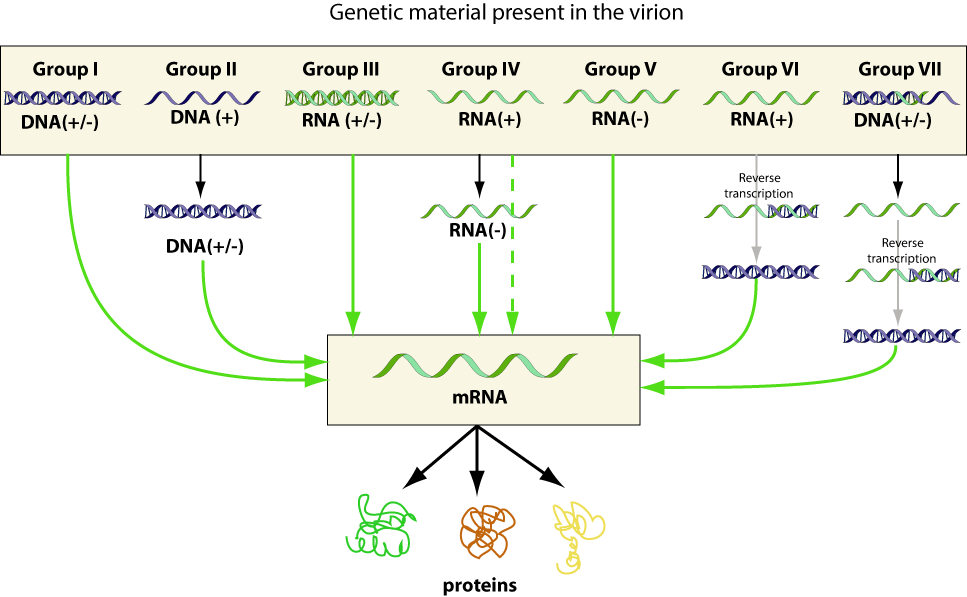
- The Baltimore Classification Scheme
- Traditional Classification Factors
Viral Infection and Replication
- The Nature of Infection
- Obligate Intracellular Parasites: Viruses must enter a living cell to function
- Permissive Cells: Only specific cells allow a virus to replicate
- Specificity: Determined by "Lock and Key" fit between viral proteins and host receptors.
- Host Range: Limited to certain species and specific cell types based on gene expression
- Stages of Replication
- 1) Attachment: Viral proteins or glycoproteins bind to specific host membrane receptors.
- 2) Entry (Penetration):Bacteriophages: a) Inject "naked" nucleic acid, leaving the capsid outside. b) Animal/Plant Viruses: Enter via endocytosis (engulfment) or fusion (envelope merges with cell membrane).
- 3) Uncoating: The viral capsid is degraded, releasing the genome into the cell
- 4) Replication: a) DNA Viruses: Usually use host enzymes to make DNA and mRNA. b) RNA Viruses: Use the RNA core as a template for new genomes and mRNA. c) Retroviruses (e.g., HIV): Use reverse transcriptase to turn RNA into DNA for host integration.
- 5) Assembly: Host cell synthesizes viral enzymes and capsids, then packages the new virions
- 6) Egress (Release): New virions exit to infect adjacent cells
- Cellular Impact (Cytopathic Effects)
- Lysis: The cell bursts and dies instantly (e.g., Rhinovirus)
- Apoptosis: Programmed "cell suicide" triggered by infection
- Budding: Virions exit individually (e.g., HIV). The cell stays alive temporarily but loses normal function
- Symptoms: Caused by both direct cell damage and the body’s own immune response
- The Process and the Impact
- The Process (The "How")
- The Replication Cycle: Uncoating: Stripping the protein shell to expose the "blueprints." Synthesis: Forcing the host to build viral proteins and copy the genome. Reverse Transcription: (Retroviruses only) Converting RNA into DNA to hide in the host's genome.
- Targeting: Finding permissive cells using a "lock and key" receptor match.
- Exit Strategies: Budding: Leaving one by one through the membrane (common in enveloped viruses). Lysis: Forcing the cell to burst to release all "offspring" at once
- Entry Methods: Injection: Only the genome enters (Bacteriophages). Endocytosis: The cell membrane swallows the whole virus. Fusion: Viral envelope blends into the cell membrane.
- The Impact (The "Result")
- Medical Intervention: Development of drugs (like AZT) that target virus-only enzymes to stop the process without harming the host.
- Disease Symptoms: A combination of direct cell damage and the body's immune response (inflammation, fever, etc.).
- Cell Death: Lysis: Immediate destruction of the cell. Apoptosis: The cell is triggered to commit "suicide."
- Functional Loss: Cells that survive (via budding) often become "zombies" that can no longer perform their normal physiological jobs.
- Cytopathic Effects (CPE): Physical damage or structural changes to the host cell.
- The Process (The "How")
- The Nature of Infection
Bacteriophages vs. Animal Viruses
- Bacteriophage
- Replication
- Productive Infection: Results in the creation of new virions.
- Lytic Cycle: The virus replicates immediately and destroys the host cell by bursting (lysis). Example: T4 phage (infects E. coli)
- Lysogenic Cycle: The viral DNA is incorporated into the host genome (now called a prophage).The virus remains silent and replicates as the bacteria divides. Example: (lambda) phage.
- Replication
- Animal Virus
- Animal Virus Entry & Exit
- No Cell Wall: Animal viruses do not need to penetrate a rigid wall.
- Entry Methods: Non-enveloped: Enter via receptor-mediated endocytosis or by creating protein channels to "inject" the genome. Enveloped: Enter via endocytosis or fusion (viral envelope merges with the cell membrane).
- Exit Methods: Budding: Enveloped viruses take a piece of the host membrane as they leave (e.g., HIV). Lysis: Non-enveloped viruses accumulate until the cell bursts (e.g., Rhinovirus).
- Types of Animal Infections
- Acute: Rapid onset of symptoms, followed by recovery as the immune system clears the virus (e.g., Influenza, Common Cold).
- Asymptomatic: Productive infection occurs but the host shows no symptoms (e.g., Roseola).
- Chronic: Long-term, low-level virus production. Often escapes the immune system for years (e.g., Hepatitis C)
- Key Differences at a GlanceVirus Presence: Acute is "hit and run"; Chronic is "stay and play."Symptoms: Acute symptoms are often intense but brief; Chronic symptoms are often invisible until significant damage is done.Detection: Acute is usually found via symptoms; Chronic is often found via routine blood work.
- Latent: Virus "hides" in tissue (e.g., nervous tissue) without producing virions for long periods.Can reactivate due to stress (e.g., Herpes Simplex, Shingles)
- Acute: Rapid onset of symptoms, followed by recovery as the immune system clears the virus (e.g., Influenza, Common Cold).
- Oncogenic Viruses
- Mechanism: Interfere with the host cell cycle by introducing growth-stimulating genes (oncogenes) or blocking growth inhibitors.
- Associated Cancers: HPV: Cervical cancer. Hepatitis B & C: Liver cancer .Other: T-cell leukemia and lymphomas
- Animal Virus Entry & Exit
- Bacteriophage
Prevention & Treatment
- Antiviral Drugs
- Mechanism: Block specific viral proteins/enzymes without harming host cells.
- Mechanism: Block specific viral proteins/enzymes without harming host cells. Success Stories: Acyclovir: Reduces herpes outbreaks (does not cure latency). Tamiflu: Blocks neuraminidase to stop flu virions from leaving cells (shortens illness). Ribavirin: A general antiviral used for various infections
- Vaccines for Treatment
- Ebola: New vaccines help the body control this rapid, high-fatality virus
- Rabies: Because the virus travels slowly to the nervous system, post-bite vaccination can stop it in time.
- The Concept: Boosting the immune system after exposure to fight an active infection.
- HIV & HAART
- The Challenge: HIV mutates rapidly, making it easy to develop resistance to single drugs.
- HAART (Highly Active Anti-Retroviral Therapy): A "cocktail" of drugs attacking different stages of the cycle:
- Fusion Inhibition: Prevents the HIV viral envelope from merging with the host's plasma membrane; stops the virus from entering.
- Integrase Inhibition: Prevents the newly formed viral DNA from being inserted into the host's own genome
- Reverse Transcriptase Inhibition: Blocks the conversion of viral RNA into double-stranded DNA; stops the "blueprint" from being created.
- Protease Inhibition: Blocks the final processing of viral proteins; prevents the assembly of functional, infectious new virions
- Result: Turns a fatal disease into a manageable, long-term condition
- Vaccines for Prevention
- Primary Goal: Build immunity to prevent outbreaks before they occur.
- Types of Vaccines: Live Attenuated: Weakened "wild-type" virus. Most effective but carries a tiny risk of back mutation (reverting to disease-causing form). Killed/Inactivated: Dead virus; cannot cause disease. Molecular Subunits: Only pieces of the virus; cannot cause disease
- Live Attenuated Vaccines:
- Cons: Small risk of back mutation (virus reverts to disease-causing form)
- Example: Oral Polio vaccine, Measles, Mumps
- Method: Uses a "wild-type" virus weakened in a lab (via different temperatures or tissues)
- Pros: Highly effective; creates a strong, long-lasting immune response
- Killed / Subunit Vaccines:
- Pros: Safe; impossible for the vaccine to cause the actual disease
- Cons: Often less effective than live versions; may require booster shots
- Example: Original Salk Polio vaccine, seasonal Influenza
- Method: Uses a completely destroyed virus or just specific molecular pieces
- Live Attenuated Vaccines:
- Mutation Challenges: Low Mutation: Vaccines for measles/mumps stay effective for years. High Mutation: Influenza requires a new vaccine annually to keep up with surface protein changes.
- Antiviral Drugs
Other Acellular Entities: Prions
- Pirons
- No Genetic Material: Contain no DNA or RNA (unique among infectious agents).
- Diseases:
- BSE ("Mad Cow Disease"): Found in cattle; spread via infected feed
- Kuru: Found in humans; spread via ritualistic cannibalism
- Variant CJD: Human version acquired by eating BSE-infected beef
- Characteristics: Deadly, difficult to treat, and resistant to standard sterilization
- Mechanism of Infection:
- PrP: The normal cellular protein PrP^c
- Chain Reaction: PrP^sc binds to normal PrP^c and converts it into the infectious form.
- Variant: The infectious, abnormally folded form PrP^sc
- Accumulation: Abnormal proteins aggregate, causing "holes" or lesions in brain tissue.
- Structure: Simpler than viruses; consist entirely of protein.
- Prions Vs Viruses
- Prions: Protein only (No nucleic acid)
- Viruses: Nucleic acid (DNA/RNA) + Protein coat
- Pirons
Imagens e arquivos do mapa
Informações
- Descrição
- Biomedicine (Infection and Immunity) Mapa Mental sobre Virology, criado por abi williams em 04-05-2026.
- Criado por
- abi williams
- Visualizações
- 0
- Avaliação