
Mapa mental
Biopsychology
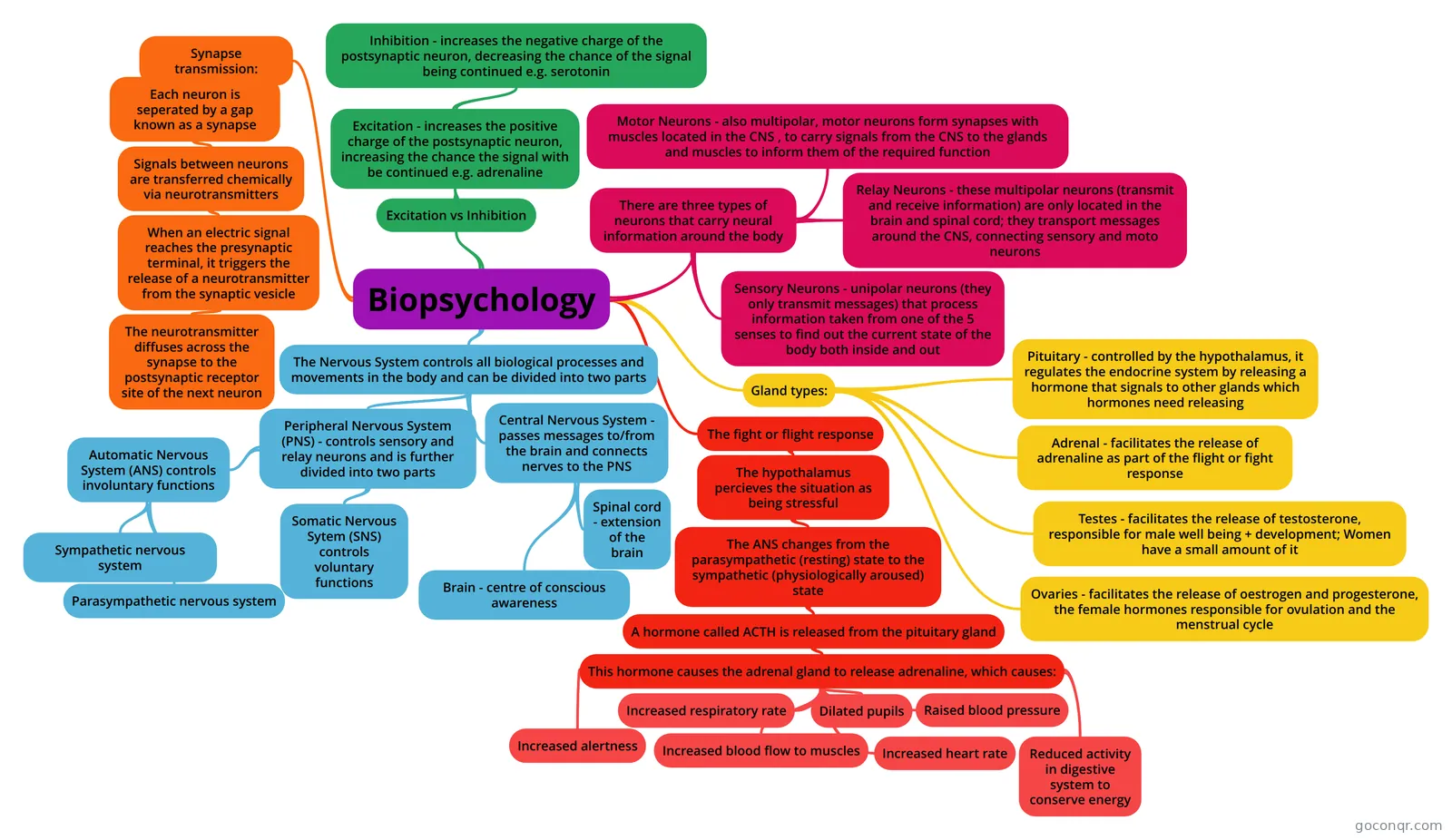
Mind map: biopsychology
Conteúdo do mapa
Biopsychology
The Nervous System controls all biological processes and movements in the body and can be divided into two parts
- Central Nervous System - passes messages to/from the brain and connects nerves to the PNS
- Brain - centre of conscious awareness
- Spinal cord - extension of the brain
- Peripheral Nervous System (PNS) - controls sensory and relay neurons and is further divided into two parts
- Automatic Nervous System (ANS) controls involuntary functions
- Sympathetic nervous system
- Parasympathetic nervous system
- Somatic Nervous Sytem (SNS) controls voluntary functions
- Automatic Nervous System (ANS) controls involuntary functions
- Central Nervous System - passes messages to/from the brain and connects nerves to the PNS
There are three types of neurons that carry neural information around the body
- Sensory Neurons - unipolar neurons (they only transmit messages) that process information taken from one of the 5 senses to find out the current state of the body both inside and out
- Relay Neurons - these multipolar neurons (transmit and receive information) are only located in the brain and spinal cord; they transport messages around the CNS, connecting sensory and moto neurons
- Motor Neurons - also multipolar, motor neurons form synapses with muscles located in the CNS , to carry signals from the CNS to the glands and muscles to inform them of the required function
Synapse transmission:
- Each neuron is seperated by a gap known as a synapse
- Signals between neurons are transferred chemically via neurotransmitters
- When an electric signal reaches the presynaptic terminal, it triggers the release of a neurotransmitter from the synaptic vesicle
- The neurotransmitter diffuses across the synapse to the postsynaptic receptor site of the next neuron
- When an electric signal reaches the presynaptic terminal, it triggers the release of a neurotransmitter from the synaptic vesicle
- Signals between neurons are transferred chemically via neurotransmitters
- Each neuron is seperated by a gap known as a synapse
Excitation vs Inhibition
- Excitation - increases the positive charge of the postsynaptic neuron, increasing the chance the signal with be continued e.g. adrenaline
- Inhibition - increases the negative charge of the postsynaptic neuron, decreasing the chance of the signal being continued e.g. serotonin
- Excitation - increases the positive charge of the postsynaptic neuron, increasing the chance the signal with be continued e.g. adrenaline
Gland types:
- Pituitary - controlled by the hypothalamus, it regulates the endocrine system by releasing a hormone that signals to other glands which hormones need releasing
- Adrenal - facilitates the release of adrenaline as part of the flight or fight response
- Testes - facilitates the release of testosterone, responsible for male well being + development; Women have a small amount of it
- Ovaries - facilitates the release of oestrogen and progesterone, the female hormones responsible for ovulation and the menstrual cycle
The fight or flight response
- The hypothalamus percieves the situation as being stressful
- The ANS changes from the parasympathetic (resting) state to the sympathetic (physiologically aroused) state
- A hormone called ACTH is released from the pituitary gland
- This hormone causes the adrenal gland to release adrenaline, which causes:
- Increased alertness
- Increased respiratory rate
- Increased blood flow to muscles
- Dilated pupils
- Increased heart rate
- Raised blood pressure
- Reduced activity in digestive system to conserve energy
- This hormone causes the adrenal gland to release adrenaline, which causes:
- A hormone called ACTH is released from the pituitary gland
- The ANS changes from the parasympathetic (resting) state to the sympathetic (physiologically aroused) state
- The hypothalamus percieves the situation as being stressful
Informações
- Descrição
- AS Biopsychology excluding the structure of nerves/neurons
- Criado por
- Emily Cushlow
- Visualizações
- 3.092
- Avaliação