
Mapa mental
The Vertebrate Brain
Conteúdo do mapa
The Vertebrate Brain
is regionally specialised
Forebrain
- Diencephalon
- Hypothalamus
- regulates homeostasis and basic survival behaviors such as
- feeding
- fighting
- fleeing
- reproducing
- regulates the biological clock
- regulates cicardian rhythms such as the sleep/wake cycle
- most mammals have a pair of suprachiasmatic nuclei (SCN) in the hypothalamus which act as a biological clock
- Biological clocks generally require external cues to remain synchronised with environmental cycles
- regulates homeostasis and basic survival behaviors such as
- Thalamus
- the main input centre for sensory information to the cerebrum
- the main output centre for motor information leaving the cerebrum
- Epithalamus
- pineal gland
- secretes melatonin
- pineal gland
- Hypothalamus
- Cerebrum/telencephalon
- the structure which varies most across species
- has two hemispheres the right and the left
- each hemisphere consists of a cerebral cortex (grey matter) overlaying white matter and basal nuclei
- in humans the cerebral cortex is the largest and most complex part of the brain
- it controls voluntary movement and cognitive functions
- the basal nuclei are important centres for planning and learning movement sequences
- diseases of the basal ganlia include
- Parkinson's
- Huntington's
- Tourette syndrome
- diseases of the basal ganlia include
- lateralisation of cortical function
- corpus callosum
- a thick band of axons provides communication between the right and left hemispheres
- split brain occurs if corpus callosum is removed
- left hemisphere
- is more adept at language, maths, logic and processing of serial sequences
- right hemisphere
- is stronger at pattern recognition, nonverbal thinking and emotional processing
- the differences in hemisphere function are called lateralisation
- corpus callosum
- the right half of the cerebral cortex controls the left side fo the body and vice versa
- each side of the cerebral cortex has four lobes:
- frontal
- temporal
- occipital
- parietal
- each lobe contains primary sensory areas and association areas where information is integrated
- Diencephalon
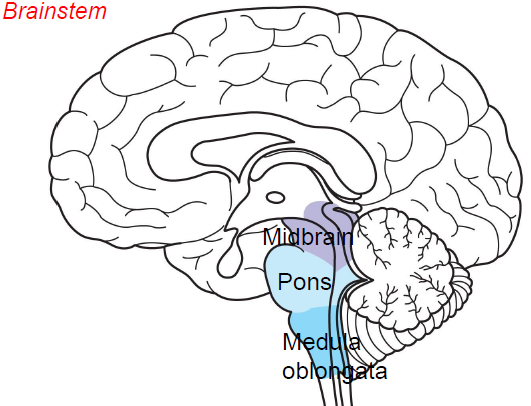
The Brainstem
- Hindbrain
- pons
- regulates the breathing centres in the meulla
- medulla oblongata
- contains centres that control several functions including
- breathing
- cardiovascular activity
- swallowing
- vomiting
- digestion
- contains centres that control several functions including
- cerebellum
- is important for
- movement coordination
- balance
- error checking during motor, perceptual and cognitive functions
- is involved in learning and remembering motor skills
- part of hind brain but not of Brainstem
- is important for
- pons
- Midbrain
- contains centres for receipt and integration of sensory information
- coordinates and conducts information between brain centres
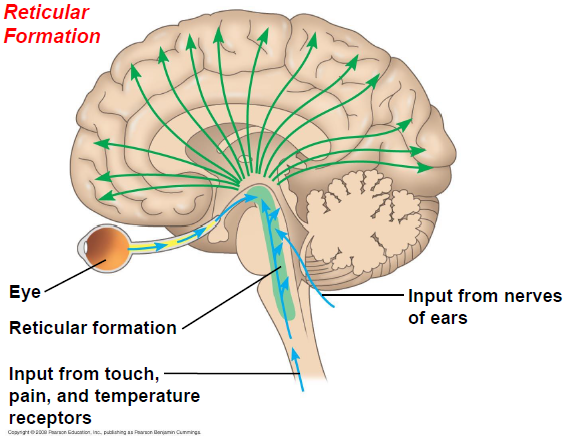
- Arousal and sleep
- controled by both the cerebrum and the brainstem
- in the core of the brainstem there is a network of neurons called the reticular formation
- this regulates the amount and type of information that reaches the cerebral cortex and affects alertness
- the hormone melatonin is released by the pineal gland
- this plays a role in the sleep cycles of birds and mammals
- sleep is essential and may play and role in the consolidation of learning and memory
- dolphins sleep with one brain hemisphere at a time
- this means they are able to swim while they're "asleep"
- dolphins sleep with one brain hemisphere at a time
- Hindbrain
the limbic system
- where emotions are generated and experienced
- this takes place in other parts of the brain as well including various sensory areas
- is a ring of structures around the brainstem inculding
- the amygdala
- located in the temporal lobe
- helps store an emotional experience as an emotional memory
- located in the temporal lobe
- the hippocampus
- parts of the thalamus
- the amygdala
- where emotions are generated and experienced
the outermost layer of the cerebral cortex has a different arrangement in bird and mammals
- in mammals the cerebral cortex has a convoluted surface called the neo cortex
- this was previously thought to be required for cognition
- cognition is the perception and reasoning that form knowledge
- however it has recently been shown that birds also demonstrate cognition even though they do not have a neocortex
- this was previously thought to be required for cognition
- in mammals the cerebral cortex has a convoluted surface called the neo cortex
Imagens e arquivos do mapa
Informações
- Descrição
- BSc degree Neurobiology (The Nervous System) Mapa Mental sobre The Vertebrate Brain, criado por yolajoy em 31-03-2014.
- Criado por
- yolajoy
- Visualizações
- 55
- Tags
- Avaliação