
Mapa mental
Attachment
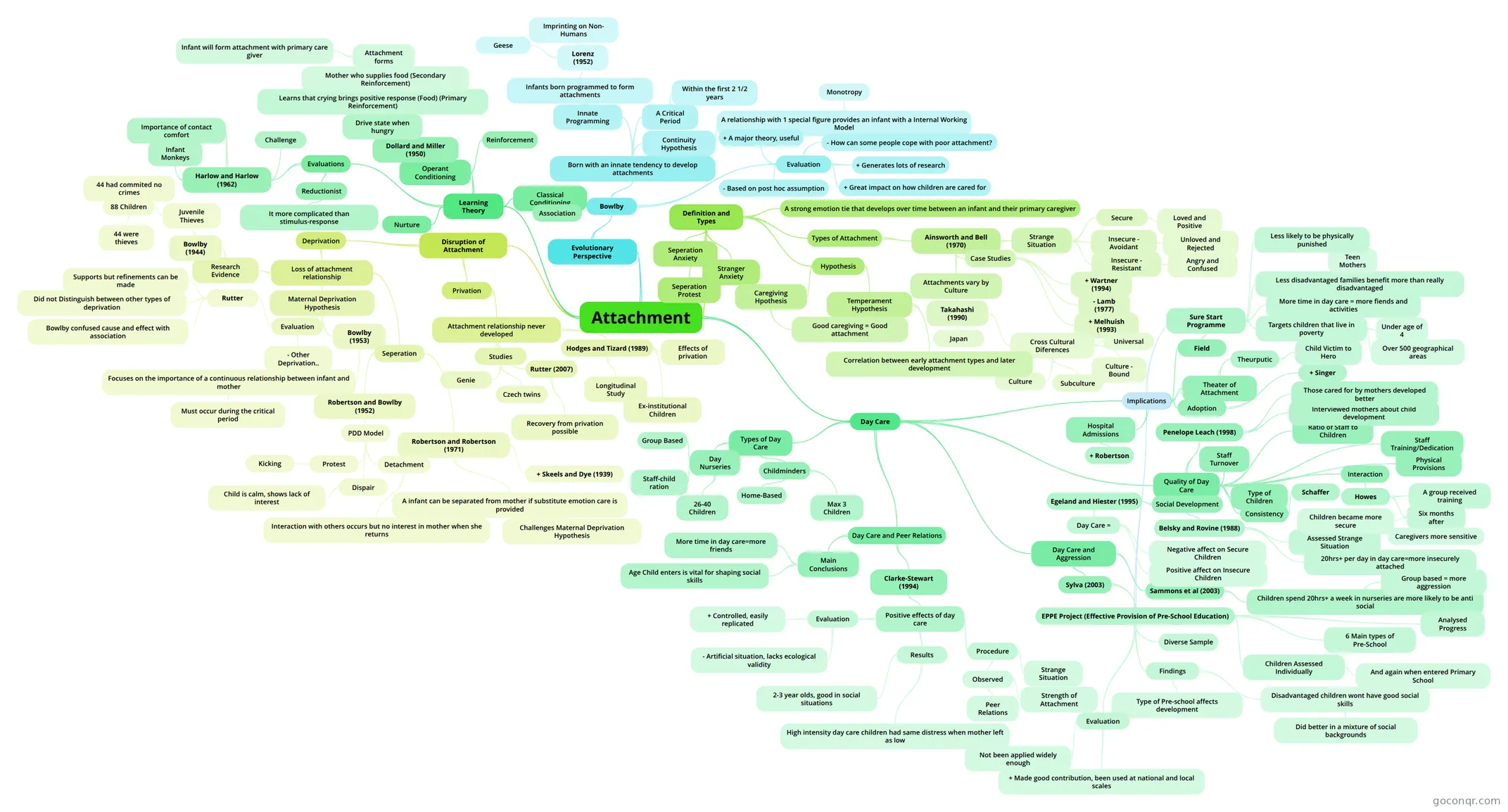
Mind map: Attachment psychology
Conteúdo do mapa
Attachment
Evolutionary Perspective
- Bowlby
- Born with an innate tendency to develop attachments
- Innate Programming
- Infants born programmed to form attachments
- Lorenz (1952)
- Imprinting on Non- Humans
- Geese
- Lorenz (1952)
- Infants born programmed to form attachments
- A Critical Period
- Within the first 2 1/2 years
- Continuity Hypothesis
- A relationship with 1 special figure provides an infant with a Internal Working Model
- Monotropy
- A relationship with 1 special figure provides an infant with a Internal Working Model
- Innate Programming
- Evaluation
- + A major theory, useful
- + Generates lots of research
- + Great impact on how children are cared for
- - How can some people cope with poor attachment?
- - Based on post hoc assumption
- Born with an innate tendency to develop attachments
- Bowlby
Learning Theory
- Classical Conditioning
- Association
- Operant Conditioning
- Reinforcement
- Dollard and Miller (1950)
- Drive state when hungry
- Learns that crying brings positive response (Food) (Primary Reinforcement)
- Mother who supplies food (Secondary Reinforcement)
- Attachment forms
- Infant will form attachment with primary care giver
- Attachment forms
- Mother who supplies food (Secondary Reinforcement)
- Learns that crying brings positive response (Food) (Primary Reinforcement)
- Drive state when hungry
- Evaluations
- Harlow and Harlow (1962)
- Importance of contact comfort
- Infant Monkeys
- Challenge
- Reductionist
- It more complicated than stimulus-response
- Harlow and Harlow (1962)
- Nurture
- Classical Conditioning
Definition and Types
- A strong emotion tie that develops over time between an infant and their primary caregiver
- Types of Attachment
- Ainsworth and Bell (1970)
- Strange Situation
- Secure
- Loved and Positive
- Insecure - Avoidant
- Unloved and Rejected
- Insecure - Resistant
- Angry and Confused
- Secure
- Case Studies
- + Wartner (1994)
- + Melhuish (1993)
- - Lamb (1977)
- Attachments vary by Culture
- Takahashi (1990)
- Cross Cultural Diferences
- Universal
- Culture - Bound
- Culture
- Subculture
- Japan
- Cross Cultural Diferences
- Takahashi (1990)
- Strange Situation
- Ainsworth and Bell (1970)
- Seperation Protest
- Seperation Anxiety
- Stranger Anxiety
- Hypothesis
- Caregiving Hpothesis
- Good caregiving = Good attachment
- Temperament Hypothesis
- Correlation between early attachment types and later development
- Caregiving Hpothesis
Disruption of Attachment
- Deprivation
- Loss of attachment relationship
- Maternal Deprivation Hypothesis
- Bowlby (1953)
- Focuses on the importance of a continuous relationship between infant and mother
- Must occur during the critical period
- Focuses on the importance of a continuous relationship between infant and mother
- Evaluation
- - Other Deprivation..
- Rutter
- Supports but refinements can be made
- Bowlby confused cause and effect with association
- Did not Distinguish between other types of deprivation
- Bowlby (1953)
- Research Evidence
- Bowlby (1944)
- Juvenile Thieves
- 88 Children
- 44 were thieves
- 44 had commited no crimes
- 88 Children
- Juvenile Thieves
- Bowlby (1944)
- Seperation
- Robertson and Robertson (1971)
- A infant can be separated from mother if substitute emotion care is provided
- Challenges Maternal Deprivation Hypothesis
- + Skeels and Dye (1939)
- A infant can be separated from mother if substitute emotion care is provided
- Robertson and Bowlby (1952)
- PDD Model
- Protest
- Kicking
- Dispair
- Child is calm, shows lack of interest
- Detachment
- Interaction with others occurs but no interest in mother when she returns
- Protest
- PDD Model
- Robertson and Robertson (1971)
- Maternal Deprivation Hypothesis
- Loss of attachment relationship
- Privation
- Attachment relationship never developed
- Studies
- Czech twins
- Genie
- Rutter (2007)
- Recovery from privation possible
- Hodges and Tizard (1989)
- Effects of privation
- Longitudinal Study
- Ex-institutional Children
- Studies
- Attachment relationship never developed
- Deprivation
Day Care
- Types of Day Care
- Day Nurseries
- Group Based
- Staff-child ration
- 26-40 Children
- Childminders
- Max 3 Children
- Home-Based
- Day Nurseries
- Quality of Day Care
- Ratio of Staff to Children
- Staff Turnover
- Physical Provisions
- Staff Training/Dedication
- Type of Children
- Penelope Leach (1998)
- Interviewed mothers about child development
- Those cared for by mothers developed better
- Social Development
- Belsky and Rovine (1988)
- Assessed Strange Situation
- 20hrs+ per day in day care=more insecurely attached
- Egeland and Hiester (1995)
- Day Care =
- Negative affect on Secure Children
- Positive affect on Insecure Children
- Day Care =
- Belsky and Rovine (1988)
- Consistency
- Schaffer
- Interaction
- Howes
- A group received training
- Six months after
- Children became more secure
- Caregivers more sensitive
- Howes
- Day Care and Aggression
- Sammons et al (2003)
- Children spend 20hrs+ a week in nurseries are more likely to be anti social
- Group based = more aggression
- Children spend 20hrs+ a week in nurseries are more likely to be anti social
- Sylva (2003)
- EPPE Project (Effective Provision of Pre-School Education)
- Diverse Sample
- 6 Main types of Pre-School
- Children Assessed Individually
- And again when entered Primary School
- Analysed Progress
- Findings
- Disadvantaged children wont have good social skills
- Did better in a mixture of social backgrounds
- Type of Pre-school affects development
- Disadvantaged children wont have good social skills
- Evaluation
- + Made good contribution, been used at national and local scales
- Not been applied widely enough
- Implications
- EPPE Project (Effective Provision of Pre-School Education)
- Sammons et al (2003)
- Day Care and Peer Relations
- Clarke-Stewart (1994)
- Positive effects of day care
- Procedure
- Strange Situation
- Observed
- Peer Relations
- Strength of Attachment
- Results
- 2-3 year olds, good in social situations
- High intensity day care children had same distress when mother left as low
- Evaluation
- + Controlled, easily replicated
- - Artificial situation, lacks ecological validity
- Procedure
- Positive effects of day care
- Main Conclusions
- More time in day care=more friends
- Age Child enters is vital for shaping social skills
- Clarke-Stewart (1994)
- Implications
- Hospital Admissions
- + Robertson
- Adoption
- + Singer
- Theater of Attachment
- Theurputic
- Child Victim to Hero
- Theurputic
- Field
- Sure Start Programme
- More time in day care = more fiends and activities
- Targets children that live in poverty
- Under age of 4
- Over 500 geographical areas
- Less disadvantaged families benefit more than really disadvantaged
- Teen Mothers
- Less likely to be physically punished
- Sure Start Programme
- Hospital Admissions
- Types of Day Care
Informações
- Descrição
- Psychology Mapa Mental sobre Attachment, criado por molzemoo em 16-04-2014.
- Criado por
- molzemoo
- Visualizações
- 15
- Avaliação