
Mapa mental
Conformity - types & explanations
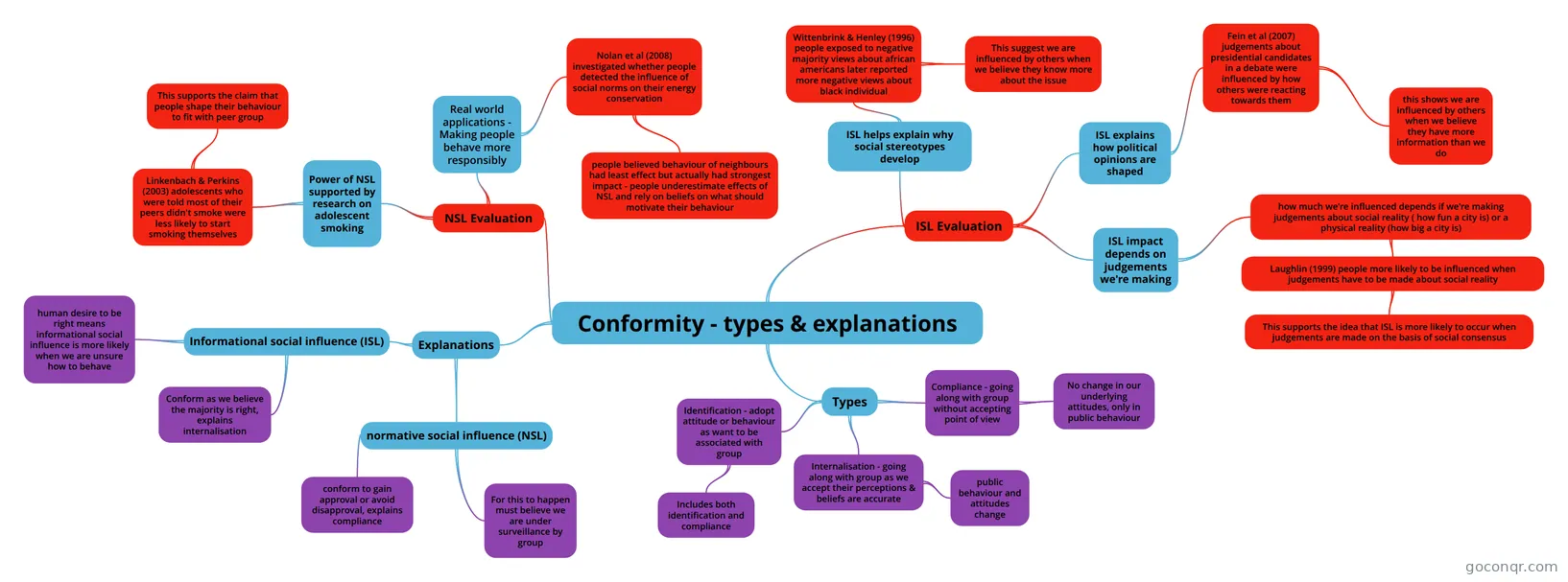
Mind map: Conformity types and explanations
Conteúdo do mapa
Conformity - types & explanations
Types
- Compliance - going along with group without accepting point of view
- No change in our underlying attitudes, only in public behaviour
- Internalisation - going along with group as we accept their perceptions & beliefs are accurate
- public behaviour and attitudes change
- Identification - adopt attitude or behaviour as want to be associated with group
- Includes both identification and compliance
- Compliance - going along with group without accepting point of view
Explanations
- normative social influence (NSL)
- conform to gain approval or avoid disapproval, explains compliance
- For this to happen must believe we are under surveillance by group
- Informational social influence (ISL)
- Conform as we believe the majority is right, explains internalisation
- human desire to be right means informational social influence is more likely when we are unsure how to behave
- normative social influence (NSL)
NSL Evaluation
- Power of NSL supported by research on adolescent smoking
- Linkenbach & Perkins (2003) adolescents who were told most of their peers didn't smoke were less likely to start smoking themselves
- This supports the claim that people shape their behaviour to fit with peer group
- Linkenbach & Perkins (2003) adolescents who were told most of their peers didn't smoke were less likely to start smoking themselves
- Real world applications - Making people behave more responsibly
- Nolan et al (2008) investigated whether people detected the influence of social norms on their energy conservation
- people believed behaviour of neighbours had least effect but actually had strongest impact - people underestimate effects of NSL and rely on beliefs on what should motivate their behaviour
- Nolan et al (2008) investigated whether people detected the influence of social norms on their energy conservation
- Power of NSL supported by research on adolescent smoking
ISL Evaluation
- ISL helps explain why social stereotypes develop
- Wittenbrink & Henley (1996) people exposed to negative majority views about african americans later reported more negative views about black individual
- This suggest we are influenced by others when we believe they know more about the issue
- Wittenbrink & Henley (1996) people exposed to negative majority views about african americans later reported more negative views about black individual
- ISL explains how political opinions are shaped
- Fein et al (2007) judgements about presidential candidates in a debate were influenced by how others were reacting towards them
- this shows we are influenced by others when we believe they have more information than we do
- Fein et al (2007) judgements about presidential candidates in a debate were influenced by how others were reacting towards them
- ISL impact depends on judgements we're making
- how much we're influenced depends if we're making judgements about social reality ( how fun a city is) or a physical reality (how big a city is)
- Laughlin (1999) people more likely to be influenced when judgements have to be made about social reality
- This supports the idea that ISL is more likely to occur when judgements are made on the basis of social consensus
- Laughlin (1999) people more likely to be influenced when judgements have to be made about social reality
- how much we're influenced depends if we're making judgements about social reality ( how fun a city is) or a physical reality (how big a city is)
- ISL helps explain why social stereotypes develop
Informações
- Descrição
- A level Psychology (Social Influence) Mapa Mental sobre Conformity - types & explanations, criado por Hannah Atkinson em 12-04-2017.
- Criado por
- Hannah Atkinson
- Visualizações
- 11
- Avaliação