
Mapa mental
ATTACHMENT REVISION SUMMARY
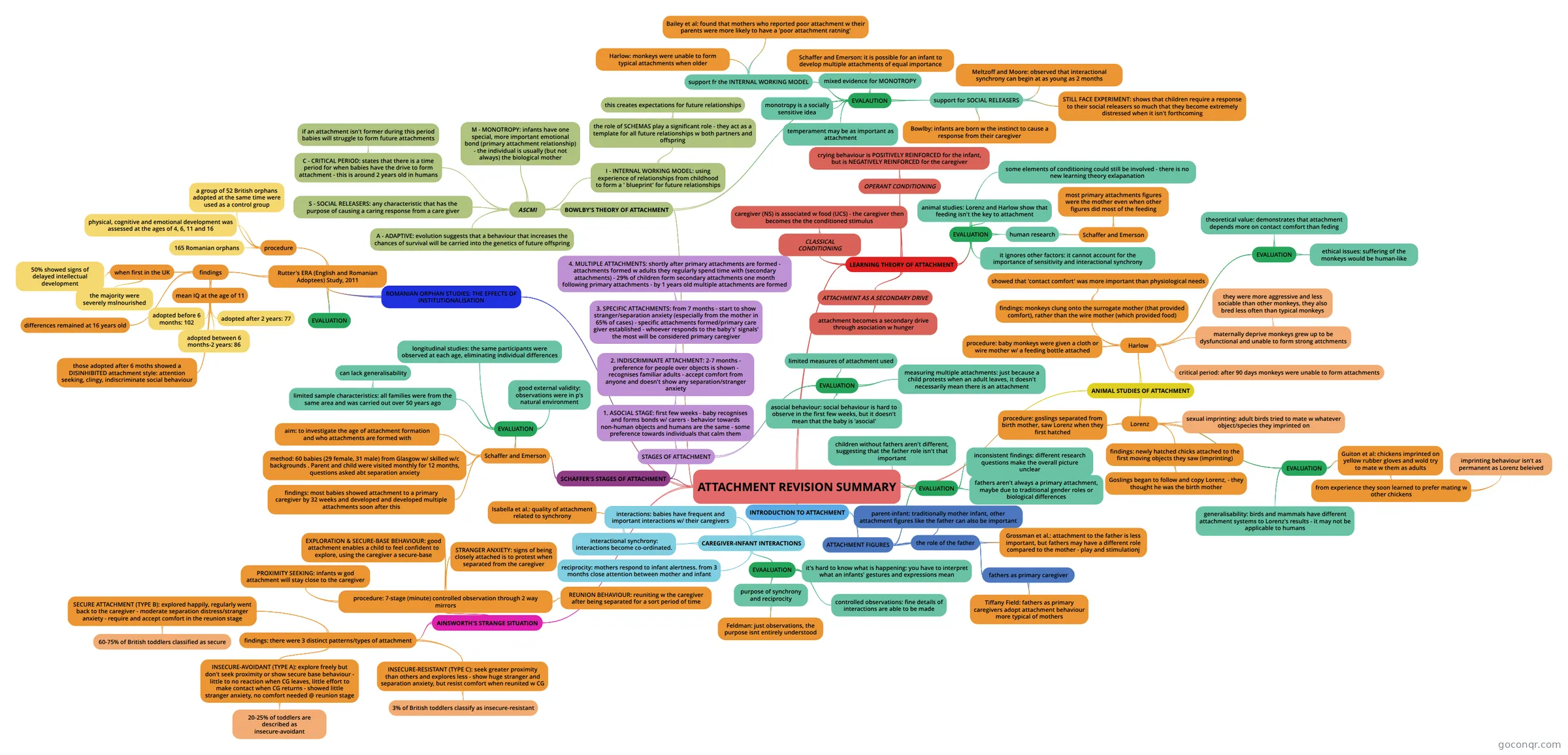
Mind map: Attachment revision summary
Conteúdo do mapa
ATTACHMENT REVISION SUMMARY
INTRODUCTION TO ATTACHMENT
- CAREGIVER-INFANT INTERACTIONS
- interactions: babies have frequent and important interactions w/ their caregivers
- reciprocity: mothers respond to infant alertness. from 3 months close attention between mother and infant
- interactional synchrony: interactions become co-ordinated.
- Isabella et al.: quality of attachment related to synchrony
- EVAALUATION
- it's hard to know what is happening: you have to interpret what an infants' gestures and expressions mean
- controlled observations: fine details of interactions are able to be made
- purpose of synchrony and reciprocity
- Feldman: just observations, the purpose isnt entirely understood
- ATTACHMENT FIGURES
- parent-infant: traditionally mother infant, other attachment figures like the father can also be important
- the role of the father
- Grossman et al.: attachment to the father is less important, but fathers may have a different role compared to the mother - play and stimulationj
- fathers as primary caregiver
- Tiffany Field: fathers as primary caregivers adopt attachment behaviour more typical of mothers
- EVALUATION
- inconsistent findings: different research questions make the overall picture unclear
- children without fathers aren't different, suggesting that the father role isn't that important
- fathers aren't always a primary attachment, maybe due to traditional gender roles or biological differences
- CAREGIVER-INFANT INTERACTIONS
SCHAFFER'S STAGES OF ATTACHMENT
- Schaffer and Emerson
- aim: to investigate the age of attachment formation and who attachments are formed with
- method: 60 babies (29 female, 31 male) from Glasgow w/ skilled w/c backgrounds . Parent and child were visited monthly for 12 months, questions asked abt separation anxiety
- findings: most babies showed attachment to a primary caregiver by 32 weeks and developed and developed multiple attachments soon after this
- EVALUATION
- good external validity: observations were in p's natural environment
- longitudinal studies: the same participants were observed at each age, eliminating individual differences
- limited sample characteristics: all families were from the same area and was carried out over 50 years ago
- can lack generalisability
- STAGES OF ATTACHMENT
- 1. ASOCIAL STAGE: first few weeks - baby recognises and forms bonds w/ carers - behavior towards non-human objects and humans are the same - some preference towards individuals that calm them
- 2. INDISCRIMINATE ATTACHMENT: 2-7 months - preference for people over objects is shown - recognises familiar adults - accept comfort from anyone and doesn't show any separation/stranger anxiety
- 3. SPECIFIC ATTACHMENTS: from 7 months - start to show stranger/separation anxiety (especially from the mother in 65% of cases) - specific attachments formed/primary care giver established - whoever responds to the baby's' signals' the most will be considered primary caregiver
- 4. MULTIPLE ATTACHMENTS: shortly after primary attachments are formed - attachments formed w adults they regularly spend time with (secondary attachments) - 29% of children form secondary attachments one month following primary attachments - by 1 years old multiple attachments are formed
- 3. SPECIFIC ATTACHMENTS: from 7 months - start to show stranger/separation anxiety (especially from the mother in 65% of cases) - specific attachments formed/primary care giver established - whoever responds to the baby's' signals' the most will be considered primary caregiver
- 2. INDISCRIMINATE ATTACHMENT: 2-7 months - preference for people over objects is shown - recognises familiar adults - accept comfort from anyone and doesn't show any separation/stranger anxiety
- EVALUATION
- asocial behaviour: social behaviour is hard to observe in the first few weeks, but it doesn't mean that the baby is 'asocial'
- limited measures of attachment used
- measuring multiple attachments: just because a child protests when an adult leaves, it doesn't necessarily mean there is an attachment
- 1. ASOCIAL STAGE: first few weeks - baby recognises and forms bonds w/ carers - behavior towards non-human objects and humans are the same - some preference towards individuals that calm them
- Schaffer and Emerson
ANIMAL STUDIES OF ATTACHMENT
- Lorenz
- procedure: goslings separated from birth mother, saw Lorenz when they first hatched
- findings: newly hatched chicks attached to the first moving objects they saw (imprinting)
- Goslings began to follow and copy Lorenz, - they thought he was the birth mother
- sexual imprinting: adult birds tried to mate w whatever object/species they imprinted on
- EVALUATION
- generalisability: birds and mammals have different attachment systems to Lorenz's results - it may not be applicable to humans
- Guiton et al: chickens imprinted on yellow rubber gloves and wold try to mate w them as adults
- from experience they soon learned to prefer mating w other chickens
- imprinting behaviour isn't as permanent as Lorenz beleived
- from experience they soon learned to prefer mating w other chickens
- Harlow
- procedure: baby monkeys were given a cloth or wire mother w/ a feeding bottle attached
- findings: monkeys clung onto the surrogate mother (that provided comfort), rather than the wire mother (which provided food)
- showed that 'contact comfort' was more important than physiological needs
- maternally deprive monkeys grew up to be dysfunctional and unable to form strong attchments
- they were more aggressive and less sociable than other monkeys, they also bred less often than typical monkeys
- critical period: after 90 days monkeys were unable to form attachments
- EVALUATION
- theoretical value: demonstrates that attachment depends more on contact comfort than feding
- ethical issues: suffering of the monkeys would be human-like
- Lorenz
LEARNING THEORY OF ATTACHMENT
- CLASSICAL CONDITIONING
- caregiver (NS) is associated w food (UCS) - the caregiver then becomes the the conditioned stimulus
- OPERANT CONDITIONING
- crying behaviour is POSITIVELY REINFORCED for the infant, but is NEGATIVELY REINFORCED for the caregiver
- ATTACHMENT AS A SECONDARY DRIVE
- attachment becomes a secondary drive through asociation w hunger
- EVALUATION
- animal studies: Lorenz and Harlow show that feeding isn't the key to attachment
- human research
- Schaffer and Emerson
- most primary attachments figures were the mother even when other figures did most of the feeding
- Schaffer and Emerson
- it ignores other factors: it cannot account for the importance of sensitivity and interactional synchrony
- some elements of conditioning could still be involved - there is no new learning theory exlapanation
- CLASSICAL CONDITIONING
BOWLBY'S THEORY OF ATTACHMENT
- ASCMI
- A - ADAPTIVE: evolution suggests that a behaviour that increases the chances of survival will be carried into the genetics of future offspring
- S - SOCIAL RELEASERS: any characteristic that has the purpose of causing a caring response from a care giver
- M - MONOTROPY: infants have one special, more important emotional bond (primary attachment relationship) - the individual is usually (but not always) the biological mother
- C - CRITICAL PERIOD: states that there is a time period for when babies have the drive to form attachment - this is around 2 years old in humans
- if an attachment isn't former during this period babies will struggle to form future attachments
- I - INTERNAL WORKING MODEL: using experience of relationships from childhood to form a ' blueprint' for future relationships
- the role of SCHEMAS play a significant role - they act as a template for all future relationships w both partners and offspring
- this creates expectations for future relationships
- the role of SCHEMAS play a significant role - they act as a template for all future relationships w both partners and offspring
- EVALAUTION
- mixed evidence for MONOTROPY
- Schaffer and Emerson: it is possible for an infant to develop multiple attachments of equal importance
- support for SOCIAL RELEASERS
- Meltzoff and Moore: observed that interactional synchrony can begin at as young as 2 months
- STILL FACE EXPERIMENT: shows that children require a response to their social releasers so much that they become extremely distressed when it isn't forthcoming
- Bowlby: infants are born w the instinct to cause a response from their caregiver
- support fr the INTERNAL WORKING MODEL
- Harlow: monkeys were unable to form typical attachments when older
- Bailey et al: found that mothers who reported poor attachment w their parents were more likely to have a 'poor attachment ratning'
- monotropy is a socially sensitive idea
- temperament may be as important as attachment
- mixed evidence for MONOTROPY
- ASCMI
AINSWORTH'S STRANGE SITUATION
- procedure: 7-stage (minute) controlled observation through 2 way mirrors
- PROXIMITY SEEKING: infants w god attachment will stay close to the caregiver
- EXPLORATION & SECURE-BASE BEHAVIOUR: good attachment enables a child to feel confident to explore, using the caregiver a secure-base
- STRANGER ANXIETY: signs of being closely attached is to protest when separated from the caregiver
- REUNION BEHAVIOUR: reuniting w the caregiver after being separated for a sort period of time
- findings: there were 3 distinct patterns/types of attachment
- SECURE ATTACHMENT (TYPE B): explored happily, regularly went back to the caregiver - moderate separation distress/stranger anxiety - require and accept comfort in the reunion stage
- 60-75% of British toddlers classified as secure
- INSECURE-AVOIDANT (TYPE A): explore freely but don't seek proximity or show secure base behaviour - little to no reaction when CG leaves, little effort to make contact when CG returns - showed little stranger anxiety, no comfort needed @ reunion stage
- 20-25% of toddlers are described as insecure-avoidant
- INSECURE-RESISTANT (TYPE C): seek greater proximity than others and explores less - show huge stranger and separation anxiety, but resist comfort when reunited w CG
- 3% of British toddlers classify as insecure-resistant
- SECURE ATTACHMENT (TYPE B): explored happily, regularly went back to the caregiver - moderate separation distress/stranger anxiety - require and accept comfort in the reunion stage
- procedure: 7-stage (minute) controlled observation through 2 way mirrors
ROMANIAN ORPHAN STUDIES: THE EFFECTS OF INSTITUTIONALISATION
- Rutter's ERA (English and Romanian Adoptees) Study, 2011
- procedure
- 165 Romanian orphans
- physical, cognitive and emotional development was assessed at the ages of 4, 6, 11 and 16
- a group of 52 British orphans adopted at the same time were used as a control group
- findings
- when first in the UK
- 50% showed signs of delayed intellectual development
- the majority were severely mslnourished
- mean IQ at the age of 11
- adopted before 6 months: 102
- adopted between 6 months-2 years: 86
- adopted after 2 years: 77
- differences remained at 16 years old
- those adopted after 6 moths showed a DISINHIBITED attachment style: attention seeking, clingy, indiscriminate social behaviour
- when first in the UK
- EVALUATION
- procedure
- Rutter's ERA (English and Romanian Adoptees) Study, 2011
Informações
- Descrição
- A level Psychology (attachment) Mapa Mental sobre ATTACHMENT REVISION SUMMARY, criado por Anchalee Lovekin em 25-04-2017.
- Criado por
- Anchalee Lovekin
- Visualizações
- 5
- Avaliação