
Mapa mental
Attachment
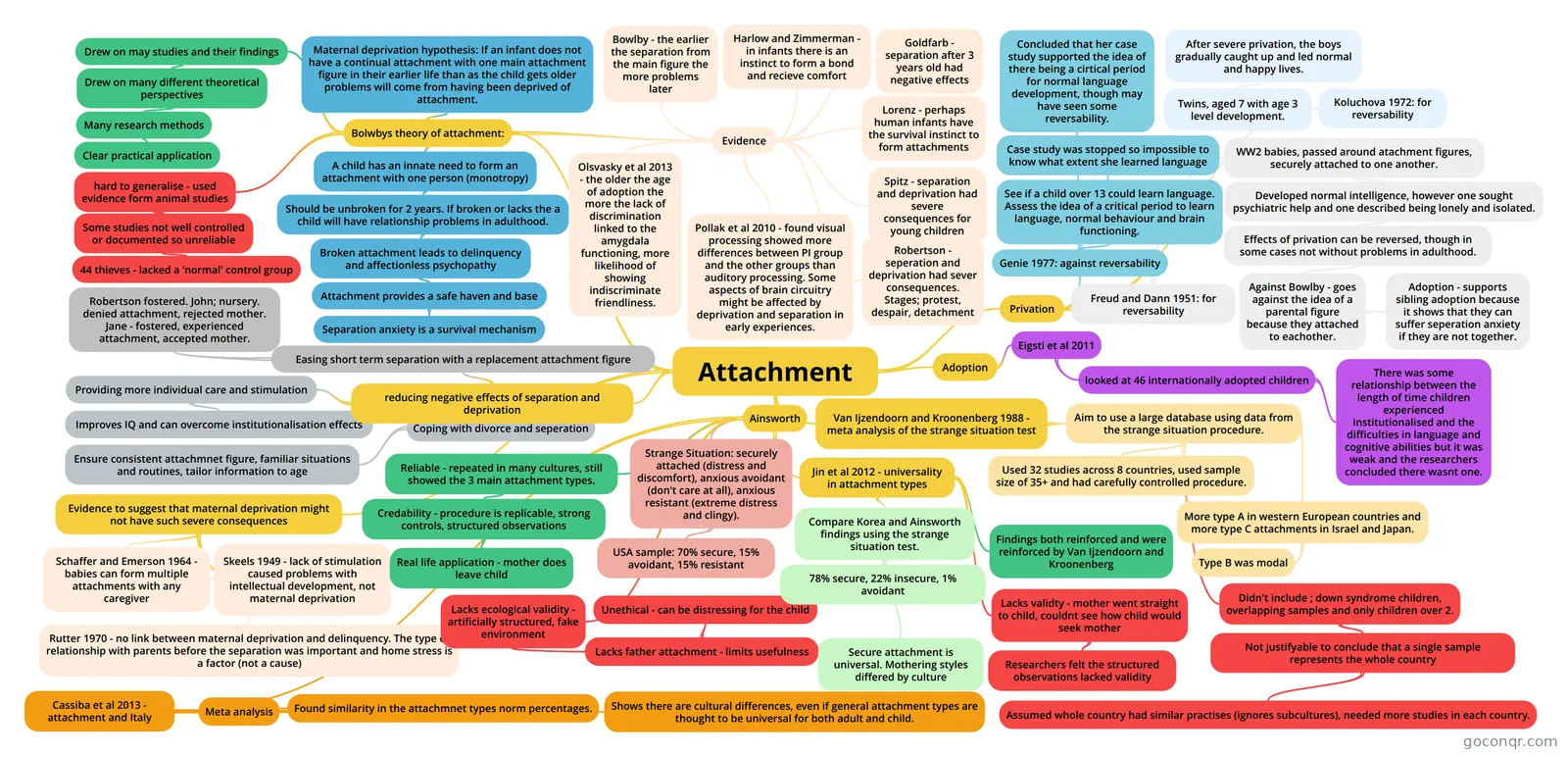
Mind map: Attachment psychology
Conteúdo do mapa
Attachment
Bolwbys theory of attachment:
- A child has an innate need to form an attachment with one person (monotropy)
- Should be unbroken for 2 years. If broken or lacks the a child will have relationship problems in adulthood.
- Broken attachment leads to delinquency and affectionless psychopathy
- Attachment provides a safe haven and base
- Separation anxiety is a survival mechanism
- Attachment provides a safe haven and base
- Broken attachment leads to delinquency and affectionless psychopathy
- Should be unbroken for 2 years. If broken or lacks the a child will have relationship problems in adulthood.
- Maternal deprivation hypothesis: If an infant does not have a continual attachment with one main attachment figure in their earlier life than as the child gets older problems will come from having been deprived of attachment.
- Drew on may studies and their findings
- Drew on many different theoretical perspectives
- Many research methods
- Clear practical application
- Many research methods
- Drew on many different theoretical perspectives
- hard to generalise - used evidence form animal studies
- Some studies not well controlled or documented so unreliable
- 44 thieves - lacked a 'normal' control group
- Some studies not well controlled or documented so unreliable
- Evidence
- Bowlby - the earlier the separation from the main figure the more problems later
- Harlow and Zimmerman - in infants there is an instinct to form a bond and recieve comfort
- Robertson - seperation and deprivation had sever consequences. Stages; protest, despair, detachment
- Spitz - separation and deprivation had severe consequences for young children
- Goldfarb - separation after 3 years old had negative effects
- Lorenz - perhaps human infants have the survival instinct to form attachments
- Olsvasky et al 2013 - the older the age of adoption the more the lack of discrimination linked to the amygdala functioning, more likelihood of showing indiscriminate friendliness.
- Pollak et al 2010 - found visual processing showed more differences between PI group and the other groups than auditory processing. Some aspects of brain circuitry might be affected by deprivation and separation in early experiences.
- A child has an innate need to form an attachment with one person (monotropy)
reducing negative effects of separation and deprivation
- Easing short term separation with a replacement attachment figure
- Robertson fostered. John; nursery. denied attachment, rejected mother. Jane - fostered, experienced attachment, accepted mother.
- Providing more individual care and stimulation
- Improves IQ and can overcome institutionalisation effects
- Coping with divorce and seperation
- Ensure consistent attachmnet figure, familiar situations and routines, tailor information to age
- Easing short term separation with a replacement attachment figure
Evidence to suggest that maternal deprivation might not have such severe consequences
- Schaffer and Emerson 1964 - babies can form multiple attachments with any caregiver
- Skeels 1949 - lack of stimulation caused problems with intellectual development, not maternal deprivation
- Rutter 1970 - no link between maternal deprivation and delinquency. The type of relationship with parents before the separation was important and home stress is a factor (not a cause)
Ainsworth
- Strange Situation: securely attached (distress and discomfort), anxious avoidant (don't care at all), anxious resistant (extreme distress and clingy).
- USA sample: 70% secure, 15% avoidant, 15% resistant
- Reliable - repeated in many cultures, still showed the 3 main attachment types.
- Credability - procedure is replicable, strong controls, structured observations
- Real life application - mother does leave child
- Credability - procedure is replicable, strong controls, structured observations
- Lacks ecological validity - artificially structured, fake environment
- Lacks father attachment - limits usefulness
- Unethical - can be distressing for the child
- Lacks father attachment - limits usefulness
- Jin et al 2012 - universality in attachment types
- Compare Korea and Ainsworth findings using the strange situation test.
- 78% secure, 22% insecure, 1% avoidant
- Secure attachment is universal. Mothering styles differed by culture
- Findings both reinforced and were reinforced by Van Ijzendoorn and Kroonenberg
- Lacks validty - mother went straight to child, couldnt see how child would seek mother
- Researchers felt the structured observations lacked validity
- Compare Korea and Ainsworth findings using the strange situation test.
- Cassiba et al 2013 - attachment and Italy
- Meta analysis
- Found similarity in the attachmnet types norm percentages.
- Shows there are cultural differences, even if general attachment types are thought to be universal for both adult and child.
- Strange Situation: securely attached (distress and discomfort), anxious avoidant (don't care at all), anxious resistant (extreme distress and clingy).
Van Ijzendoorn and Kroonenberg 1988 - meta analysis of the strange situation test
- Aim to use a large database using data from the strange situation procedure.
- Didn't include ; down syndrome children, overlapping samples and only children over 2.
- Not justifyable to conclude that a single sample represents the whole country
- Assumed whole country had similar practises (ignores subcultures), needed more studies in each country.
- Not justifyable to conclude that a single sample represents the whole country
- More type A in western European countries and more type C attachments in Israel and Japan.
- Type B was modal
- Used 32 studies across 8 countries, used sample size of 35+ and had carefully controlled procedure.
- Didn't include ; down syndrome children, overlapping samples and only children over 2.
- Aim to use a large database using data from the strange situation procedure.
Privation
- Genie 1977: against reversability
- See if a child over 13 could learn language. Assess the idea of a critical period to learn language, normal behaviour and brain functioning.
- Case study was stopped so impossible to know what extent she learned language
- Concluded that her case study supported the idea of there being a cirtical period for normal language development, though may have seen some reversability.
- Koluchova 1972: for reversability
- Twins, aged 7 with age 3 level development.
- After severe privation, the boys gradually caught up and led normal and happy lives.
- Twins, aged 7 with age 3 level development.
- Freud and Dann 1951: for reversability
- WW2 babies, passed around atachment figures, securely attached to one another.
- Developed normal intelligence, however one sought psychiatric help and one described being lonely and isolated.
- Effects of privation can be reversed, though in some cases not without problems in adulthood.
- Against Bowlby - goes against the idea of a parental figure because they attached to eachother.
- Adoption - supports sibling adoption because it shows that they can suffer seperation anxiety if they are not together.
- Against Bowlby - goes against the idea of a parental figure because they attached to eachother.
- Effects of privation can be reversed, though in some cases not without problems in adulthood.
- Developed normal intelligence, however one sought psychiatric help and one described being lonely and isolated.
- WW2 babies, passed around atachment figures, securely attached to one another.
- Genie 1977: against reversability
Adoption
- Eigsti et al 2011
- looked at 46 internationally adopted children
- There was some relationship between the length of time children experienced institutionalised and the difficulties in language and cognitive abilities but it was weak and the researchers concluded there wasnt one.
- looked at 46 internationally adopted children
- Eigsti et al 2011
Informações
- Descrição
- A level Psychology Mapa Mental sobre Attachment, criado por Lauren Pitcher em 14-06-2017.
- Criado por
- Lauren Pitcher
- Visualizações
- 0
- Histórico
-
- Criado por Hannah Martin · 13 jun 2017
- Copiado por Lauren Pitcher · 14 jun 2017
- Avaliação