
Mapa mental
Problems faced by the Weimar Republic in the 1920s
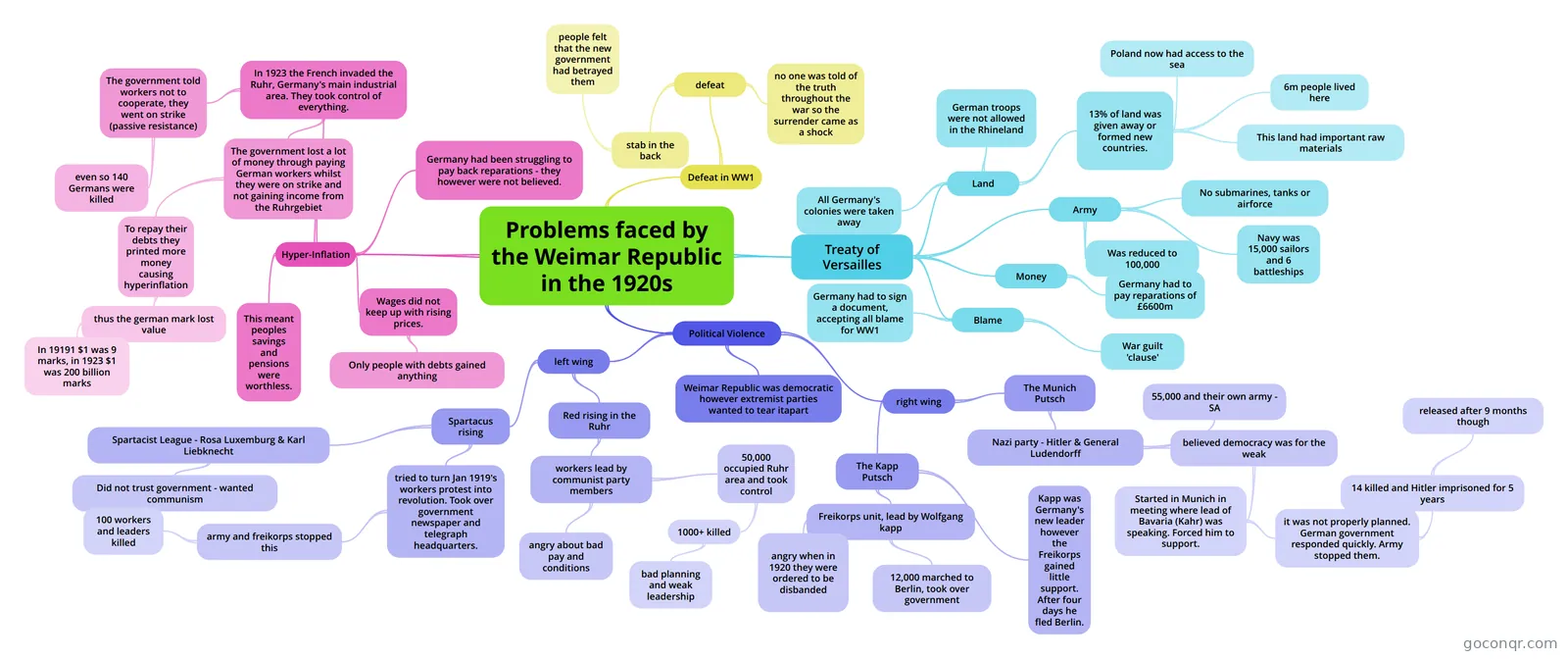
Mind map: Problems faced by the Weimar Republic in the 1920s
Conteúdo do mapa
Problems faced by the Weimar Republic in the 1920s
Treaty of Versailles
- Land
- All Germany's colonies were taken away
- 13% of land was given away or formed new countries.
- This land had important raw materials
- 6m people lived here
- Poland now had access to the sea
- German troops were not allowed in the Rhineland
- Army
- Was reduced to 100,000
- Navy was 15,000 sailors and 6 battleships
- No submarines, tanks or airforce
- Money
- Germany had to pay reparations of £6600m
- Blame
- Germany had to sign a document, accepting all blame for WW1
- War guilt 'clause'
- Land
Defeat in WW1
- defeat
- stab in the back
- people felt that the new government had betrayed them
- no one was told of the truth throughout the war so the surrender came as a shock
- stab in the back
- defeat
Hyper-Inflation
- Germany had been struggling to pay back reparations - they however were not believed.
- In 1923 the French invaded the Ruhr, Germany's main industrial area. They took control of everything.
- The government told workers not to cooperate, they went on strike (passive resistance)
- even so 140 Germans were killed
- The government lost a lot of money through paying German workers whilst they were on strike and not gaining income from the Ruhrgebiet
- To repay their debts they printed more money causing hyperinflation
- thus the german mark lost value
- In 19191 $1 was 9 marks, in 1923 $1 was 200 billion marks
- thus the german mark lost value
- To repay their debts they printed more money causing hyperinflation
- The government told workers not to cooperate, they went on strike (passive resistance)
- This meant peoples savings and pensions were worthless.
- Wages did not keep up with rising prices.
- Only people with debts gained anything
Political Violence
- left wing
- Spartacus rising
- Spartacist League - Rosa Luxemburg & Karl Liebknecht
- Did not trust government - wanted communism
- tried to turn Jan 1919's workers protest into revolution. Took over government newspaper and telegraph headquarters.
- army and freikorps stopped this
- 100 workers and leaders killed
- army and freikorps stopped this
- Spartacist League - Rosa Luxemburg & Karl Liebknecht
- Red rising in the Ruhr
- workers lead by communist party members
- angry about bad pay and conditions
- 50,000 occupied Ruhr area and took control
- 1000+ killed
- bad planning and weak leadership
- 1000+ killed
- workers lead by communist party members
- Spartacus rising
- right wing
- The Kapp Putsch
- Freikorps unit, lead by Wolfgang kapp
- angry when in 1920 they were ordered to be disbanded
- 12,000 marched to Berlin, took over government
- Kapp was Germany's new leader however the Freikorps gained little support. After four days he fled Berlin.
- Freikorps unit, lead by Wolfgang kapp
- The Munich Putsch
- Nazi party - Hitler & General Ludendorff
- 55,000 and their own army - SA
- believed democracy was for the weak
- Started in Munich in meeting where lead of Bavaria (Kahr) was speaking. Forced him to support.
- it was not properly planned. German government responded quickly. Army stopped them.
- 14 killed and Hitler imprisoned for 5 years
- released after 9 months though
- 14 killed and Hitler imprisoned for 5 years
- it was not properly planned. German government responded quickly. Army stopped them.
- Started in Munich in meeting where lead of Bavaria (Kahr) was speaking. Forced him to support.
- Nazi party - Hitler & General Ludendorff
- The Kapp Putsch
- Weimar Republic was democratic however extremist parties wanted to tear itapart
- left wing
Informações
- Descrição
- GCSE History Mapa Mental sobre Problems faced by the Weimar Republic in the 1920s, criado por MARINA POLITIS em 12-06-2014.
- Criado por
- MARINA POLITIS
- Visualizações
- 387
- Avaliação