
Mapa mental
Adolescence
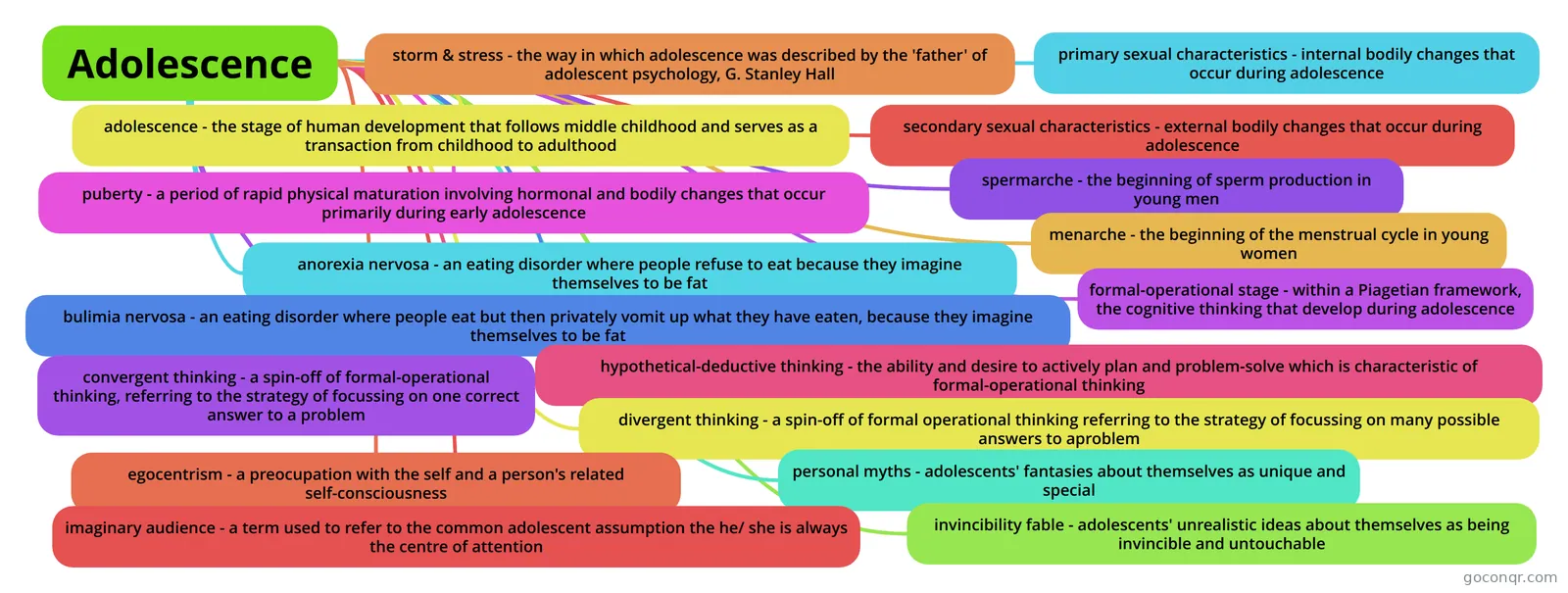
Mind map: adolescence psychology
Conteúdo do mapa
Adolescence
storm & stress - the way in which adolescence was described by the 'father' of adolescent psychology, G. Stanley Hall
adolescence - the stage of human development that follows middle childhood and serves as a transaction from childhood to adulthood
puberty - a period of rapid physical maturation involving hormonal and bodily changes that occur primarily during early adolescence
primary sexual characteristics - internal bodily changes that occur during adolescence
secondary sexual characteristics - external bodily changes that occur during adolescence
spermarche - the beginning of sperm production in young men
menarche - the beginning of the menstrual cycle in young women
anorexia nervosa - an eating disorder where people refuse to eat because they imagine themselves to be fat
bulimia nervosa - an eating disorder where people eat but then privately vomit up what they have eaten, because they imagine themselves to be fat
formal-operational stage - within a Piagetian framework, the cognitive thinking that develop during adolescence
hypothetical-deductive thinking - the ability and desire to actively plan and problem-solve which is characteristic of formal-operational thinking
convergent thinking - a spin-off of formal-operational thinking, referring to the strategy of focussing on one correct answer to a problem
divergent thinking - a spin-off of formal operational thinking referring to the strategy of focussing on many possible answers to aproblem
egocentrism - a preocupation with the self and a person's related self-consciousness
personal myths - adolescents' fantasies about themselves as unique and special
invincibility fable - adolescents' unrealistic ideas about themselves as being invincible and untouchable
imaginary audience - a term used to refer to the common adolescent assumption the he/ she is always the centre of attention
Informações
- Descrição
- University Psychology 144 (Chapter 6) Mapa Mental sobre Adolescence, criado por Zeneatha Jònsson em 26-08-2014.
- Criado por
- Zeneatha Jònsson
- Visualizações
- 421
- Tags
- Avaliação