
Mapa mental
Memory
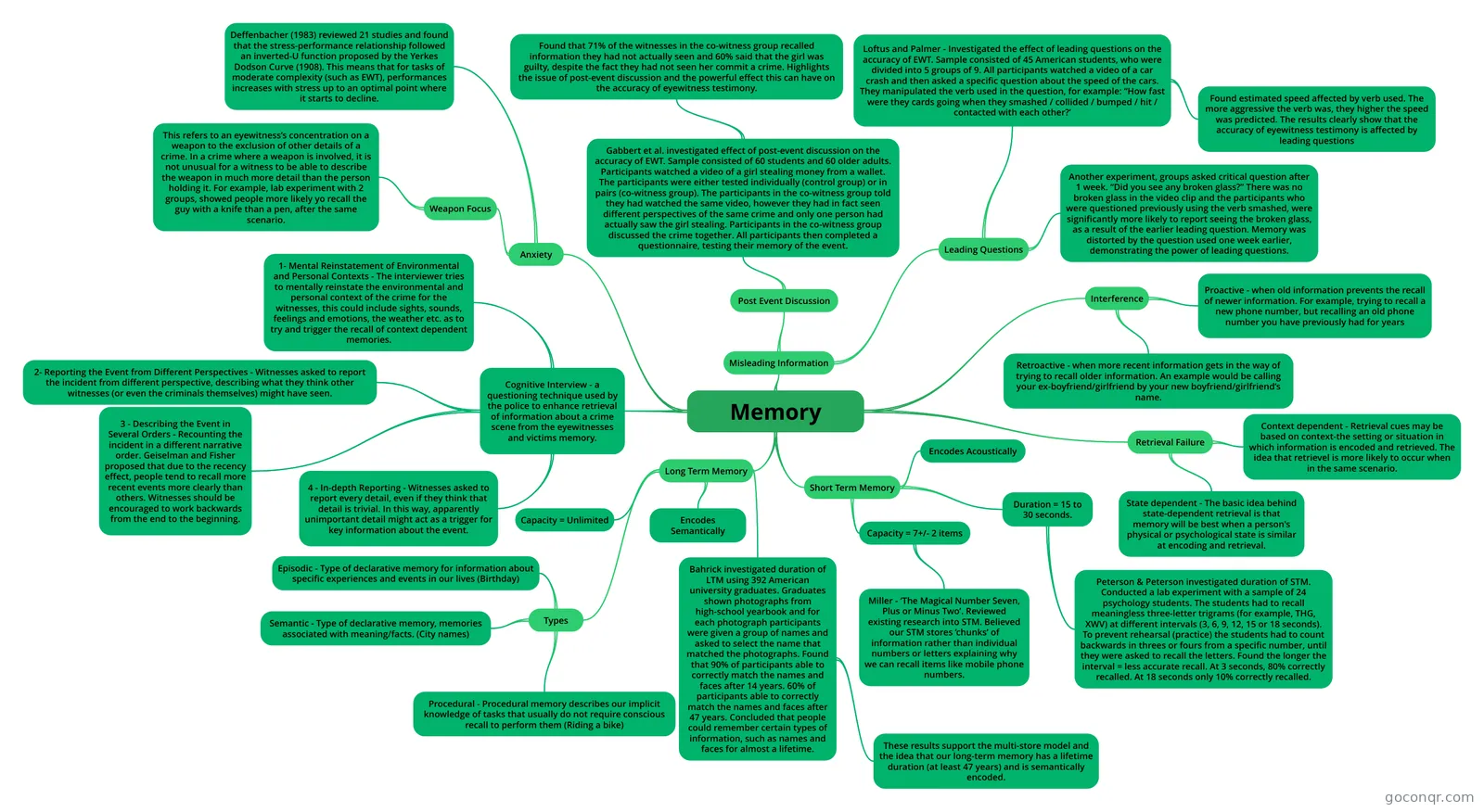
Mind map: Memory
Conteúdo do mapa
Memory
Short Term Memory
- Capacity = 7+/- 2 items
- Miller - ‘The Magical Number Seven, Plus or Minus Two’. Reviewed existing research into STM. Believed our STM stores ‘chunks’ of information rather than individual numbers or letters explaining why we can recall items like mobile phone numbers.
- Duration = 15 to 30 seconds.
- Peterson & Peterson investigated duration of STM. Conducted a lab experiment with a sample of 24 psychology students. The students had to recall meaningless three-letter trigrams (for example, THG, XWV) at different intervals (3, 6, 9, 12, 15 or 18 seconds). To prevent rehearsal (practice) the students had to count backwards in threes or fours from a specific number, until they were asked to recall the letters. Found the longer the interval = less accurate recall. At 3 seconds, 80% correctly recalled. At 18 seconds only 10% correctly recalled.
- Encodes Acoustically
- Capacity = 7+/- 2 items
Long Term Memory
- Encodes Semantically
- Capacity = Unlimited
- Bahrick investigated duration of LTM using 392 American university graduates. Graduates shown photographs from high-school yearbook and for each photograph participants were given a group of names and asked to select the name that matched the photographs. Found that 90% of participants able to correctly match the names and faces after 14 years. 60% of participants able to correctly match the names and faces after 47 years. Concluded that people could remember certain types of information, such as names and faces for almost a lifetime.
- These results support the multi-store model and the idea that our long-term memory has a lifetime duration (at least 47 years) and is semantically encoded.
- Types
- Episodic - Type of declarative memory for information about specific experiences and events in our lives (Birthday)
- Procedural - Procedural memory describes our implicit knowledge of tasks that usually do not require conscious recall to perform them (Riding a bike)
- Semantic - Type of declarative memory, memories associated with meaning/facts. (City names)
Misleading Information
- Leading Questions
- Loftus and Palmer - Investigated the effect of leading questions on the accuracy of EWT. Sample consisted of 45 American students, who were divided into 5 groups of 9. All participants watched a video of a car crash and then asked a specific question about the speed of the cars. They manipulated the verb used in the question, for example: “How fast were they cards going when they smashed / collided / bumped / hit / contacted with each other?’
- Found estimated speed affected by verb used. The more aggressive the verb was, they higher the speed was predicted. The results clearly show that the accuracy of eyewitness testimony is affected by leading questions
- Another experiment, groups asked critical question after 1 week. “Did you see any broken glass?” There was no broken glass in the video clip and the participants who were questioned previously using the verb smashed, were significantly more likely to report seeing the broken glass, as a result of the earlier leading question. Memory was distorted by the question used one week earlier, demonstrating the power of leading questions.
- Loftus and Palmer - Investigated the effect of leading questions on the accuracy of EWT. Sample consisted of 45 American students, who were divided into 5 groups of 9. All participants watched a video of a car crash and then asked a specific question about the speed of the cars. They manipulated the verb used in the question, for example: “How fast were they cards going when they smashed / collided / bumped / hit / contacted with each other?’
- Post Event Discussion
- Gabbert et al. investigated effect of post-event discussion on the accuracy of EWT. Sample consisted of 60 students and 60 older adults. Participants watched a video of a girl stealing money from a wallet. The participants were either tested individually (control group) or in pairs (co-witness group). The participants in the co-witness group told they had watched the same video, however they had in fact seen different perspectives of the same crime and only one person had actually saw the girl stealing. Participants in the co-witness group discussed the crime together. All participants then completed a questionnaire, testing their memory of the event.
- Found that 71% of the witnesses in the co-witness group recalled information they had not actually seen and 60% said that the girl was guilty, despite the fact they had not seen her commit a crime. Highlights the issue of post-event discussion and the powerful effect this can have on the accuracy of eyewitness testimony.
- Gabbert et al. investigated effect of post-event discussion on the accuracy of EWT. Sample consisted of 60 students and 60 older adults. Participants watched a video of a girl stealing money from a wallet. The participants were either tested individually (control group) or in pairs (co-witness group). The participants in the co-witness group told they had watched the same video, however they had in fact seen different perspectives of the same crime and only one person had actually saw the girl stealing. Participants in the co-witness group discussed the crime together. All participants then completed a questionnaire, testing their memory of the event.
- Leading Questions
Interference
- Retroactive - when more recent information gets in the way of trying to recall older information. An example would be calling your ex-boyfriend/girlfriend by your new boyfriend/girlfriend’s name.
- Proactive - when old information prevents the recall of newer information. For example, trying to recall a new phone number, but recalling an old phone number you have previously had for years
Retrieval Failure
- State dependent - The basic idea behind state-dependent retrieval is that memory will be best when a person's physical or psychological state is similar at encoding and retrieval.
- Context dependent - Retrieval cues may be based on context-the setting or situation in which information is encoded and retrieved. The idea that retrievel is more likely to occur when in the same scenario.
Cognitive Interview - a questioning technique used by the police to enhance retrieval of information about a crime scene from the eyewitnesses and victims memory.
- 1- Mental Reinstatement of Environmental and Personal Contexts - The interviewer tries to mentally reinstate the environmental and personal context of the crime for the witnesses, this could include sights, sounds, feelings and emotions, the weather etc. as to try and trigger the recall of context dependent memories.
- 2- Reporting the Event from Different Perspectives - Witnesses asked to report the incident from different perspective, describing what they think other witnesses (or even the criminals themselves) might have seen.
- 3 - Describing the Event in Several Orders - Recounting the incident in a different narrative order. Geiselman and Fisher proposed that due to the recency effect, people tend to recall more recent events more clearly than others. Witnesses should be encouraged to work backwards from the end to the beginning.
- 4 - In-depth Reporting - Witnesses asked to report every detail, even if they think that detail is trivial. In this way, apparently unimportant detail might act as a trigger for key information about the event.
Anxiety
- Deffenbacher (1983) reviewed 21 studies and found that the stress-performance relationship followed an inverted-U function proposed by the Yerkes Dodson Curve (1908). This means that for tasks of moderate complexity (such as EWT), performances increases with stress up to an optimal point where it starts to decline.
- Weapon Focus
- This refers to an eyewitness’s concentration on a weapon to the exclusion of other details of a crime. In a crime where a weapon is involved, it is not unusual for a witness to be able to describe the weapon in much more detail than the person holding it. For example, lab experiment with 2 groups, showed people more likely yo recall the guy with a knife than a pen, after the same scenario.
Informações
- Descrição
- Mapa Mental sobre Memory, criado por Toni Bagguley em 12-02-2019.
- Criado por
- Toni Bagguley
- Visualizações
- 0
- Avaliação