
Mapa mental
Classic Study: Rosenhan (1973)
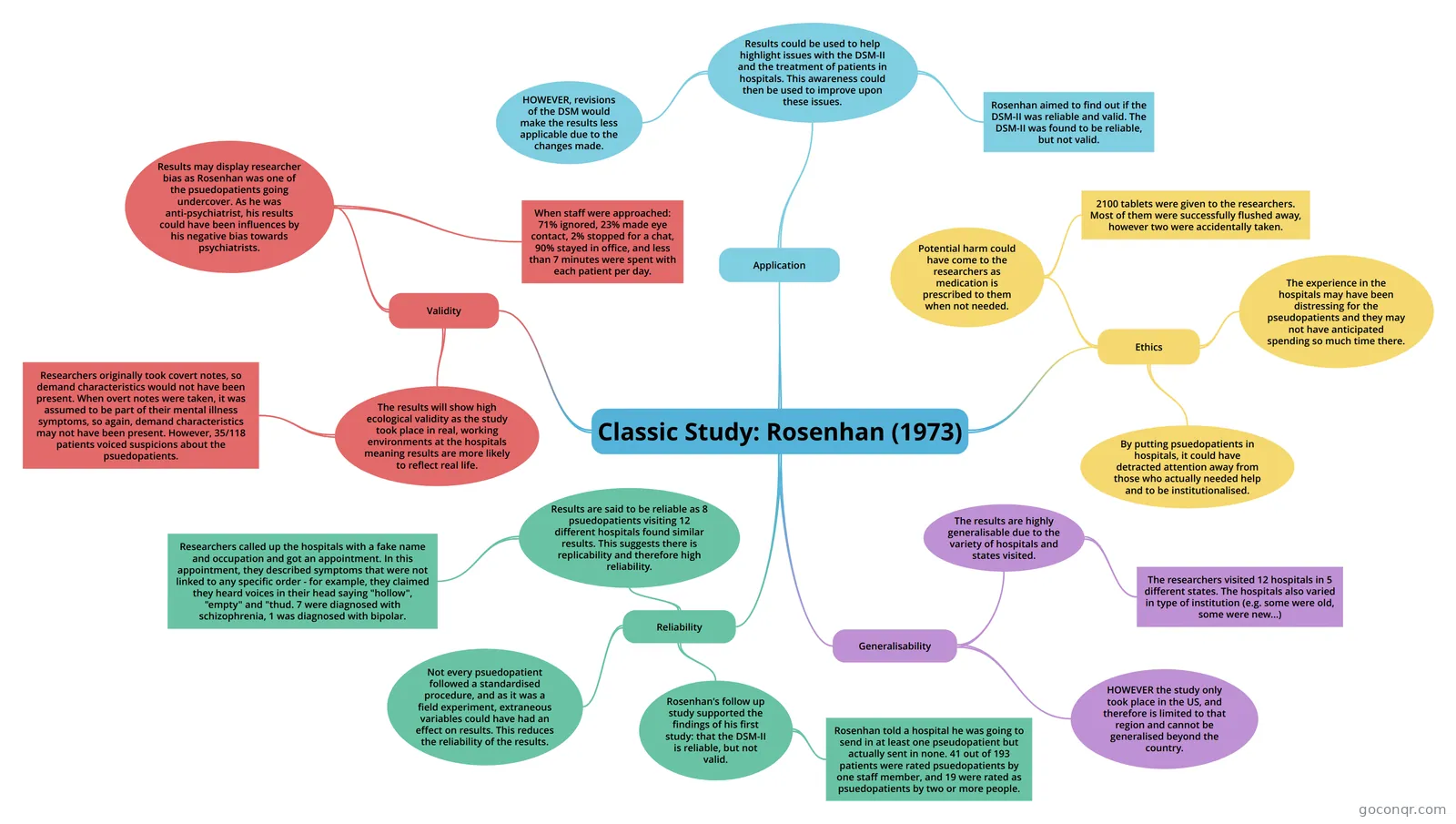
Mind map: Rosenhan (1973) classic study
Conteúdo do mapa
Classic Study: Rosenhan (1973)
Generalisability
- The results are highly generalisable due to the variety of hospitals and states visited.
- The researchers visited 12 hospitals in 5 different states. The hospitals also varied in type of institution (e.g. some were old, some were new...)
- HOWEVER the study only took place in the US, and therefore is limited to that region and cannot be generalised beyond the country.
- The results are highly generalisable due to the variety of hospitals and states visited.
Reliability
- Results are said to be reliable as 8 psuedopatients visiting 12 different hospitals found similar results. This suggests there is replicability and therefore high reliability.
- Researchers called up the hospitals with a fake name and occupation and got an appointment. In this appointment, they described symptoms that were not linked to any specific order - for example, they claimed they heard voices in their head saying "hollow", "empty" and "thud. 7 were diagnosed with schizophrenia, 1 was diagnosed with bipolar.
- Rosenhan's follow up study supported the findings of his first study: that the DSM-II is reliable, but not valid.
- Rosenhan told a hospital he was going to send in at least one pseudopatient but actually sent in none. 41 out of 193 patients were rated psuedopatients by one staff member, and 19 were rated as psuedopatients by two or more people.
- Not every psuedopatient followed a standardised procedure, and as it was a field experiment, extraneous variables could have had an effect on results. This reduces the reliability of the results.
- Results are said to be reliable as 8 psuedopatients visiting 12 different hospitals found similar results. This suggests there is replicability and therefore high reliability.
Application
- Results could be used to help highlight issues with the DSM-II and the treatment of patients in hospitals. This awareness could then be used to improve upon these issues.
- HOWEVER, revisions of the DSM would make the results less applicable due to the changes made.
- Rosenhan aimed to find out if the DSM-II was reliable and valid. The DSM-II was found to be reliable, but not valid.
- Results could be used to help highlight issues with the DSM-II and the treatment of patients in hospitals. This awareness could then be used to improve upon these issues.
Ethics
- The experience in the hospitals may have been distressing for the pseudopatients and they may not have anticipated spending so much time there.
- Potential harm could have come to the researchers as medication is prescribed to them when not needed.
- 2100 tablets were given to the researchers. Most of them were successfully flushed away, however two were accidentally taken.
- By putting psuedopatients in hospitals, it could have detracted attention away from those who actually needed help and to be institutionalised.
Validity
- The results will show high ecological validity as the study took place in real, working environments at the hospitals meaning results are more likely to reflect real life.
- Researchers originally took covert notes, so demand characteristics would not have been present. When overt notes were taken, it was assumed to be part of their mental illness symptoms, so again, demand characteristics may not have been present. However, 35/118 patients voiced suspicions about the psuedopatients.
- Results may display researcher bias as Rosenhan was one of the psuedopatients going undercover. As he was anti-psychiatrist, his results could have been influences by his negative bias towards psychiatrists.
- When staff were approached: 71% ignored, 23% made eye contact, 2% stopped for a chat, 90% stayed in office, and less than 7 minutes were spent with each patient per day.
- The results will show high ecological validity as the study took place in real, working environments at the hospitals meaning results are more likely to reflect real life.
Informações
- Descrição
- A level Psychology (Clinical Psychology) Mapa Mental sobre Classic Study: Rosenhan (1973), criado por Katie Greensted em 30-03-2019.
- Criado por
- Katie Greensted
- Visualizações
- 3
- Avaliação