
Mapa mental
Eating Behaviour
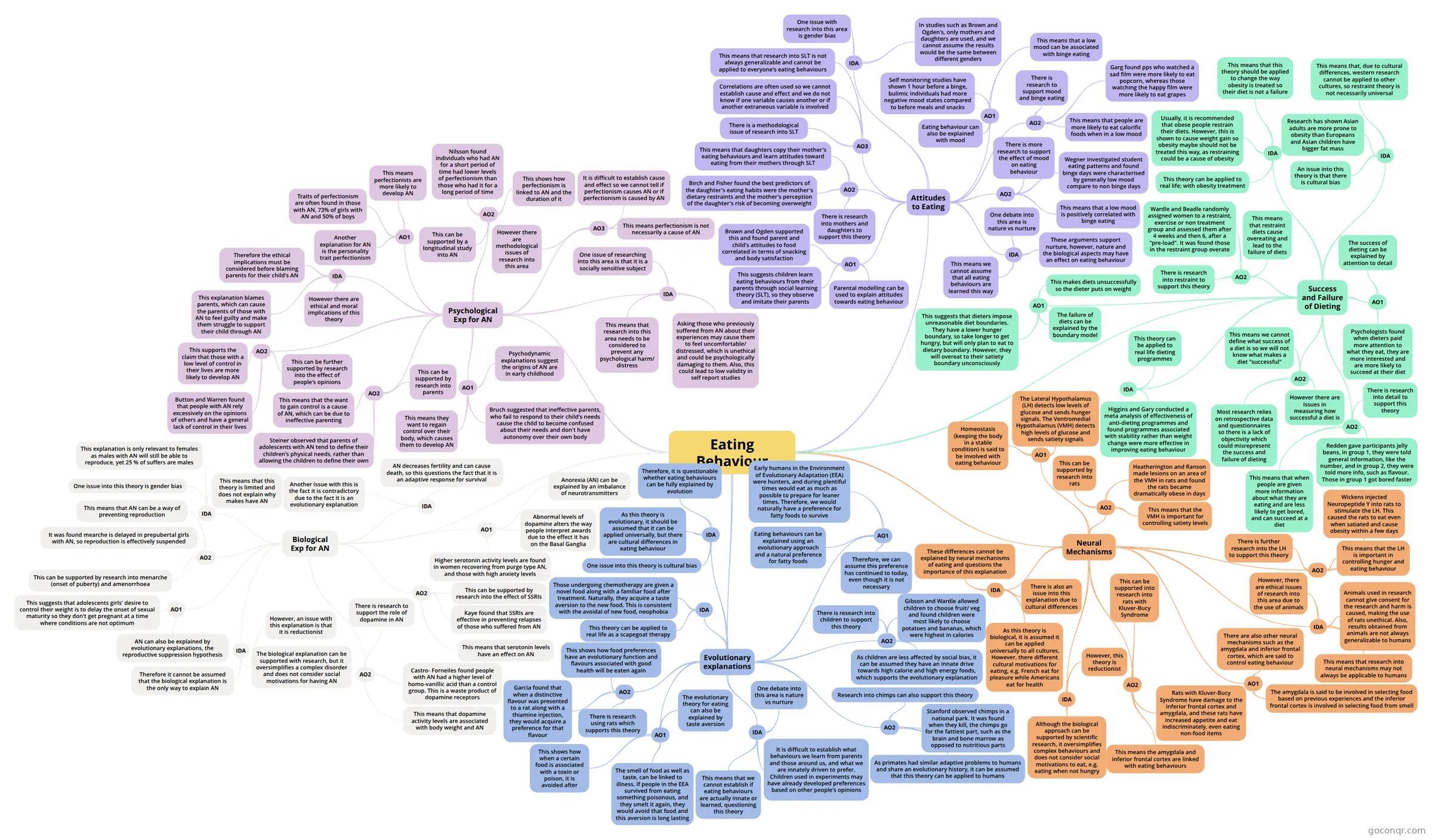
Mind map: eating behaviour
Conteúdo do mapa
Eating Behaviour
Success and Failure of Dieting
- AO1
- The failure of diets can be explained by the boundary model
- This suggests that dieters impose unreasonable diet boundaries. They have a lower hunger boundary, so take longer to get hungry, but will only plan to eat to dietary boundary. However, they will overeat to their satiety boundary unconsciously
- This makes diets unsuccessfully so the dieter puts on weight
- AO2
- There is research into restraint to support this theory
- Wardle and Beadle randomly assigned women to a restraint, exercise or non treatment group and assessed them after 4 weeks and then 6, after a "pre-load". It was found those in the restraint group overate
- This means that restraint diets cause overeating and lead to the failure of diets
- IDA
- This theory can be applied to real life; with obesity treatment
- Usually, it is recommended that obese people restrain their diets. However, this is shown to cause weight gain so obesity maybe should not be treated this way, as restraining could be a cause of obesity
- This means that this theory should be applied to change the way obesity is treated so their diet is not a failure
- IDA
- An issue into this theory is that there is cultural bias
- Research has shown Asian adults are more prone to obesity than Europeans and Asian children have bigger fat mass
- This means that, due to cultural differences, western research cannot be applied to other cultures, so restraint theory is not necessarily universal
- AO1
- The success of dieting can be explained by attention to detail
- Psychologists found when dieters paid more attention to what they eat, they are more interested and are more likely to succeed at their diet
- AO2
- There is research into detail to support this theory
- Redden gave participants jelly beans, in group 1, they were told general information, like the number, and in group 2, they were told more info, such as flavour. Those in group 1 got bored faster
- This means that when people are given more information about what they are eating and are less likely to get bored, and can succeed at a diet
- AO2
- However there are issues in measuring how successful a diet is
- Most research relies on retrospective data and questionnaires so there is a lack of objectivity which could misrepresent the success and failure of dieting
- This means we cannot define what success of a diet is so we will not know what makes a diet "successful"
- IDA
- This theory can be applied to real life dieting programmes
- Higgins and Gary conducted a meta analysis of effectiveness of anti-dieting programmes and found programmes associated with stability rather than weight change were more effective in improving eating behaviour
- AO1
Neural Mechanisms
- AO1
- Homeostasis (keeping the body in a stable condition) is said to be involved with eating behaviour
- The Lateral Hypothalamus (LH) detects low levels of glucose and sends hunger signals. The Ventromedial Hypothalamus (VMH) detects high levels of glucose and sends satiety signals
- IDA
- However, there are ethical issues of research into this area due to the use of animals
- Animals used in research cannot give consent for the research and harm is caused, making the use of rats unethical. Also, results obtained from animals are not always generalizable to humans
- This means that research into neural mechanisms may not always be applicable to humans
- AO2
- This can be supported by research into rats
- Heatherington and Ranson made lesions on an area of the VMH in rats and found the rats became dramatically obese in days
- This means that the VMH is important for controlling satiety levels
- AO2
- There is further research into the LH to support this theory
- Wickens injected Neuropeptide Y into rats to stimulate the LH. This caused the rats to eat even when satiated and cause obesity within a few days
- This means that the LH is important in controlling hunger and eating behaviour
- AO1
- There are also other neural mechanisms such as the amygdala and inferior frontal cortex, which are said to control eating behaviour
- The amygdala is said to be involved in selecting food based on previous experiences and the inferior frontal cortex is involved in selecting food from smell
- AO2
- This can be supported into research into rats with Kluver-Bucy Syndrome
- Rats with Kluver-Bucy Syndrome have damage to the inferior frontal cortex and amygdala, and these rats have increased appetite and eat indiscriminately, even eating non-food items
- This means the amygdala and inferior frontal cortex are linked with eating behaviours
- IDA
- However, this theory is reductionist
- Although the biological approach can be supported by scientific research, it oversimplifies complex behaviours and does not consider social motivations to eat, e.g. eating when not hungry
- IDA
- There is also an issue into this explanation due to cultural differences
- As this theory is biological, it is assumed it can be applied universally to all cultures. However, there different cultural motivations for eating, e.g. French eat for pleasure while Americans eat for health
- These differences cannot be explained by neural mechanisms of eating and questions the importance of this explanation
- AO1
Evolutionary explanations
- AO2
- There is research into children to support this theory
- Gibson and Wardle allowed children to choose fruit/ veg and found children were most likely to choose potatoes and bananas, which were highest in calories
- As children are less affected by social bias, it can be assumed they have an innate drive towards high calorie and high energy foods, which supports the evolutionary explanation
- AO1
- Eating behaviours can be explained using an evolutionary approach and a natural preference for fatty foods
- Early humans in the Environment of Evolutionary Adaptation (EEA) were hunters, and during plentiful times would eat as much as possible to prepare for leaner times. Therefore, we would naturally have a preference for fatty foods to survive
- Therefore, we can assume this preference has continued to today, even though it is not necessary
- AO2
- Research into chimps can also support this theory
- Stanford observed chimps in a national park. It was found when they kill, the chimps go for the fattiest part, such as the brain and bone marrow as opposed to nutritious parts
- As primates had similar adaptive problems to humans and share an evolutionary history, it can be assumed that this theory can be applied to humans
- IDA
- One debate into this area is nature vs nurture
- It is difficult to establish what behaviours we learn from parents and those around us, and what we are innately driven to prefer. Children used in experiments may have already developed preferences based on other people's opinions
- This means that we cannot establish if eating behaviours are actually innate or learned, questioning this theory
- AO1
- The evolutionary theory for eating can also be explained by taste aversion
- The smell of food as well as taste, can be linked to illness. If people in the EEA survived from eating something poisonous, and they smelt it again, they would avoid that food and this aversion is long lasting
- This shows how when a certain food is associated with a toxin or poison, it is avoided after
- AO2
- There is research using rats which supports this theory
- Garcia found that when a distinctive flavour was presented to a rat along with a thiamine injection, they would acquire a preference for that flavour
- This shows how food preferences have an evolutionary function and flavours associated with good health will be eaten again
- IDA
- This theory can be applied to real life as a scapegoat therapy
- Those undergoing chemotherapy are given a novel food along with a familiar food after treatment. Naturally, they acquire a taste aversion to the new food. This is consistent with the avoidal of new food, neophobia
- IDA
- One issue into this theory is cultural bias
- As this theory is evolutionary, it should be assumed that it can be applied universally, but there are cultural differences in eating behaviour
- Therefore, it is questionable whether eating behaviours can be fully explained by evolution
- AO2
Biological Exp for AN
- AO1
- Anorexia (AN) can be explained by an imbalance of neurotransmitters
- Abnormal levels of dopamine alters the way people interpret awards due to the effect it has on the Basal Ganglia
- Higher serotonin activity levels are found in women recovering from purge type AN, and those with high anxiety levels
- AO2
- This can be supported by research into the effect of SSRIs
- Kaye found that SSRIs are effective in preventing relapses of those who suffered from AN
- This means that serotonin levels have an effect on AN
- AO2
- There is research to support the role of dopamine in AN
- Castro- Forneiles found people with AN had a higher level of homo-vanillic acid than a control group. This is a waste product of dopamine receptors
- This means that dopamine activity levels are associated with body weight and AN
- IDA
- However, an issue with this explanation is that it is reductionist
- The biological explanation can be supported with research, but it oversimplifies a complex disorder and does not consider social motivations for having AN
- Therefore it cannot be assumed that the biological explanation is the only way to explain AN
- AO1
- AN can also be explained by evolutionary explanations, the reproductive suppression hypothesis
- This suggests that adolescents girls' desire to control their weight is to delay the onset of sexual maturity so they don't get pregnant at a time where conditions are not optimum
- AO2
- This can be supported by research into menarche (onset of puberty) and amenorrhoea
- It was found mearche is delayed in prepubertal girls with AN, so reproduction is effectively suspended
- This means that AN can be a way of preventing reproduction
- IDA
- One issue into this theory is gender bias
- This explanation is only relevant to females as males with AN will still be able to reproduce, yet 25 % of suffers are males
- This means that this theory is limited and does not explain why makes have AN
- IDA
- Another issue with this is the fact it is contradictory due to the fact it is an evolutionary explanation
- AN decreases fertility and can cause death, so this questions the fact that it is an adaptive response for survival
- AO1
Psychological Exp for AN
- AO1
- Psychodynamic explanations suggest the origins of AN are in early childhood
- Bruch suggested that ineffective parents, who fail to respond to their child's needs cause the child to become confused about their needs and don't have autonomy over their own body
- This means they want to regain control over their body, which causes them to develop AN
- AO2
- This can be supported by research into parents
- Steiner observed that parents of adolescents with AN tend to define their children's physical needs, rather than allowing the children to define their own
- This means that the want to gain control is a cause of AN, which can be due to ineffective parenting
- AO2
- This can be further supported by research into the effect of people's opinions
- Button and Warren found that people with AN rely excessively on the opinions of others and have a general lack of control in their lives
- This supports the claim that those with a low level of control in their lives are more likely to develop AN
- AO1
- Another explanation for AN is the personality trait perfectionism
- Traits of perfectionism are often found in those with AN, 73% of girls with AN and 50% of boys
- This means perfectionists are more likely to develop AN
- AO2
- This can be supported by a longitudinal study into AN
- Nilsson found individuals who had AN for a short period of time had lower levels of perfectionism than those who had it for a long period of time
- This shows how perfectionism is linked to AN and the duration of it
- AO3
- However there are methodological issues of research into this area
- It is difficult to establish cause and effect so we cannot tell if perfectionism causes AN or if perfectionism is caused by AN
- This means perfectionism is not necessarily a cause of AN
- IDA
- However there are ethical and moral implications of this theory
- This explanation blames parents, which can cause the parents of those with AN to feel guilty and make them struggle to support their child through AN
- Therefore the ethical implications must be considered before blaming parents for their child's AN
- IDA
- One issue of researching into this area is that it is a socially sensitive subject
- Asking those who previously suffered from AN about their experiences may cause them to feel uncomfortable/ distressed, which is unethical and could be psychologically damaging to them. Also, this could lead to low validity in self report studies
- This means that research into this area needs to be considered to prevent any psychological harm/ distress
- AO1
Attitudes to Eating
- AO1
- Parental modelling can be used to explain attitudes towards eating behaviour
- This suggests children learn eating behaviours from their parents through social learning theory (SLT), so they observe and imitate their parents
- Brown and Ogden supported this and found parent and child's attitudes to food correlated in terms of snacking and body satisfaction
- AO2
- There is research into mothers and daughters to support this theory
- Birch and Fisher found the best predictors of the daughter's eating habits were the mother's dietary restraints and the mother's perception of the daughter's risk of becoming overweight
- This means that daughters copy their mother's eating behaviours and learn attitudes toward eating from their mothers through SLT
- AO3
- There is a methodological issue of research into SLT
- Correlations are often used so we cannot establish cause and effect and we do not know if one variable causes another or if another extraneous variable is involved
- This means that research into SLT is not always generalizable and cannot be applied to everyone's eating behaviours
- IDA
- One issue with research into this area is gender bias
- In studies such as Brown and Ogden's, only mothers and daughters are used, and we cannot assume the results would be the same between different genders
- AO1
- Eating behaviour can also be explained with mood
- Self monitoring studies have shown 1 hour before a binge, bulimic individuals had more negative mood states compared to before meals and snacks
- This means that a low mood can be associated with binge eating
- AO2
- There is research to support mood and binge eating
- Garg found pps who watched a sad film were more likely to eat popcorn, whereas those watching the happy film were more likely to eat grapes
- This means that people are more likely to eat calorific foods when in a low mood
- AO2
- There is more research to support the effect of mood on eating behaviour
- Wegner investigated student eating patterns and found binge days were characterised by generally low mood compare to non binge days
- This means that a low mood is positively correlated with binge eating
- IDA
- One debate into this area is nature vs nurture
- These arguments support nurture, however, nature and the biological aspects may have an effect on eating behaviour
- This means we cannot assume that all eating behaviours are learned this way
- AO1
Informações
- Descrição
- AS Psychology Mapa Mental sobre Eating Behaviour, criado por singn014 em 26-02-2015.
- Criado por
- singn014
- Visualizações
- 0
- Avaliação
Mais sobre Attitudes to food and eating