
Mapa mental
Memory.
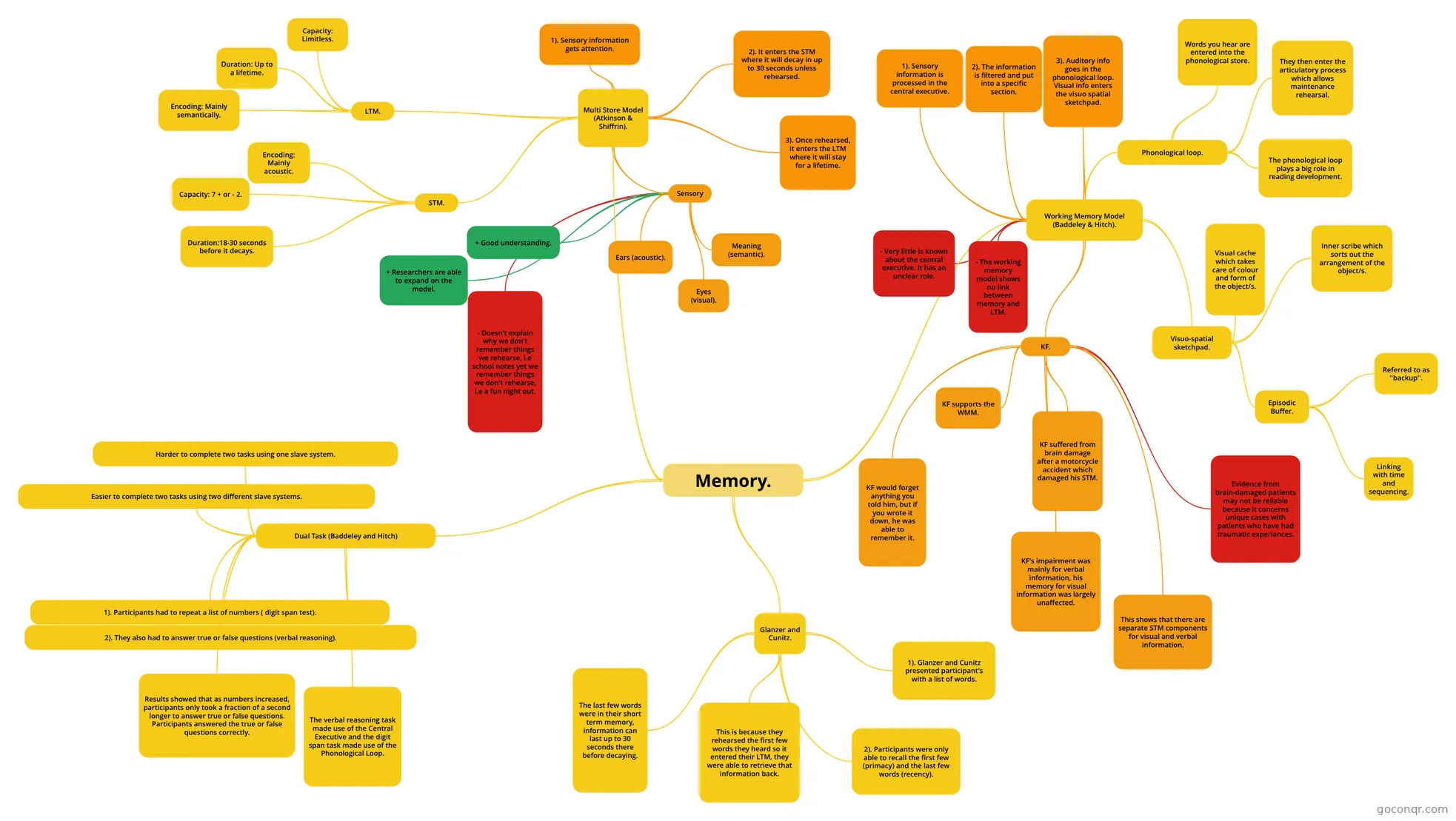
Mind map: Memory models
Conteúdo do mapa
Memory.
Multi Store Model (Atkinson & Shiffrin).
- 1). Sensory information gets attention.
- 2). It enters the STM where it will decay in up to 30 seconds unless rehearsed.
- 3). Once rehearsed, it enters the LTM where it will stay for a lifetime.
- Sensory
- Ears (acoustic).
- Eyes (visual).
- Meaning (semantic).
- + Good understanding.
- + Researchers are able to expand on the model.
- - Doesn't explain why we don't remember things we rehearse, i.e school notes yet we remember things we don't rehearse, i.e a fun night out.
- LTM.
- Capacity: Limitless.
- Duration: Up to a lifetime.
- Encoding: Mainly semantically.
- STM.
- Capacity: 7 + or - 2.
- Duration:18-30 seconds before it decays.
- Encoding: Mainly acoustic.
Working Memory Model (Baddeley & Hitch).
- 1). Sensory information is processed in the central executive.
- 2). The information is filtered and put into a specific section.
- 3). Auditory info goes in the phonological loop. Visual info enters the visuo spatial sketchpad.
- Phonological loop.
- Words you hear are entered into the phonological store.
- They then enter the articulatory process which allows maintenance rehearsal.
- The phonological loop plays a big role in reading development.
- Visuo-spatial sketchpad.
- Visual cache which takes care of colour and form of the object/s.
- Inner scribe which sorts out the arrangement of the object/s.
- Episodic Buffer.
- Linking with time and sequencing.
- Referred to as ''backup''.
- KF.
- KF supports the WMM.
- KF suffered from brain damage after a motorcycle accident which damaged his STM.
- KF's impairment was mainly for verbal information, his memory for visual information was largely unaffected.
- KF would forget anything you told him, but if you wrote it down, he was able to remember it.
- This shows that there are separate STM components for visual and verbal information.
- Evidence from brain-damaged patients may not be reliable because it concerns unique cases with patients who have had traumatic experiences.
- - Very little is known about the central executive. It has an unclear role.
- - The working memory model shows no link between memory and LTM.
Glanzer and Cunitz.
- 1). Glanzer and Cunitz presented participant's with a list of words.
- 2). Participants were only able to recall the first few (primacy) and the last few words (recency).
- This is because they rehearsed the first few words they heard so it entered their LTM, they were able to retrieve that information back.
- The last few words were in their short term memory, information can last up to 30 seconds there before decaying.
Dual Task (Baddeley and Hitch)
- 1). Participants had to repeat a list of numbers ( digit span test).
- 2). They also had to answer true or false questions (verbal reasoning).
- Results showed that as numbers increased, participants only took a fraction of a second longer to answer true or false questions. Participants answered the true or false questions correctly.
- The verbal reasoning task made use of the Central Executive and the digit span task made use of the Phonological Loop.
- Harder to complete two tasks using one slave system.
- Easier to complete two tasks using two different slave systems.
Informações
- Descrição
- A level Psychology AQA memory mind map.
- Criado por
- Khashayar Khani
- Visualizações
- 154
- Tags
- Avaliação