
Mapa mental
Labour Reforms of 45-51
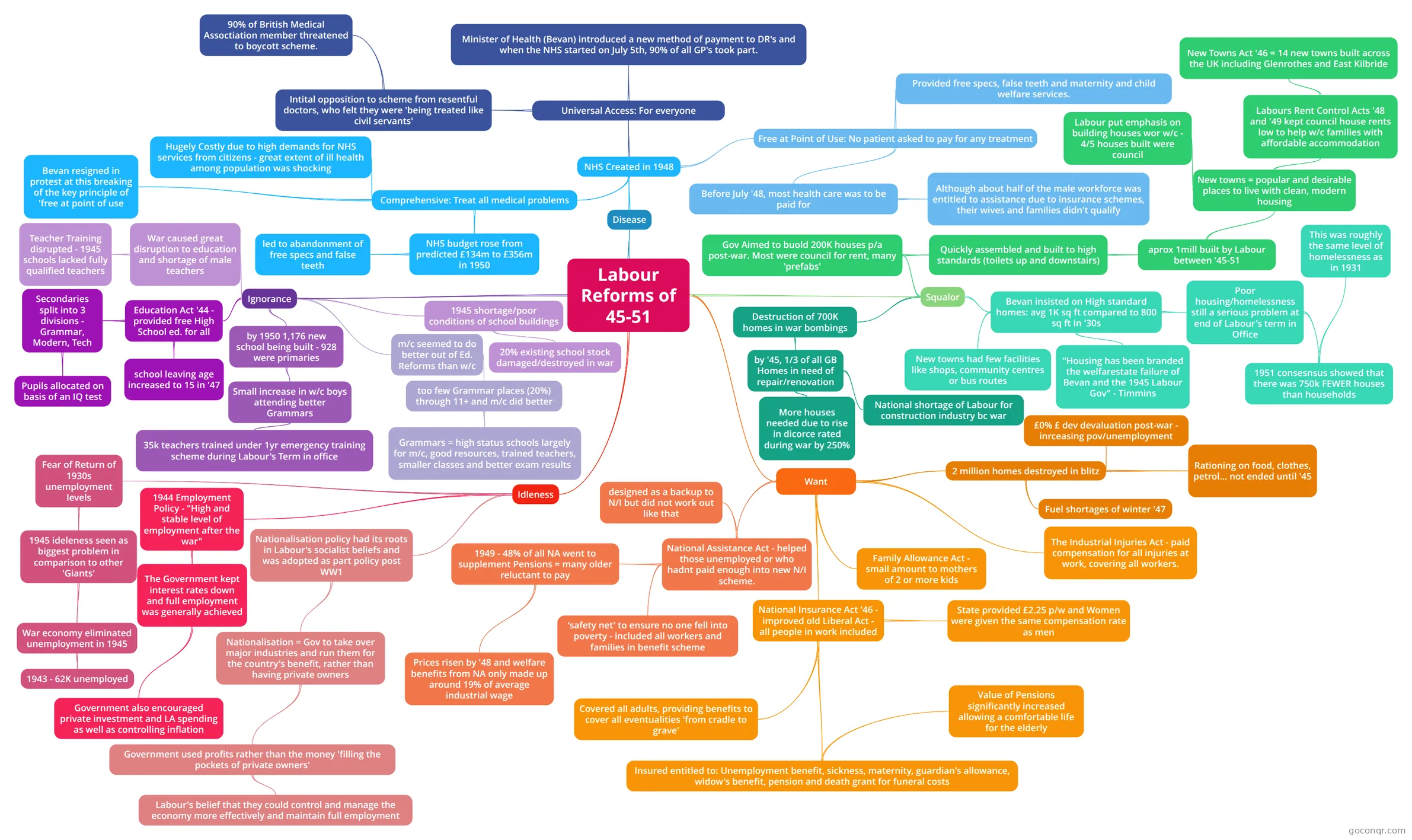
Mind map: Labour reforms 1945-51
Conteúdo do mapa
Labour Reforms of 45-51
Disease
- NHS Created in 1948
- Comprehensive: Treat all medical problems
- Hugely Costly due to high demands for NHS services from citizens - great extent of ill health among population was shocking
- NHS budget rose from predicted £134m to £356m in 1950
- led to abandonment of free specs and false teeth
- Bevan resigned in protest at this breaking of the key principle of 'free at point of use
- Universal Access: For everyone
- Intital opposition to scheme from resentful doctors, who felt they were 'being treated like civil servants'
- 90% of British Medical Assoctiation member threatened to boycott scheme.
- Minister of Health (Bevan) introduced a new method of payment to DR's and when the NHS started on July 5th, 90% of all GP's took part.
- Intital opposition to scheme from resentful doctors, who felt they were 'being treated like civil servants'
- Free at Point of Use: No patient asked to pay for any treatment
- Before July '48, most health care was to be paid for
- Although about half of the male workforce was entitled to assistance due to insurance schemes, their wives and families didn't qualify
- Provided free specs, false teeth and maternity and child welfare services.
- Before July '48, most health care was to be paid for
- Comprehensive: Treat all medical problems
- NHS Created in 1948
Squalor
- Gov Aimed to buold 200K houses p/a post-war. Most were council for rent, many 'prefabs'
- Quickly assembled and built to high standards (toilets up and downstairs)
- aprox 1mill built by Labour between '45-51
- New towns = popular and desirable places to live with clean, modern housing
- Labour put emphasis on building houses wor w/c - 4/5 houses built were council
- Labours Rent Control Acts '48 and '49 kept council house rents low to help w/c families with affordable accommodation
- New Towns Act '46 = 14 new towns built across the UK including Glenrothes and East Kilbride
- New towns = popular and desirable places to live with clean, modern housing
- aprox 1mill built by Labour between '45-51
- Quickly assembled and built to high standards (toilets up and downstairs)
- Destruction of 700K homes in war bombings
- by '45, 1/3 of all GB Homes in need of repair/renovation
- National shortage of Labour for construction industry bc war
- More houses needed due to rise in dicorce rated during war by 250%
- by '45, 1/3 of all GB Homes in need of repair/renovation
- Bevan insisted on High standard homes: avg 1K sq ft compared to 800 sq ft in '30s
- Poor housing/homelessness still a serious problem at end of Labour's term in Office
- 1951 consesnsus showed that there was 750k FEWER houses than households
- This was roughly the same level of homelessness as in 1931
- 1951 consesnsus showed that there was 750k FEWER houses than households
- New towns had few facilities like shops, community centres or bus routes
- "Housing has been branded the welfarestate failure of Bevan and the 1945 Labour Gov" - Timmins
- Poor housing/homelessness still a serious problem at end of Labour's term in Office
- Gov Aimed to buold 200K houses p/a post-war. Most were council for rent, many 'prefabs'
Ignorance
- War caused great disruption to education and shortage of male teachers
- Teacher Training disrupted - 1945 schools lacked fully qualified teachers
- 1945 shortage/poor conditions of school buildings
- 20% existing school stock damaged/destroyed in war
- Education Act '44 - provided free High School ed. for all
- Secondaries split into 3 divisions - Grammar, Modern, Tech
- Pupils allocated on basis of an IQ test
- school leaving age increased to 15 in '47
- Secondaries split into 3 divisions - Grammar, Modern, Tech
- by 1950 1,176 new school being built - 928 were primaries
- Small increase in w/c boys attending better Grammars
- 35k teachers trained under 1yr emergency training scheme during Labour's Term in office
- Small increase in w/c boys attending better Grammars
- m/c seemed to do better out of Ed. Reforms than w/c
- too few Grammar places (20%) through 11+ and m/c did better
- Grammars = high status schools largely for m/c, good resources, trained teachers, smaller classes and better exam results
- too few Grammar places (20%) through 11+ and m/c did better
- War caused great disruption to education and shortage of male teachers
Idleness
- Fear of Return of 1930s unemployment levels
- 1945 ideleness seen as biggest problem in comparison to other 'Giants'
- War economy eliminated unemployment in 1945
- 1943 - 62K unemployed
- War economy eliminated unemployment in 1945
- 1945 ideleness seen as biggest problem in comparison to other 'Giants'
- 1944 Employment Policy - "High and stable level of employment after the war"
- The Government kept interest rates down and full employment was generally achieved
- Government also encouraged private investment and LA spending as well as controlling inflation
- The Government kept interest rates down and full employment was generally achieved
- Nationalisation policy had its roots in Labour's socialist beliefs and was adopted as part policy post WW1
- Nationalisation = Gov to take over major industries and run them for the country's benefit, rather than having private owners
- Government used profits rather than the money 'filling the pockets of private owners'
- Labour's belief that they could control and manage the economy more effectively and maintain full employment
- Government used profits rather than the money 'filling the pockets of private owners'
- Nationalisation = Gov to take over major industries and run them for the country's benefit, rather than having private owners
- Fear of Return of 1930s unemployment levels
Want
- 2 million homes destroyed in blitz
- £0% £ dev devaluation post-war - inrceasing pov/unemployment
- Rationing on food, clothes, petrol... not ended until '45
- Fuel shortages of winter '47
- Family Allowance Act - small amount to mothers of 2 or more kids
- The Industrial Injuries Act - paid compensation for all injuries at work, covering all workers.
- National Insurance Act '46 - improved old Liberal Act - all people in work included
- State provided £2.25 p/w and Women were given the same compensation rate as men
- Covered all adults, providing benefits to cover all eventualities 'from cradle to grave'
- Insured entitled to: Unemployment benefit, sickness, maternity, guardian's allowance, widow's benefit, pension and death grant for funeral costs
- Value of Pensions significantly increased allowing a comfortable life for the elderly
- National Assistance Act - helped those unemployed or who hadnt paid enough into new N/I scheme.
- 'safety net' to ensure no one fell into poverty - included all workers and families in benefit scheme
- designed as a backup to N/I but did not work out like that
- 1949 - 48% of all NA went to supplement Pensions = many older reluctant to pay
- Prices risen by '48 and welfare benefits from NA only made up around 19% of average industrial wage
- 2 million homes destroyed in blitz
Informações
- Descrição
- higher history Mapa Mental sobre Labour Reforms of 45-51, criado por Julia falconer em 03-04-2015.
- Criado por
- Julia falconer
- Visualizações
- 73
- Tags
- Avaliação