
Mapa mental
biodiversity
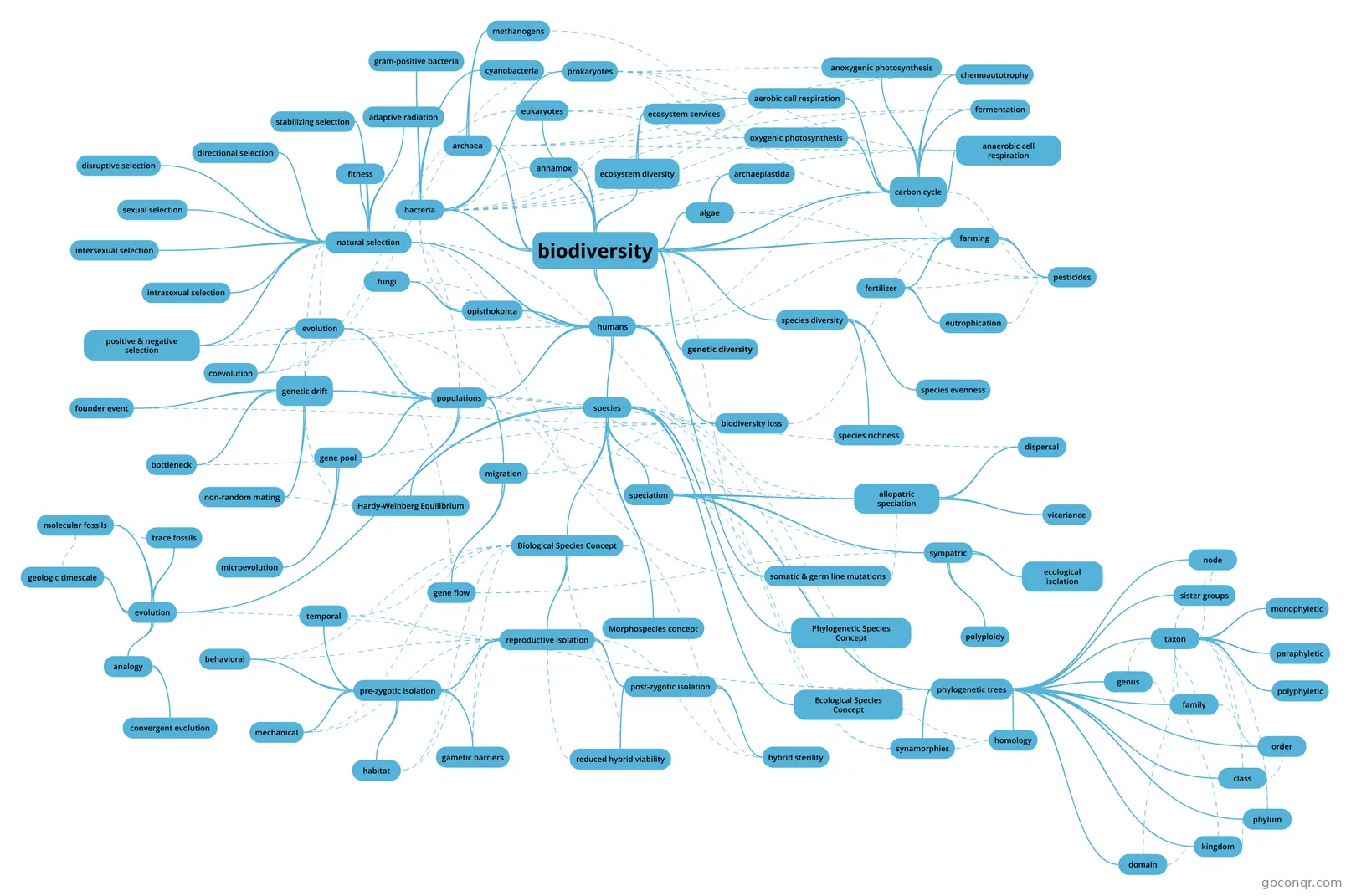
Mind map: biodiversity
Conteúdo do mapa
biodiversity
humans
- biodiversity loss
- opisthokonta
- fungi
- species
- a group that is capable of sharing alleles
- speciation
- occurs when two populations are no longer able to produce fertile offspring
- allopatric speciation
- populations which are geographically separated from each other
- dispersal
- individuals colonize a distant place far from the main population
- vicariance
- a population splits due to a geographic barrier
- sympatric
- speciation with gene flow between diverging populations
- ecological isolation
- polyploidy
- doubling of cells during cell division
- phylogenetic trees
- speciation can be thought as a process of branching & a phylogenetic tree is a hypothesis about the evolutionary history of a species
- node
- represents the most recent common ancestor of 2 descendant species on a tree
- sister groups
- a phylogenetic tree is simply a set of sister group relationships
- taxon
- formal means of naming groups
- monophyletic
- all members share a single common ancestor that is not shared with any other species
- paraphyletic
- includes some, but not all, of the descendants of a common ancestor
- polyphyletic
- grouping that does not include the last common ancestor of all members
- genus
- larger, more inclusive branch of the tree
- family
- larger, more inclusive branch of a tree
- class
- orders form a class
- order
- formed from a family
- phylum
- formed from classes
- kingdom
- formed from a phylum
- domain
- the three largest limbs of the entire tree
- homology
- characters that are similar because of a descent from a common ancestor
- synamorphies
- shared derived characteristics
- Biological Species Concept
- one or more populations whose members interbreed under natural conditions and produce fertile offspring
- reproductive isolation
- pre-zygotic isolation
- temporal
- isolation as a function of time
- behavioral
- behavior differs between two populations
- mechanical
- anatomical incompatibility
- habitat
- gametic barriers
- prevention of wrong sperm egg combo
- temporal
- post-zygotic isolation
- reduced hybrid viability
- lower chance of survival for organisms whose parents have incompatible genes
- hybrid sterility
- adult species fail to develop functional gametes and are sterile
- reduced hybrid viability
- pre-zygotic isolation
- Morphospecies concept
- members of the same species usually have similar DNA sequences that are distinct from those of other species
- Ecological Species Concept
- two species cannot coexist in the same location if they are too similar because it causes competition for resources
- Phylogenetic Species Concept
- members of a species all share a common ancestor and fate
- evolution
- analogy
- similarities due to independent adaptation by different species
- convergent evolution
- result of convergent evolution is an analogy
- trace fossils
- preserve a record of behavior and anatomy
- molecular fossils
- helps document organisms that rarely form conventional fossils
- geologic timescale
- series of time divisions that mark Earth's history
- analogy
- populations
- migration
- gene flow
- random genetic exchange of alleles among populations due to migration
- gene flow
- genetic drift
- founder event
- form of reduction in population size
- bottleneck
- form of reduction in population size
- non-random mating
- result of genetic drift
- founder event
- gene pool
- all the genes in a population
- microevolution
- changes in gene pool
- evolution
- change in allele or genotype frequencies over time
- coevolution
- prokaryotes have coevolved with eukaryotes
- Hardy-Weinberg Equilibrium
- populations meet Hardy-Weinberg equilibrium when certain conditions are met in a population
- migration
- somatic & germ line mutations
- occurs in body's cells
- natural selection
- positive & negative selection
- variances in population
- fitness
- measured as the fit between organisms and its environment
- stabilizing selection
- directional selection
- disruptive selection
- sexual selection
- MODES OF NATURAL SELECTION
- intersexual selection
- intrasexual selection
- adaptive radiation
- unusual rapid evolutionary diversification in which natural selection accelerates the rates of both speciation and adaptation and occurs when there are multiple opportunities for exploitation.
- positive & negative selection
bacteria
- prokaryotic domain of microscopic organisms
- prokaryotes
- bacteria and cyanobacteria
- cyanobacteria
- gram-positive bacteria
- bacteria that include organisms that cause and cure disease
farming
- fertilizer
- eutrophication
- pesticides
- fertilizer
carbon cycle
- oxygenic photosynthesis
- a photosynthetic reaction that uses water as the electron donor resulting in the production of oxygen
- aerobic cell respiration
- complete oxidation of carbon compounds to CO2 using a compound other than oxygen as the electron acceptor
- anoxygenic photosynthesis
- a photosynthetic reaction that uses something other than water as the electron donor and thus does NOT produce oxygen
- chemoautotrophy
- derives energy from oxidation of inorganic compounds
- fermentation
- partial oxidation of carbon compounds to molecules that are less oxidized than CO2, resulting in some ATP production
- anaerobic cell respiration
- cells can break down sugars to generate energy in the absence of oxygen
- oxygenic photosynthesis
algae
- archaeplastida
ecosystem diversity
- diverse systems have primary productivity
- ecosystem services
genetic diversity
- raw material for adaptive change
species diversity
- species richness
- measures species diversity
- species evenness
- measures species diversity
- species richness
archaea
- prokaryotic domain of microscopic organisms
- methanogens
- recycles organic molecules in environments where the supplies of electron acceptors for respiration are limited
eukaryotes
annamox
- supports bacteria and archaeans in oxygen-depleted parts of the ocean
Informações
- Descrição
- Mapa Mental sobre biodiversity, criado por McKenzie Rogers em 28-08-2020.
- Criado por
- McKenzie Rogers
- Visualizações
- 0
- Avaliação