
Mapa mental
Tissues
Conteúdo do mapa
Tissues
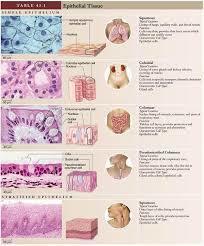
Epithelial Tissues
- Line body cavities and cover extrernal and internal body surfaces
- Distinguishable by having little extracellular matrix between closely packed cells
- Are avascular
- Have a nerve supply
- Have a high capacity for cell division
- Apical, Lateral, and Basal Surface
- Basement Membrane
- Covering and Lining Epithelium
- Simple
- Stratified
- PseudoStratified
- Glandular Epithelium
- 4 Types of Shapes
- Squamous
- Cuboidal
- Columnar
- Transitional
Connective Tissue
- General Facts
- Most abundant Tissue Type
- The function depends on its form
- Composed of variety of cells widely dispersed throughout an extracellular matrix
- The extracellular matrix determines the tissue's qualities
- Consists of a fluid, gel or solid ground substance, plus protein fibers
- Ground Substance
- consists of water and a variety of large biomolecules
- Types of Cells
- Fibroblasts
- Large, flat, branching cells
- Secrete fibers & ground substance of matrix
- Macrophages
- formed from white blood cells
- Irregular shape with short, branching projections
- Engulf bacteria and cell debris by phagocytosis
- Plasma Cells
- small cells that develop from white blood cells
- Make antibodies
- Proteins that attack or neutralize foreign invaders
- Important in immune responses
- Mast cells
- abundant alongside the blood vessels
- Produce Histamine
- A chemical that dilates blood vessels as part of the inflammatory response
- Also kill bacteria
- Adipocytes
- Fat Cells
- Store Triglycerides
- Found below the skin and around organs such as the heart and kidneys
- Fibroblasts
- Fibers
- Collagen Fibers
- Very strong and flexible
- Occur in parallel bundles
- Found in most types of connective tissue, especially bone, cartilage, tendons, and ligaments
- Elastic Fibers
- smaller than collagen and form branching networks
- made of elastin
- can stretch up to 1.5x their length
- recoil after having been stretched
- Reticular fibers
- also smaller than collagen and form branching networks
- Found in basement membranes and provide support for many soft organs
- Collagen Fibers
- Classification of Connective Tissue
- Loose Connective Tissue
- Areolar
- Widely distributed throughout the body
- Combined with adipose tissue, it makes up the subcutaneous layer of skin
- Anchors skin to underlying tissues and organs
- Adipose
- Found whenever areolar connective tissue is found
- Vascular
- Provides same function as lipids
- Reticular
- Consists of fine, interlacing reticular fibers and cells
- Forms the stroma (supporting framework) of organs
- Helps bind together smooth muscle cells
- Filters worn-out blood cells and bacteria
- Areolar
- Dense Connective Tissue
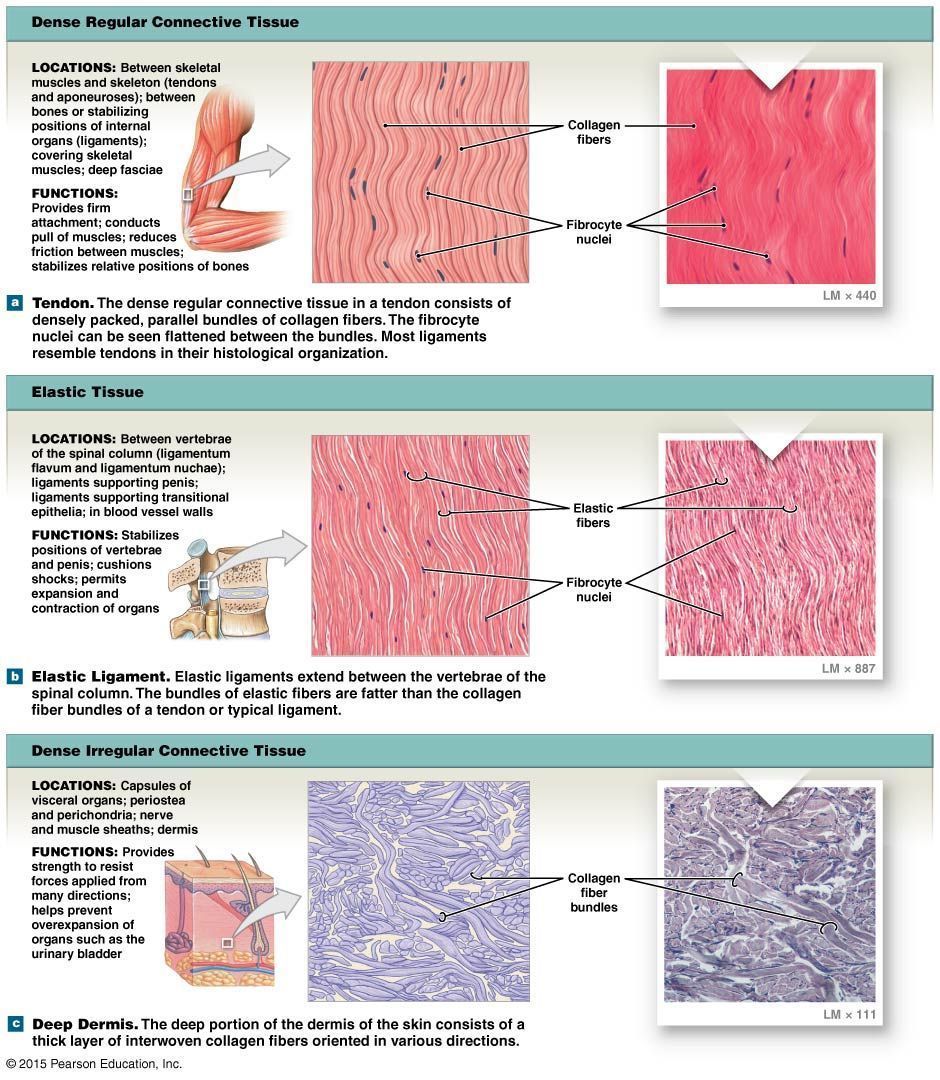
- Regular
- Bundles of regularly arranged parallel collagen fibers
- Tough, but pliable tissue
- Makes up tendons and most ligaments
- Irregular
- Bundles of irregularly arranged collagen fibers
- Found where pulling forces are exerted in various directions
- Found in the dermis of the skin, heart valves, perichondrium, and periosteum
- Elastic
- Consists of branching elastic fibers
- Makes up lung tissue and elastic arteries
- Regular
- Cartilage
- General Facts
- Collagen and elastic fibers embedded in chondroitin sulfate ground substance
- Surface is surrounded by perichondrium
- Has no blood vessels or nerves, except for in the perichondrium.
- Cells: Chondrocytes
- Fibrocartilage
- Fibers visible
- Strongest Type
- Example: Vertebral discs, knee cartilages
- Elastic
- Chondrocytes in threadlike elastic network
- Example: ear cartilage
- Hyaline
- Appears clear because fibers are not easily visible
- Example: at ends of long bones, fetal skeleton
- General Facts
- Bone: Osseous Tissue
- Supports, protects, and allows movement
- Cells called osteoblasts, osteoclasts, osteocytes
- Site of blood formation (red marrow) and storage of minerals (Ca, P)
- Houses yellow bone marrow, which stores triglycerides
- Liquid Connective Tissue
- Blood
- Matrix is plasma
- Cells: red blood cells, white blood cells, platelets
- Lymph
- Matrix is lypmh: similar to plasma but with much less protein
- some white blood cells
- Blood
- Loose Connective Tissue
- General Facts
Muscle Tissue
- Functions
- produces movement
- release heat
- maintains posture
- supports soft tissues
- Moves substances
- Cells
- Elongated, contractile
- Types
- Skeletal Muscle
- pulls on bones allowing body movements; voluntary and striated
- Cardiac Muscle
- forms wall of heart; pumps blood through blood vessels; involuntary and striated
- Smooth Muscle
- found in walls of hollow organs such as stomach and bladder; involuntary
- Skeletal Muscle
- Functions
Nervous Tissue
- conduct nerve impulses
- Types of Cells
- Nuerons: convert stimuli into nerve impulses and conduct them
- Neuroglia: do not generate nerve impulses, but serve support functions
Imagens e arquivos do mapa
Informações
- Descrição
- Mapa Mental sobre Tissues, criado por Benjamin Cortez em 07-10-2020.
- Criado por
- Benjamin Cortez
- Visualizações
- 8
- Avaliação