
Mapa mental
How did the Cold War develop?
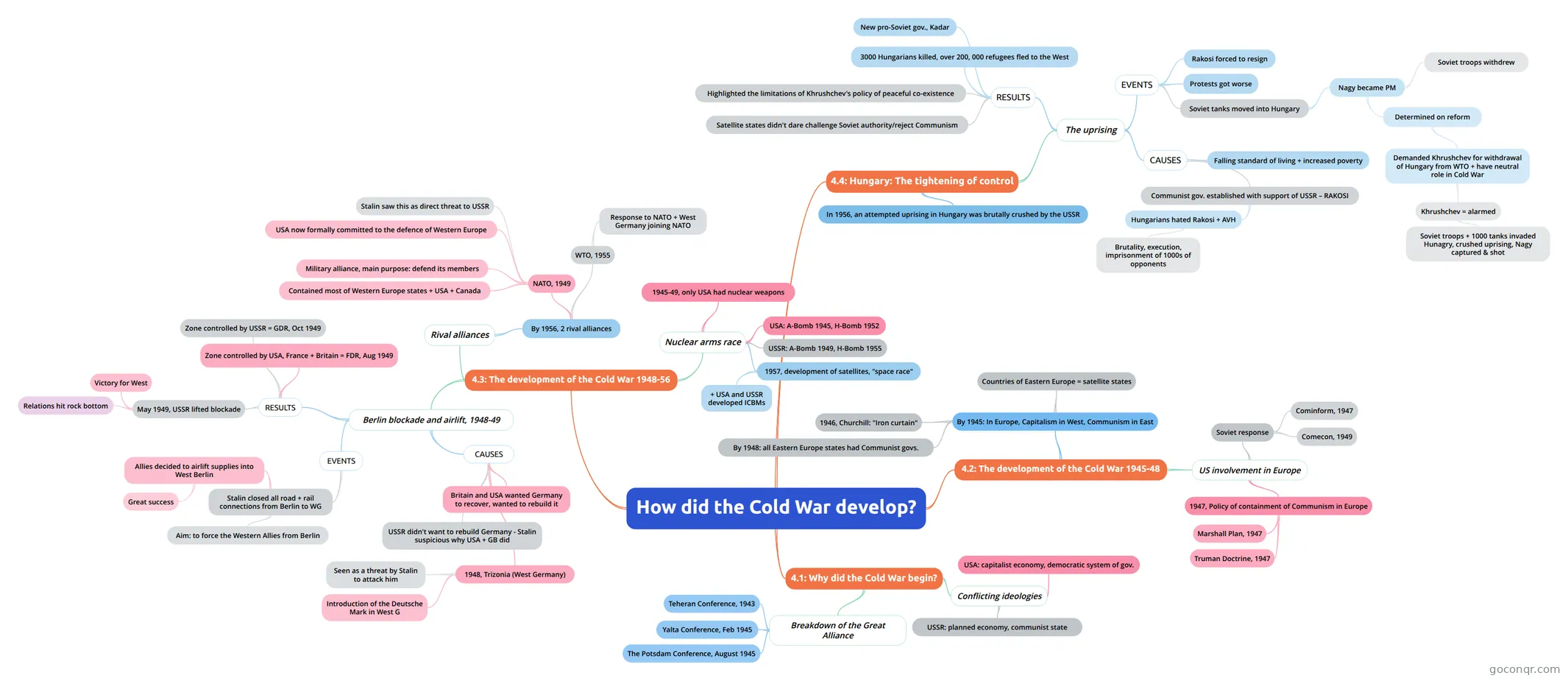
Mind map: how did the Cold War develop
Conteúdo do mapa
How did the Cold War develop?
4.1: Why did the Cold War begin?
- Conflicting ideologies
- USA: capitalist economy, democratic system of gov.
- USSR: planned economy, communist state
- Breakdown of the Great Alliance
- Teheran Conference, 1943
- Stalin wanted to punish + weaken Germany with reparations but Churchill + Roosevelt wanted to rebuild Germany
- Yalta Conference, Feb 1945
- 4 agreements made: 1 – Germany would be divided into 4 zones: run by USA, USSR, Britain and France. 2 – Berlin (in East) would also be split into 4 zones. 3 – Free elections for countries of eastern Europe. 4 – USSR would join war against Japan in return for territory in Manchuria + Sakhalin Island.
- The Potsdam Conference, August 1945
- US President Roosevelt died in April 1945, replaced by Truman, during conference Churchill replace by Attlee. New leaders didn't get on well with Stalin. 2 agreements made: 1 – Nazi Party to be banned + leaders to be trailed as war criminals. 2 – Oder-Neisse rivers to be border between Poland and Germany.
- Teheran Conference, 1943
- Conflicting ideologies
4.2: The development of the Cold War 1945-48
- By 1945: In Europe, Capitalism in West, Communism in East
- Countries of Eastern Europe = satellite states
- USSR-backed Communist parties to take control of the country – in Bulgaria, Albania, Poland, Romania and Hungary opponents were beaten, murdered and frightened into submission.
- By 1948: all Eastern Europe states had Communist govs.
- 1946, Churchill: "Iron curtain"
- Countries of Eastern Europe = satellite states
- US involvement in Europe
- 1947, Policy of containment of Communism in Europe
- Truman Doctrine, 1947
- Aim: Contain spread of communism, but not push it back
- Marshall Plan, 1947
- Aim: Economic recovery of Western Europe to prevent spread of Communism + important for American businesses to have future trading partners.
- Truman Doctrine, 1947
- Soviet response
- Cominform, 1947
- Alliance of Communist countries. Aimed to spread communist ideas + help Stalin tighten his hold on his communist allies (restricted their contact with the West.
- Comecon, 1949
- Aim: to coordinate production + trade of Eastern European countries.
- Cominform, 1947
- 1947, Policy of containment of Communism in Europe
- By 1945: In Europe, Capitalism in West, Communism in East
4.3: The development of the Cold War 1948-56
- Berlin blockade and airlift, 1948-49
- CAUSES
- Continue to occupy Germany or try to rebuild it?
- Britain and USA wanted Germany to recover, wanted to rebuild it
- They could not afford to keep feeding its people + punishing German would not help future peace.
- USSR didn't want to rebuild Germany - Stalin suspicious why USA + GB did
- 1948, Trizonia (West Germany)
- Merging of US + GB + French zones. With help of Marshall Aid, West Germany began to recover and prosper ≠ East Germany poverty and hunger. Many east germans fled to the West through Berlin.
- Seen as a threat by Stalin to attack him
- Introduction of the Deutsche Mark in West G
- To further help economic recovery the USA and Britain introduced a new currency, the Deutsche Mark, in the three western zones. But they did not consult Stalin, and he was furious - a united and strong Germany posed a threat to Soviet security.
- EVENTS
- Stalin closed all road + rail connections from Berlin to WG
- Aim: to force the Western Allies from Berlin
- Allies decided to airlift supplies into West Berlin
- Lasted until following Spring 1949. West Berliners supplied with everything from food to oil, and building supplies.
- Great success
- Stalin closed all road + rail connections from Berlin to WG
- RESULTS
- May 1949, USSR lifted blockade
- Victory for West
- Relations hit rock bottom
- Zone controlled by USA, France + Britain = FDR, Aug 1949
- FDR = Federal Republic of Germany
- Zone controlled by USSR = GDR, Oct 1949
- GDR = German Democratic Republic
- May 1949, USSR lifted blockade
- CAUSES
- Rival alliances
- By 1956, 2 rival alliances
- NATO, 1949
- North Atlantic Treaty Organisation
- USA now formally committed to the defence of Western Europe
- Stalin saw this as direct threat to USSR
- Military alliance, main purpose: defend its members
- Contained most of Western Europe states + USA + Canada
- WTO, 1955
- The Warsaw Pact
- Response to NATO + West Germany joining NATO
- NATO, 1949
- By 1956, 2 rival alliances
- Nuclear arms race
- 1945-49, only USA had nuclear weapons
- USA: A-Bomb 1945, H-Bomb 1952
- USSR: A-Bomb 1949, H-Bomb 1955
- 1957, development of satellites, "space race"
- + USA and USSR developed ICBMs
- ICBMs = long-range missiles
- + USA and USSR developed ICBMs
- Berlin blockade and airlift, 1948-49
4.4: Hungary: The tightening of control
- In 1956, an attempted uprising in Hungary was brutally crushed by the USSR
- The uprising
- CAUSES
- Communist gov. established with support of USSR – RAKOSI
- Hungarians hated Rakosi + AVH
- AVH = Secret Police
- Brutality, execution, imprisonment of 1000s of opponents
- Hungarians hated Rakosi + AVH
- Falling standard of living + increased poverty
- Communist gov. established with support of USSR – RAKOSI
- EVENTS
- Protests got worse
- Stalin's statue pulled down and dragged through the streets
- Rakosi forced to resign
- Soviet tanks moved into Hungary
- Nagy became PM
- Soviet troops withdrew
- Determined on reform
- Demanded Khrushchev for withdrawal of Hungary from WTO + have neutral role in Cold War
- Khrushchev = alarmed
- Free elections = end of Communism in Hungary + gap in iron curtain (Soviet buffer zone from West).
- Soviet troops + 1000 tanks invaded Hunagry, crushed uprising, Nagy captured & shot
- Khrushchev = alarmed
- Demanded Khrushchev for withdrawal of Hungary from WTO + have neutral role in Cold War
- Nagy became PM
- Protests got worse
- RESULTS
- 3000 Hungarians killed, over 200, 000 refugees fled to the West
- Highlighted the limitations of Khrushchev's policy of peaceful co-existence
- New pro-Soviet gov., Kadar
- Re-established Communist control of Hungary + negotiated withdrawal of Soviet troops
- Satellite states didn't dare challenge Soviet authority/reject Communism
- CAUSES
Informações
- Descrição
- International Relations: Section 4: How did the Cold War develop? 1943-56
- Criado por
- E A
- Visualizações
- 1.316
- Tags
- Avaliação