
Mapa mental
CZECHOSLOVAKIA : THE PRAGUE SPRING
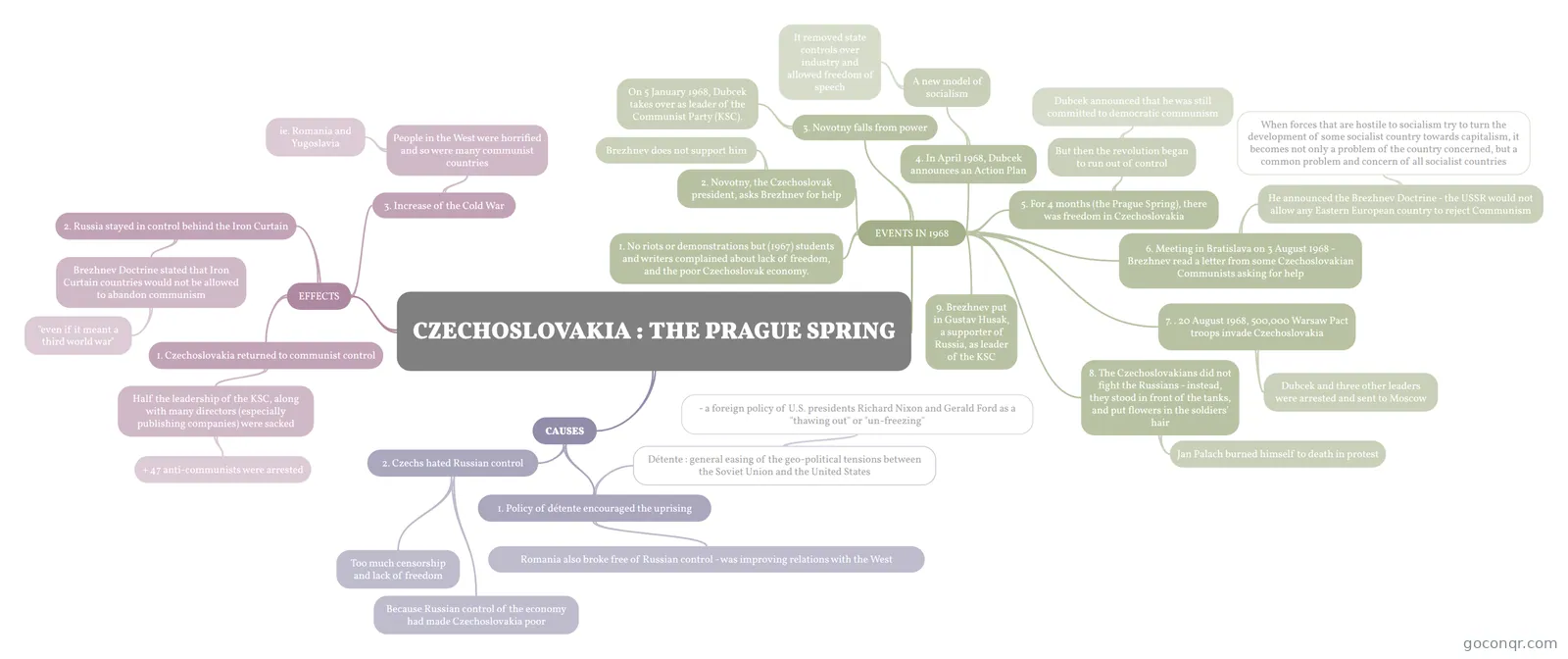
Mind map: Czechoslovakia: the Prague Spring
Conteúdo do mapa
CZECHOSLOVAKIA : THE PRAGUE SPRING
EVENTS IN 1968
- 1. No riots or demonstrations but (1967) students and writers complained about lack of freedom, and the poor Czechoslovak economy.
- 2. Novotny, the Czechoslovak president, asks Brezhnev for help
- Brezhnev does not support him
- 3. Novotny falls from power
- On 5 January 1968, Dubcek takes over as leader of the Communist Party (KSC).
- 4. In April 1968, Dubcek announces an Action Plan
- A new model of socialism
- It removed state controls over industry and allowed freedom of speech
- A new model of socialism
- 5. For 4 months (the Prague Spring), there was freedom in Czechoslovakia
- But then the revolution began to run out of control
- Dubcek announced that he was still committed to democratic communism
- But then the revolution began to run out of control
- 6. Meeting in Bratislava on 3 August 1968 - Brezhnev read a letter from some Czechoslovakian Communists asking for help
- He announced the Brezhnev Doctrine - the USSR would not allow any Eastern European country to reject Communism
- When forces that are hostile to socialism try to turn the development of some socialist country towards capitalism, it becomes not only a problem of the country concerned, but a common problem and concern of all socialist countries
- He announced the Brezhnev Doctrine - the USSR would not allow any Eastern European country to reject Communism
- 7.. 20 August 1968, 500,000 Warsaw Pact troops invade Czechoslovakia
- Dubcek and three other leaders were arrested and sent to Moscow
- 8. The Czechoslovakians did not fight the Russians - instead, they stood in front of the tanks, and put flowers in the soldiers' hair
- Jan Palach burned himself to death in protest
- 9. Brezhnev put in Gustav Husak, a supporter of Russia, as leader of the KSC
CAUSES
- 1. Policy of détente encouraged the uprising
- Détente : general easing of the geo-political tensions between the Soviet Union and the United States
- - a foreign policy of U.S. presidents Richard Nixon and Gerald Ford as a "thawing out" or "un-freezing"
- Romania also broke free of Russian control - was improving relations with the West
- Détente : general easing of the geo-political tensions between the Soviet Union and the United States
- 2. Czechs hated Russian control
- Because Russian control of the economy had made Czechoslovakia poor
- Too much censorship and lack of freedom
- 1. Policy of détente encouraged the uprising
EFFECTS
- 1. Czechoslovakia returned to communist control
- Half the leadership of the KSC, along with many directors (especially publishing companies) were sacked
- + 47 anti-communists were arrested
- Half the leadership of the KSC, along with many directors (especially publishing companies) were sacked
- 2. Russia stayed in control behind the Iron Curtain
- Brezhnev Doctrine stated that Iron Curtain countries would not be allowed to abandon communism
- "even if it meant a third world war"
- Brezhnev Doctrine stated that Iron Curtain countries would not be allowed to abandon communism
- 3. Increase of the Cold War
- People in the West were horrified and so were many communist countries
- ie. Romania and Yugoslavia
- People in the West were horrified and so were many communist countries
- 1. Czechoslovakia returned to communist control
Informações
- Descrição
- Prague Spring- causes, effects, events.
- Criado por
- Alina A
- Visualizações
- 297
- Tags
- Avaliação