
Mapa mental
Child Development: topic 3
Conteúdo do mapa
Child Development: topic 3
Diet during Pregnancy
- Raw egg, unpasteurised milk- Salmonella= miscarriage/ premature birth
- Some types of fish eg. shark swordfish- Mercury= delayed nervous system development
- Peanuts- Can lead to a peanut allergy in the child
- Good: Lean meat fish etc, atarch foods, citrus fruits (vitamin c), fruits & veg (fibre, vitamins, minerals, dairy products, fish with edible bones eg sardines (vital for making bones and teeth), margarine (vitamin D), taking fat-soluble vitamins, folic acid (vitB)-especially first 12 weeks
- Soft blue cheese, paste, prepared salads, ready-meals- Listeria found in unprepared foods and can cause miscarriage, stillbirth, meningitis and pneumonia
- Unwashed raw fruit, raw meat, unpasteuruised goat's milk- Toxoplasmosis= eye damage/ hydrocephalus/ stillbirth/ miscarriage
- Liver and liver products- Vitamin A= birth defects
- Unwashed raw fruit, raw meat, unpasteuruised goat's milk- Toxoplasmosis= eye damage/ hydrocephalus/ stillbirth/ miscarriage
- Soft blue cheese, paste, prepared salads, ready-meals- Listeria found in unprepared foods and can cause miscarriage, stillbirth, meningitis and pneumonia
- Some types of fish eg. shark swordfish- Mercury= delayed nervous system development
- Avoid being over/under weight
- No drugs/ small amount alcohol
- Avoid STD/Is (take precaustions etc)
- What can help fertility?
- Disease eg.Polycystic ovary syndrome, Endometriosis
- Low sperm count
- Stages of Labour
- Stage 1: Contractions make your cervix gradually open up (dilate)- longest stage
- Stage 2: Contractions more frequent & stronger, cervix is fully open & you begin crowning then full birth. Part of labour where you help baby move through vagina by pushing during contractions
- Stage 3: After birth, womb contracts & causes placenta to come out through the vagina
- Stage 2: Contractions more frequent & stronger, cervix is fully open & you begin crowning then full birth. Part of labour where you help baby move through vagina by pushing during contractions
- Stage 1: Contractions make your cervix gradually open up (dilate)- longest stage
- Your Hormones
- Causes of infertility
- Genetics
- Stages of Labour
- Mutation/Blockage of fallopian tubes
- Low sperm count
- Healthy balanced diet
- Excercise
- Don't smoke
- Disease eg.Polycystic ovary syndrome, Endometriosis
- What can help fertility?
- Avoid stress
- Avoid STD/Is (take precaustions etc)
- No drugs/ small amount alcohol
- Raw egg, unpasteurised milk- Salmonella= miscarriage/ premature birth
Stages of growth for a baby
- 4-5 weeks: Embryo=5mm, rudimentary heart started to beat, arms & legs=buds
- 6-7 weeks:Embryo=8mm, limb buds look real, heart seen beating on ultrasound
- 8-9 weeks:Unborn baby=foetus=2cm. Toes, fingers & major internal organs starting to form
- 10-14: Foetus=7cm, organs complete. By 12 weeks baby=fully formed
- 15-22 weeks: Mother feels movement. 22w=greasy, white protective film called VERNIX CASEOSA has begun to form. Foetus covered in fine, downy hair=LANUGO
- 23-30 weeks: Covered in vernix, lanugo=disappeared. 28w+ foetus=viable (good chance of survival if born)
- 31-40 weeks:Becomes plumper, vernix & lanugo disappear. Foetus= settles in head-down position
- 23-30 weeks: Covered in vernix, lanugo=disappeared. 28w+ foetus=viable (good chance of survival if born)
- 15-22 weeks: Mother feels movement. 22w=greasy, white protective film called VERNIX CASEOSA has begun to form. Foetus covered in fine, downy hair=LANUGO
- 10-14: Foetus=7cm, organs complete. By 12 weeks baby=fully formed
- 8-9 weeks:Unborn baby=foetus=2cm. Toes, fingers & major internal organs starting to form
- 6-7 weeks:Embryo=8mm, limb buds look real, heart seen beating on ultrasound
- 4-5 weeks: Embryo=5mm, rudimentary heart started to beat, arms & legs=buds
Reproductive organs
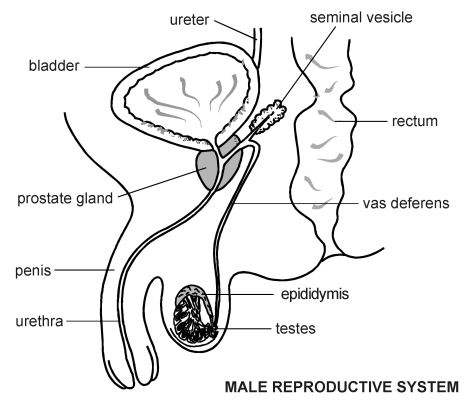
- Sperm duct: Where sperm passes through to mix with fluids that are produced by glands, fluid provides sperm cells w/nutrients. Mix of sperm & fluids=semen
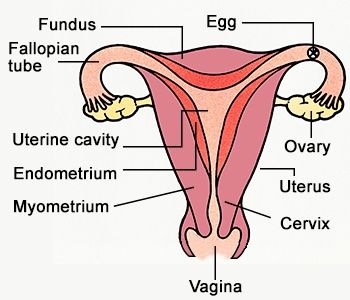
- Uterus: (Womb) muscular bag w/soft lining, where baby develops
- Fallopian tubes: Connects ovaries to womb, lined with carries egg along to uterus
- Vagina: Muscular tube leads from cervix to outside
- Cervix: Strong ring of muscle between lower end of uterus & vagina, keeps baby in place
- Ovaries: Control production of oestrogen & progesterone which control menstrual cycle, contain hundreds of eggs
- Urethra: Tube inside penis that carries urine & semen, there's a ring of muscle that ensures the urine & semen don't mix
- Scrotum: Bag of skin which stores testes
- Ovaries: Control production of oestrogen & progesterone which control menstrual cycle, contain hundreds of eggs
- Testes- 2, make male hormone testosterone and produces sperm
- Cervix: Strong ring of muscle between lower end of uterus & vagina, keeps baby in place
- Penis: Pass urine & pass semen. Made of shaft & glans, shaft=main part, glans=tip at end=small slit to release urnine/semen
- Uterus: (Womb) muscular bag w/soft lining, where baby develops
- Sperm duct: Where sperm passes through to mix with fluids that are produced by glands, fluid provides sperm cells w/nutrients. Mix of sperm & fluids=semen
Alternative conception
- IVM (In vito maturation)
- ICSI (intra-cytoplasmic sperm injection)
- Eggs are matured in lab berfore being fertilised by sperm. Difference between IVM & IVF= eggs are immature when they are cikkected=woman does not need to take many drugs before the eggs can be collected
- Used in combination with IVF, injecting a single sperm into the centre of an egg. After fertilisatuion up to 3 embryos are replaced in uterus. ICSI oftern recommended to low sperm count.
- IVF-Woman's eggs collected and fertilised with partner's sperm in a lab, healthiest ones put back in womb
- GIFT (gamete intra-fallopian transfer)
- Another woman carries baby. Partial surrogacy: surrogate mother conceives baby using her own egg with other father's sperm. (artificial insemination-syringe), Full surrogacy: Surrogate mother carries intended parents genetic child conceived through IVF
- Similar to IVF, eggs & sperm collected and screened for healthiest. Then e&s mixed together and implanted back into fallopian tube for natural fertilisation.
- Another woman carries baby. Partial surrogacy: surrogate mother conceives baby using her own egg with other father's sperm. (artificial insemination-syringe), Full surrogacy: Surrogate mother carries intended parents genetic child conceived through IVF
- GIFT (gamete intra-fallopian transfer)
- IVF-Woman's eggs collected and fertilised with partner's sperm in a lab, healthiest ones put back in womb
- Used in combination with IVF, injecting a single sperm into the centre of an egg. After fertilisatuion up to 3 embryos are replaced in uterus. ICSI oftern recommended to low sperm count.
- IVM (In vito maturation)
Parts of growth for an embryo
- Amniotic sac=filed with amniotic fluid provides protective cushion for foetus
- Placenta=provides foetus with oxygen and nourishment
- Ectopic pregnancy=mistakes happen in ovum & implantation occurs in wrong place-not sustainable
- Umbilical chord= removes foetal waste also a barrier to certain microorganisms
- Preparation for pregnancy
- Parents relationship
- Shouldn't be to save the relationship because it often does the opposite
- Decision should be joint otherwise it could put a strain on the relationship which the child might be blamed for
- Money
- Need to be financially stable enough to care and support the child
- Enviroment
- The accommodation needs to be safe instead and out
- Needs to be big enough for the child to grow
- Is it near facilities that the child might need such as schools or parks
- Changes in lifestyle
- Babies are totally dependent on their parents therefore they require a lot of your time and dedication
- This means that you're not able to do what you want when you want some of the time and if you want a child you need to be willing to accept this
- Also, when you are going out you need to take into consideration that you need to pack all the baby's equipment to take with you
- This means that you're not able to do what you want when you want some of the time and if you want a child you need to be willing to accept this
- Babies are totally dependent on their parents therefore they require a lot of your time and dedication
- Possible signs of pregnancy
- Period is missed
- SIckness
- Metallic taste in mouth
- Need to go to the toilet more frequently
- Constipation possible
- More vaginal mucus is discharged
- Breasts are tender and the nipples and areola become darker
- Tiredness occurs more frequently
- New cravings and dislikes
- Constipation possible
- Need to go to the toilet more frequently
- Possible fainting spells
- Period is missed
- Changes in lifestyle
- Is it near facilities that the child might need such as schools or parks
- Needs to be big enough for the child to grow
- The accommodation needs to be safe instead and out
- Money
- Need to be able to support each other and be mature and responsible
- Decision should be joint otherwise it could put a strain on the relationship which the child might be blamed for
- Shouldn't be to save the relationship because it often does the opposite
- Parents relationship
- Ectopic pregnancy=mistakes happen in ovum & implantation occurs in wrong place-not sustainable
- Placenta=provides foetus with oxygen and nourishment
- Amniotic sac=filed with amniotic fluid provides protective cushion for foetus
Menstrual cycle
- The process where the uterus is prepared to receive a fertilised egg and then the thickened uterus lining detaches if the egg is not fertilised
- Usually begins between 10-17 years of age
- Average cycle takes place over 28 days but this can vary between person to person
- The first half of the cycle begins by the uterus thickening,. AT day 14the egg is released from the ovary and travels down the fallopian tubes. if the egg isn't fertilised the uterus lining is removed from the body through the menstrual bleed
- Average cycle takes place over 28 days but this can vary between person to person
- Usually begins between 10-17 years of age
- The process where the uterus is prepared to receive a fertilised egg and then the thickened uterus lining detaches if the egg is not fertilised
Conception
- During sexual intercourse, sperm meets egg and a baby is conceived
- The fertilised egg reaches the uterus where it will implant into the uterus lining. An embryo begins to form, which becomes a foetus after 8 weeks
- During sexual intercourse, sperm meets egg and a baby is conceived
Imagens e arquivos do mapa
Informações
- Descrição
- GSCE Child development Mapa Mental sobre Child Development: topic 3, criado por Lisa Cracknell em 03-09-2015.
- Criado por
- Lisa Cracknell
- Visualizações
- 3
- Tags
- Histórico
-
- Criado por chloe.england10 · 3 set 2015
- Copiado por chelsea.bird3 · 3 set 2015
- Copiado por Lisa Cracknell · 3 set 2015
- Avaliação