
Mapa mental
Medieval period: c1250-c1500
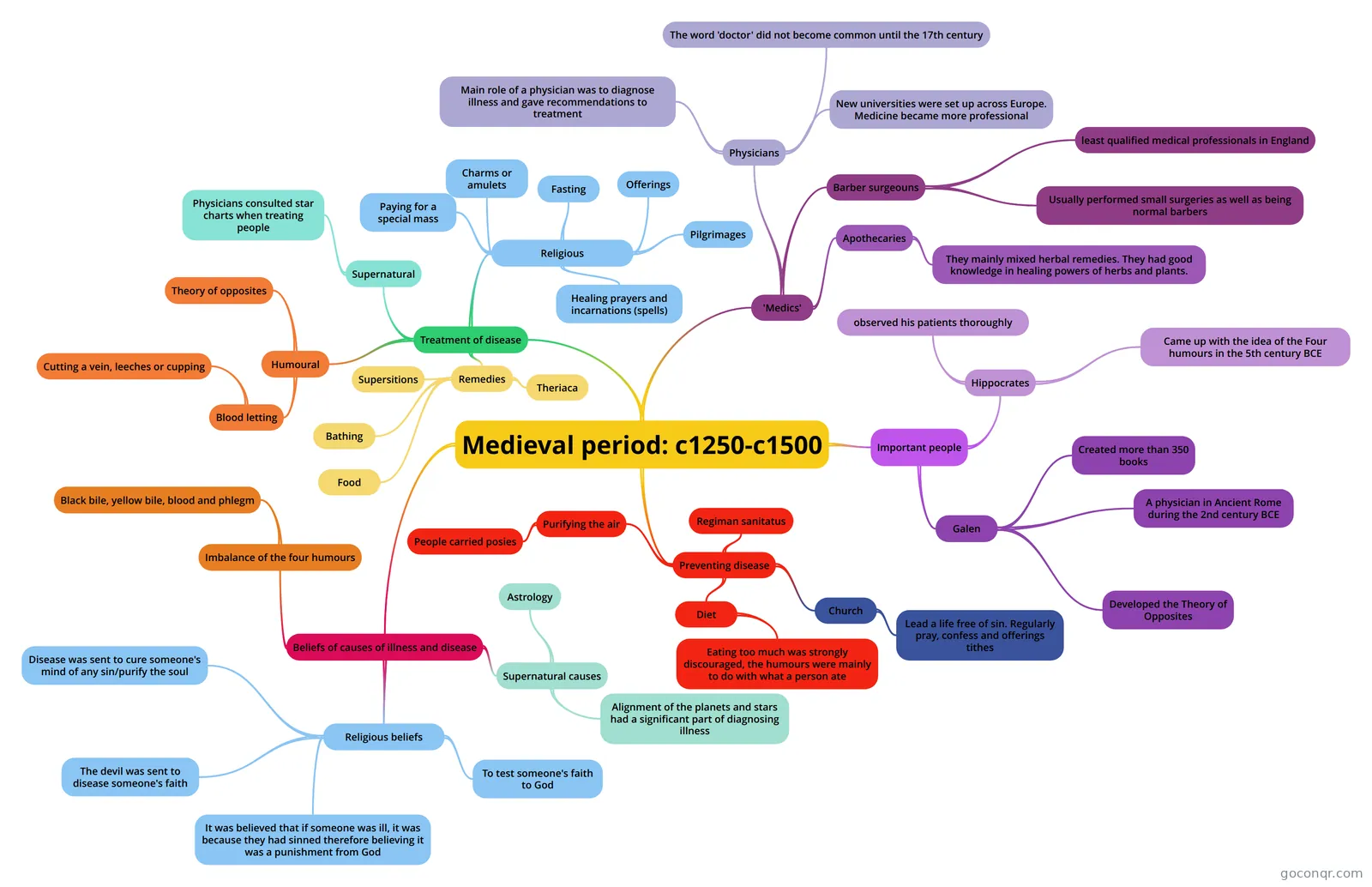
Mind map: Medieval period c1250-c1500 medicine
Conteúdo do mapa
Medieval period: c1250-c1500
Beliefs of causes of illness and disease
- Religious beliefs
- Many people could not read or write. This meant that the Church had all the power of what people believed. They thought that illness was sent by God as a punishment or as a test towards their faith. It was also believed that the devil sent illness as a way to get rid of faith
- It was believed that if someone was ill, it was because they had sinned therefore believing it was a punishment from God
- The devil was sent to disease someone's faith
- Disease was sent to cure someone's mind of any sin/purify the soul
- To test someone's faith to God
- Supernatural causes
- Alignment of the planets and stars had a significant part of diagnosing illness
- Astrology
- Imbalance of the four humours
- This came from the ideas of the Ancient Greeks
- Black bile, yellow bile, blood and phlegm
- Religious beliefs
Important people
- Galen
- A physician in Ancient Rome during the 2nd century BCE
- Created more than 350 books
- Developed the Theory of Opposites
- Hippocrates
- Came up with the idea of the Four humours in the 5th century BCE
- observed his patients thoroughly
- To this day, doctors have to use the Hippocratic Oath - observe patients carefully and treat them based on their symptoms.
- Galen
Treatment of disease
- Religious
- Healing prayers and incarnations (spells)
- Paying for a special mass
- Fasting
- Pilgrimages
- Offerings
- Charms or amulets
- Supernatural
- Physicians consulted star charts when treating people
- Humoural
- Theory of opposites
- One of the many works by the Ancient Rome Physician Galen
- Blood letting
- Was also known as Phlebotomy
- Cutting a vein, leeches or cupping
- Many people ended up dying from this due to the lack of knowledge facing bleeding and infection.
- Theory of opposites
- Remedies
- Theriaca
- A spice-based mixture that could contain up to 70 ingredients. These included: - ginger - cardamom - pepper - saffron - viper flesh - opium
- Supersitions
- Bathing
- Food
- Theriaca
- Religious
Preventing disease
- Church
- Lead a life free of sin. Regularly pray, confess and offerings tithes
- Diet
- Eating too much was strongly discouraged, the humours were mainly to do with what a person ate
- Regiman sanitatus
- The Regimen Sanitatis was a set of instructions given to patients from physicians. These were only really used by those who were rich or in the upper class. It was used to help people maintain their health.
- Purifying the air
- It was a very strong belief that Miasma (bad air) was a contribution to illness and disease
- People carried posies
- Usually carried posies in a pomander which was a large amulet worn around the waist
- Church
'Medics'
- Apothecaries
- They mainly mixed herbal remedies. They had good knowledge in healing powers of herbs and plants.
- Physicians
- New universities were set up across Europe. Medicine became more professional
- The word 'doctor' did not become common until the 17th century
- Main role of a physician was to diagnose illness and gave recommendations to treatment
- Barber surgeouns
- least qualified medical professionals in England
- Usually performed small surgeries as well as being normal barbers
- They usually performed teeth removal and bleeding techniques.
- Apothecaries
Informações
- Descrição
- GCSE History Mapa Mental sobre Medieval period: c1250-c1500, criado por Kyra Clarke em 30-09-2023.
- Criado por
- Kyra Clarke
- Visualizações
- 62
- Tags
- Avaliação