
Mapa mental
Abnormality
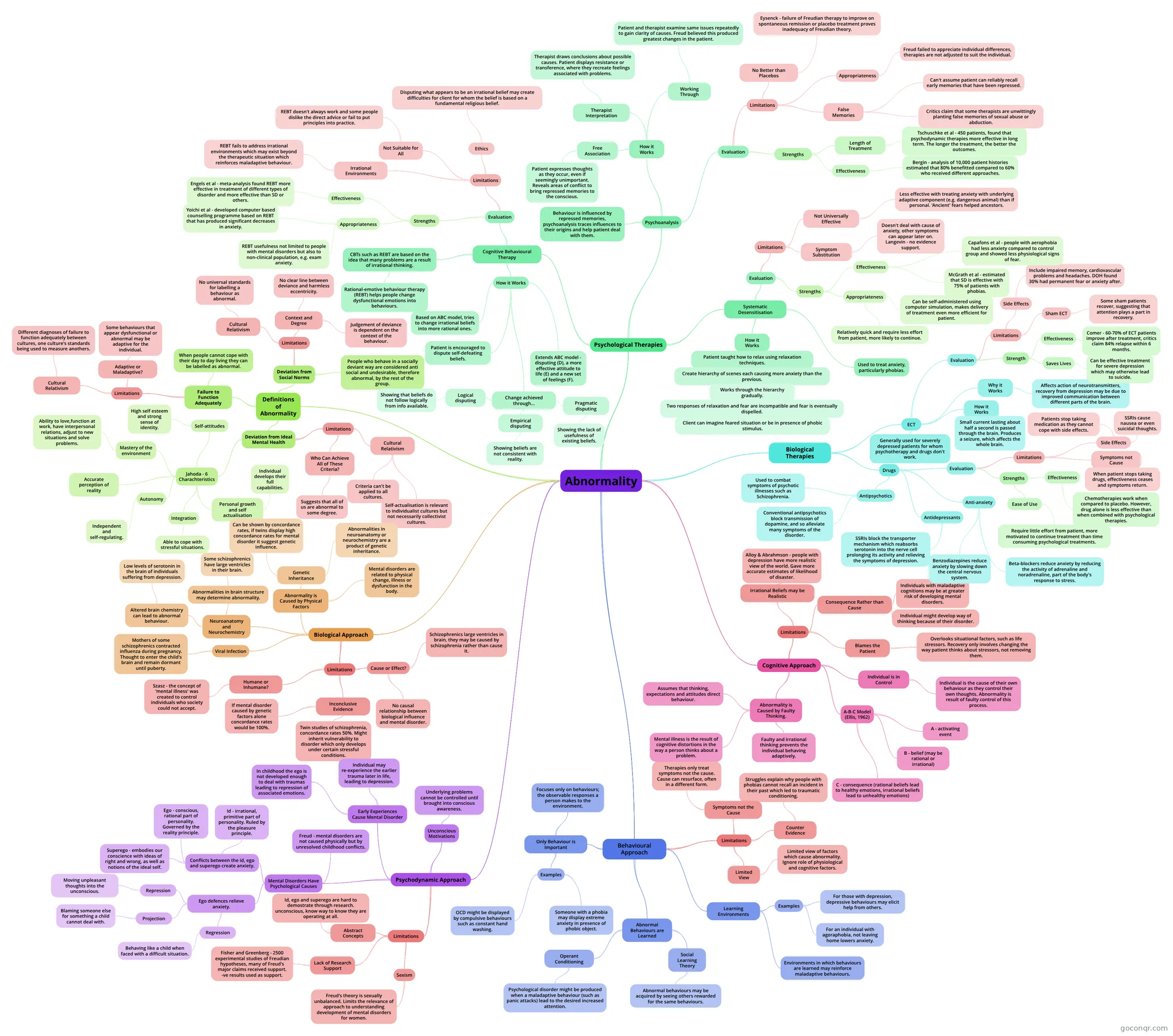
Mind map: Abnormality psychology
Conteúdo do mapa
Abnormality
Definitions of Abnormality
- Deviation from Social Norms
- People who behave in a socially deviant way are considered anti social and undesirable, therefore abnormal, by the rest of the group.
- Limitations
- Context and Degree
- Judgement of deviance is dependent on the context of the behaviour.
- No clear line between deviance and harmless eccentricity.
- Cultural Relativism
- No universal standards for labelling a behaviour as abnormal.
- Context and Degree
- Failure to Function Adequately
- When people cannot cope with their day to day living they can be labelled as abnormal.
- Limitations
- Adaptive or Maladaptive?
- Some behaviours that appear dysfunctional or abnormal may be adaptive for the individual.
- Cultural Relativism
- Different diagnoses of failure to function adequately between cultures, one culture's standards being used to measure anothers.
- Adaptive or Maladaptive?
- Deviation from Ideal Mental Health
- Jahoda - 6 Charachteristics
- Self-attitudes
- High self esteem and strong sense of identity.
- Personal growth and self actualisation
- Individual develops their full capabilities.
- Integration
- Able to cope with stressful situations.
- Autonomy
- Independent and self-regulating.
- Accurate perception of reality
- Mastery of the environment
- Ability to love,function at work, have interpersonal relations, adjust to new situations and solve problems.
- Self-attitudes
- Limitations
- Who Can Achieve All of These Criteria?
- Suggests that all of us are abnormal to some degree.
- Cultural Relativism
- Criteria can't be applied to all cultures.
- Self-actualisation is relevant to individualist cultures but not necessarily collectivist cultures.
- Who Can Achieve All of These Criteria?
- Jahoda - 6 Charachteristics
- Deviation from Social Norms
Biological Approach
- Abnormality is Caused by Physical Factors
- Mental disorders are related to physical change, illness or dysfunction in the body.
- Genetic Inheritance
- Abnormalities in neuroanatomy or neurochemistry are a product of genetic inheritance.
- Can be shown by concordance rates, if twins display high concordance rates for mental disorder it suggest genetic influence.
- Viral Infection
- Mothers of some schizophrenics contracted influenza during pregnancy. Thought to enter the child's brain and remain dormant until puberty.
- Neuroanatomy and Neurochemistry
- Abnormalities in brain structure may determine abnormality.
- Some schizophrenics have large ventricles in their brain.
- Altered brain chemistry can lead to abnormal behaviour.
- Low levels of serotonin in the brain of individuals suffering from depression.
- Abnormalities in brain structure may determine abnormality.
- Limitations
- Humane or Inhumane?
- Szasz - the concept of 'mental illness' was created to control individuals who society could not accept.
- Inconclusive Evidence
- If mental disorder caused by genetic factors alone concordance rates would be 100%.
- Twin studies of schizophrenia, concordance rates 50%. Might inherit vulnerability to disorder which only develops under certain stressful conditions.
- Cause or Effect?
- No causal relationship between biological influence and mental disorder.
- Schizophrenics large ventricles in brain, they may be caused by schizophrenia rather than cause it.
- Humane or Inhumane?
- Abnormality is Caused by Physical Factors
Psychodynamic Approach
- Mental Disorders Have Psychological Causes
- Freud - mental disorders are not caused physically but by unresolved childhood conflicts.
- Conflicts between the id, ego and superego create anxiety.
- Id - irrational, primitive part of personality. Ruled by the pleasure principle.
- Ego - conscious, rational part of personality. Governed by the reality principle.
- Superego - embodies our conscience with ideas of right and wrong, as well as notions of the ideal self.
- Ego defences relieve anxiety.
- Repression
- Moving unpleasant thoughts into the unconscious.
- Projection
- Blaming someone else for something a child cannot deal with.
- Regression
- Behaving like a child when faced with a difficult situation.
- Repression
- Early Experiences Cause Mental Disorder
- In childhood the ego is not developed enough to deal with traumas leading to repression of associated emotions.
- Individual may re-experience the earlier trauma later in life, leading to depression.
- Unconscious Motivations
- Underlying problems cannot be controlled until brought into conscious awareness.
- Limitations
- Abstract Concepts
- Id, ego and superego are hard to demostrate through research. unconscious, know way to know they are operating at all.
- Lack of Research Support
- Fisher and Greenberg - 2500 experimental studies of Freudian hypotheses, many of Freud's major claims received support. -ve results used as support.
- Sexism
- Freud's theory is sexually unbalanced. Limits the relevance of approach to understanding development of mental disorders for women.
- Abstract Concepts
- Mental Disorders Have Psychological Causes
Behavioural Approach
- Only Behaviour is Important
- Focuses only on behaviours; the observable responses a person makes to the environment.
- Examples
- OCD might be displayed by compulsive behaviours such as constant hand washing.
- Someone with a phobia may display extreme anxiety in presence of phobic object.
- Abnormal Behaviours are Learned
- Operant Conditioning
- Psychological disorder might be produced when a maladaptive behaviour (such as panic attacks) lead to the desired increased attention.
- Social Learning Theory
- Abnormal behaviours may be acquired by seeing others rewarded for the same behaviours.
- Operant Conditioning
- Learning Environments
- Environments in which behaviours are learned may reinforce maladaptive behaviours.
- Examples
- For an individual with agoraphobia, not leaving home lowers anxiety.
- For those with depression, depressive behaviours may elicit help from others.
- Limitations
- Limited View
- Limited view of factors which cause abnormality. Ignore role of physiological and cognitive factors.
- Counter Evidence
- Struggles explain why people with phobias cannot recall an incident in their past which led to traumatic conditioning.
- Symptoms not the Cause
- Therapies only treat symptoms not the cause. Cause can resurface, often in a different form.
- Limited View
- Only Behaviour is Important
Cognitive Approach
- Abnormality is Caused by Faulty Thinking.
- Assumes that thinking, expectations and attitudes direct behaviour.
- Mental illness is the result of cognitive distortions in the way a person thinks about a problem.
- Faulty and irrational thinking prevents the individual behaving adaptively.
- A-B-C Model (Ellis, 1962)
- A - activating event
- B - belief (may be rational or irrational)
- C - consequence (rational beliefs lead to healthy emotions, irrational beliefs lead to unhealthy emotions)
- Individual is in Control
- Individual is the cause of their own behaviour as they control their own thoughts. Abnormality is result of faulty control of this process.
- Limitations
- Blames the Patient
- Overlooks situational factors, such as life stressors. Recovery only involves changing the way patient thinks about stressors, not removing them.
- Consequence Rather than Cause
- Individual might develop way of thinking because of their disorder.
- Individuals with maladaptive cognitions may be at greater risk of developing mental disorders.
- Irrational Beliefs may be Realistic
- Alloy & Abrahmson - people with depression have more realistic view of the world. Gave more accurate estimates of likelihood of disaster.
- Blames the Patient
- Abnormality is Caused by Faulty Thinking.
Biological Therapies
- Drugs
- Antipsychotics
- Used to combat symptoms of psychotic illnesses such as Schizophrenia.
- Conventional antipsychotics block transmission of dopamine, and so alleviate many symptoms of the disorder.
- Antidepressants
- SSRIs block the transporter mechanism which reabsorbs serotonin into the nerve cell prolonging its activity and relieving the symptoms of depression.
- Anti-anxiety
- Benzodiazepines reduce anxiety by slowing down the central nervous system.
- Beta-blockers reduce anxiety by reducing the activity of adrenaline and noradrenaline, part of the body's response to stress.
- Evaluation
- Strengths
- Effectiveness
- Chemotherapies work when compared to placebo. However, drug alone is less effective than when combined with psychological therapies.
- Ease of Use
- Require little effort from patient, more motivated to continue treatment than time consuming psychological treatments.
- Effectiveness
- Limitations
- Symptoms not Cause
- When patient stops taking drugs, effectiveness ceases and symptoms return.
- Side Effects
- Patients stop taking medication as they cannot cope with side effects.
- SSRIs cause nausea or even suicidal thoughts.
- Symptoms not Cause
- Strengths
- Antipsychotics
- ECT
- Generally used for severely depressed patients for whom psychotherapy and drugs don't work.
- How it Works
- Small current lasting about half a second is passed through the brain. Produces a seizure, which affects the whole brain.
- Why it Works
- Affects action of neurotransmitters, recovery from depression may be due to improved communication between different parts of the brain.
- Evaluation
- Strength
- Saves Lives
- Can be effective treatment for severe depression which may otherwise lead to suicide.
- Effectiveness
- Comer - 60-70% of ECT patients improve after treatment, critics claim 84% relapse within 6 months.
- Saves Lives
- Limitations
- Sham ECT
- Some sham patients recover, suggesting that attention plays a part in recovery.
- Side Effects
- Include impaired memory, cardiovascular problems and headaches. DOH found 30% had permanent fear or anxiety after.
- Sham ECT
- Strength
- Drugs
Psychological Therapies
- Systematic Desensitisation
- Used to treat anxiety, particularly phobias.
- How it Works
- Patient taught how to relax using relaxation techniques.
- Create hierarchy of scenes each causing more anxiety than the previous.
- Works through the hierarchy gradually.
- Two responses of relaxation and fear are incompatible and fear is eventually dispelled.
- Client can imagine feared situation or be in presence of phobic stimulus.
- Two responses of relaxation and fear are incompatible and fear is eventually dispelled.
- Works through the hierarchy gradually.
- Create hierarchy of scenes each causing more anxiety than the previous.
- Patient taught how to relax using relaxation techniques.
- Evaluation
- Strengths
- Appropriateness
- Relatively quick and require less effort from patient, more likely to continue.
- Can be self-administered using computer simulation, makes delivery of treatment even more efficient for patient.
- Effectiveness
- Capafons et al - people with aerophobia had less anxiety compared to control group and showed less physiological signs of fear.
- McGrath et al - estimated that SD is effective with 75% of patients with phobias.
- Appropriateness
- Limitations
- Symptom Substitution
- Doesn't deal with cause of anxiety, other symptoms can appear later on. Langevin - no evidence support.
- Not Universally Effective
- Less effective with treating anxiety with underlying adaptive component (e.g. dangerous animal) than if personal. 'Ancient' fears helped ancestors.
- Symptom Substitution
- Strengths
- Cognitive Behavioural Therapy
- CBTs such as REBT are based on the idea that many problems are a result of irrational thinking.
- Rational-emotive behaviour therapy (REBT) helps people change dysfunctional emotions into behaviours.
- How it Works
- Based on ABC model, tries to change irrational beliefs into more rational ones.
- Patient is encouraged to dispute self-defeating beliefs.
- Change achieved through...
- Logical disputing
- Showing that beliefs do not follow logically from info available.
- Empirical disputing
- Showing beliefs are not consistent with reality.
- Pragmatic disputing
- Showing the lack of usefulness of existing beliefs.
- Logical disputing
- Extends ABC model - disputing (D), a more effective attitude to life (E) and a new set of feelings (F).
- Evaluation
- Strengths
- Appropriateness
- REBT usefulness not limited to people with mental disorders but also to non-clinical population, e.g. exam anxiety.
- Yoichi et al - developed computer based counselling programme based on REBT that has produced significant decreases in anxiety.
- Effectiveness
- Engels et al - meta-analysis found REBT more effective in treatment of different types of disorder and more effective than SD or others.
- Appropriateness
- Limitations
- Irrational Environments
- REBT fails to address irrational environments which may exist beyond the therapeutic situation which reinforces maladaptive behaviour.
- Not Suitable for All
- REBT doesn't always work and some people dislike the direct advice or fail to put principles into practice.
- Ethics
- Disputing what appears to be an irrational belief may create difficulties for client for whom the belief is based on a fundamental religious belief.
- Irrational Environments
- Strengths
- CBTs such as REBT are based on the idea that many problems are a result of irrational thinking.
- Psychoanalysis
- Behaviour is influenced by repressed memories, psychoanalysis traces influences to their origins and help patient deal with them.
- How it Works
- Free Association
- Patient expresses thoughts as they occur, even if seemingly unimportant. Reveals areas of conflict to bring repressed memories to the conscious.
- Therapist Interpretation
- Therapist draws conclusions about possible causes. Patient displays resistance or transference, where they recreate feelings associated with problems.
- Working Through
- Patient and therapist examine same issues repeatedly to gain clarity of causes. Freud believed this produced greatest changes in the patient.
- Free Association
- Evaluation
- Strengths
- Effectiveness
- Bergin - analysis of 10,000 patient histories estimated that 80% benefitted compared to 60% who received different approaches.
- Length of Treatment
- Tschuschke et al - 450 patients, found that psychodynamic therapies more effective in long term. The longer the treatment, the better the outcomes.
- Effectiveness
- Limitations
- No Better than Placebos
- Eysenck - failure of Freudian therapy to improve on spontaneous remission or placebo treatment proves inadequacy of Freudian theory.
- Appropriateness
- Freud failed to appreciate individual differences, therapies are not adjusted to suit the individual.
- False Memories
- Critics claim that some therapists are unwittingly planting false memories of sexual abuse or abduction.
- Can't assume patient can reliably recall early memories that have been repressed.
- No Better than Placebos
- Strengths
- Systematic Desensitisation
Informações
- Descrição
- Psychology (Abnormality) Mapa Mental sobre Abnormality, criado por smita089 em 08-04-2013.
- Criado por
- smita089
- Visualizações
- 293
- Tags
- Avaliação