
Mapa mental
Stress
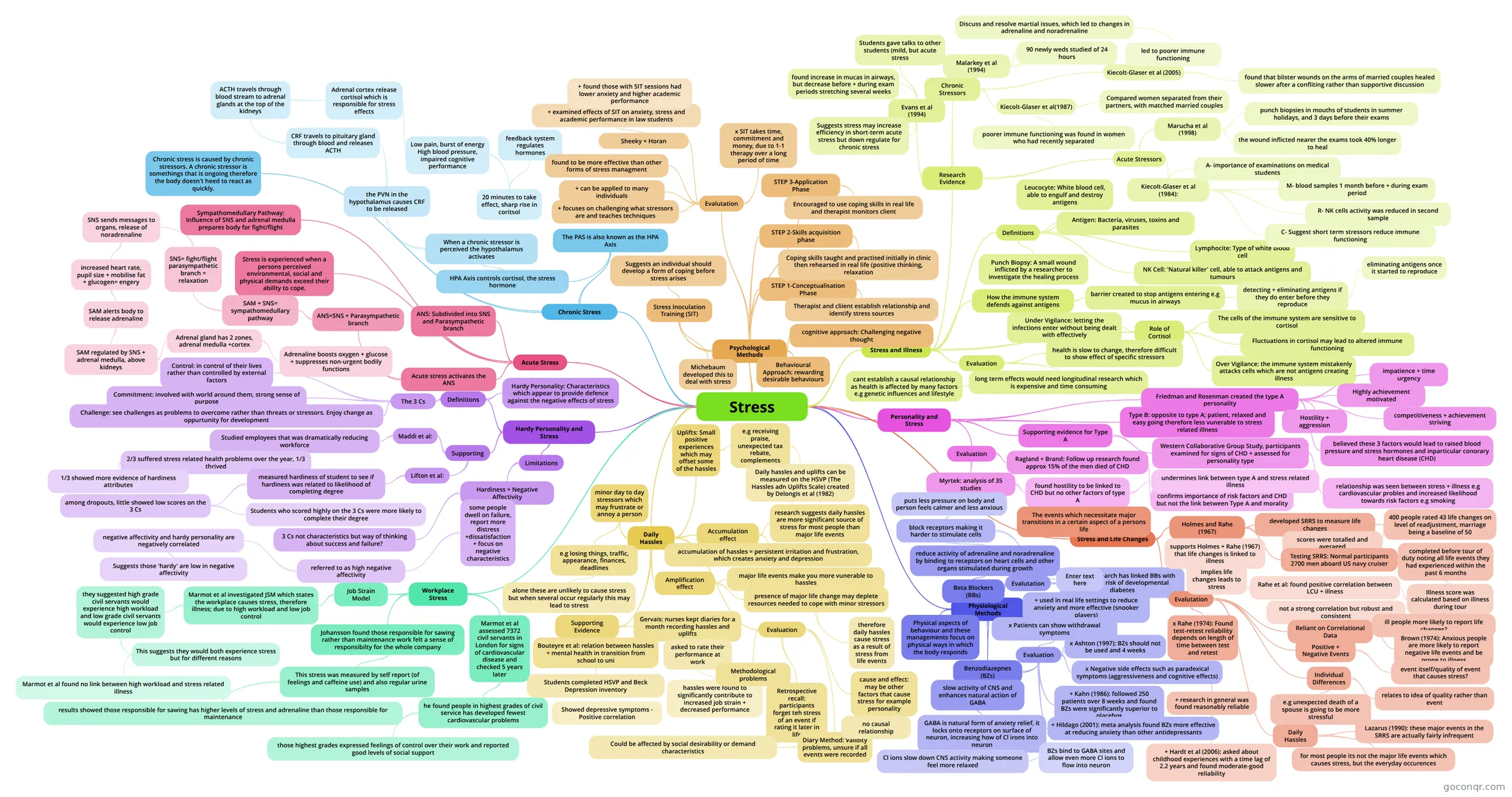
Mind map: Stress
Conteúdo do mapa
Stress
Acute Stress
- Stress is experienced when a persons perceived environmental, social and physical demands exceed their ability to cope.
- ANS: Subdivided into SNS and Parasympathetic branch
- Sympathomedullary Pathway: Influence of SNS and adrenal medulla prepares body for fight/flight
- Acute stress activates the ANS
- ANS=SNS + Parasympathetic branch
- SAM + SNS= sympathomedullary pathway
- SNS= fight/flight parasympathetic branch = relaxation
- SNS sends messages to organs, release of noradrenaline
- increased heart rate, pupil size + mobilise fat + glucogen= engery
- SAM alerts body to release adrenaline
- SAM regulated by SNS + adrenal medulla, above kidneys
- Adrenal gland has 2 zones, adrenal medulla +cortex
- Adrenaline boosts oxygen + glucose + suppresses non-urgent bodily functions
- Adrenal gland has 2 zones, adrenal medulla +cortex
- SAM regulated by SNS + adrenal medulla, above kidneys
- SAM alerts body to release adrenaline
- increased heart rate, pupil size + mobilise fat + glucogen= engery
- SNS sends messages to organs, release of noradrenaline
- SNS= fight/flight parasympathetic branch = relaxation
- SAM + SNS= sympathomedullary pathway
- ANS=SNS + Parasympathetic branch
Chronic Stress
- Chronic stress is caused by chronic stressors. A chronic stressor is somethings that is ongoing therefore the body doesn't heed to react as quickly.
- The PAS is also known as the HPA Axis
- HPA Axis controls cortisol, the stress hormone
- When a chronic stressor is perceived the hypothalamus activates
- the PVN in the hypothalamus causes CRF to be released
- CRF travels to pituitary gland through blood and releases ACTH
- ACTH travels through blood stream to adrenal glands at the top of the kidneys
- Adrenal cortex release cortisol which is responsible for stress effects
- Low pain, burst of energy High blood pressure, impaired cognitive performance
- 20 minutes to take effect, sharp rise in coritsol
- feedback system regulates hormones
- 20 minutes to take effect, sharp rise in coritsol
- Low pain, burst of energy High blood pressure, impaired cognitive performance
- Adrenal cortex release cortisol which is responsible for stress effects
- ACTH travels through blood stream to adrenal glands at the top of the kidneys
- CRF travels to pituitary gland through blood and releases ACTH
- the PVN in the hypothalamus causes CRF to be released
- When a chronic stressor is perceived the hypothalamus activates
- HPA Axis controls cortisol, the stress hormone
Stress and Illness
- Definitions
- Antigen: Bacteria, viruses, toxins and parasites
- Leucocyte: White blood cell, able to engulf and destroy antigens
- Lymphocite: Type of white blood cell
- NK Cell: 'Natural killer' cell, able to attack antigens and tumours
- Punch Biopsy: A small wound inflicted by a researcher to investigate the healing process
- How the immune system defends against antigens
- barrier created to stop antigens entering e.g mucus in airways
- detecting + eliminating antigens if they do enter before they reproduce
- eliminating antigens once it started to reproduce
- detecting + eliminating antigens if they do enter before they reproduce
- barrier created to stop antigens entering e.g mucus in airways
- Role of Cortisol
- The cells of the immune system are sensitive to cortisol
- Fluctuations in cortisol may lead to altered immune functioning
- Over Vigilance: the immune system mistakenly attacks cells which are not antigens creating illness
- Under Vigilance: letting the infections enter without being dealt with effectively
- Evaluation
- health is slow to change, therefore difficult to show effect of specific stressors
- long term effects would need longitudinal research which is expensive and time consuming
- cant establish a causal relationship as health is affected by many factors e.g genetic influences and lifestyle
- Research Evidence
- Acute Stressors
- Kiecolt-Glaser et al (1984):
- A- importance of examinations on medical students
- M- blood samples 1 month before + during exam period
- R- NK cells activity was reduced in second sample
- C- Suggest short term stressors reduce immune functioning
- Marucha et al (1998)
- punch biopsies in mouths of students in summer holidays, and 3 days before their exams
- the wound inflicted nearer the exams took 40% longer to heal
- Kiecolt-Glaser et al (1984):
- Chronic Stressors
- Kiecolt-Glaser et al(1987)
- Compared women separated from their partners, with matched married couples
- poorer immune functioning was found in women who had recently separated
- Kiecolt-Glaser et al (2005)
- found that blister wounds on the arms of married couples healed slower after a confliting rather than supportive discussion
- Malarkey et al (1994)
- 90 newly weds studied of 24 hours
- Discuss and resolve martial issues, which led to changes in adrenaline and noradrenaline
- led to poorer immune functioning
- Kiecolt-Glaser et al(1987)
- Evans et al (1994)
- Students gave talks to other students (mild, but acute stress
- found increase in mucas in airways, but decrease before + during exam periods stretching several weeks
- Suggests stress may increase efficiency in short-term acute stress but down regulate for chronic stress
- Acute Stressors
- Definitions
Stress and Life Changes
- The events which necessitate major transitions in a certain aspect of a persons life
- Holmes and Rahe (1967)
- developed SRRS to measure life changes
- 400 people rated 43 life changes on level of readjustment, marriage being a baseline of 50
- scores were totalled and averaged
- 400 people rated 43 life changes on level of readjustment, marriage being a baseline of 50
- Testing SRRS: Normal participants 2700 men aboard US navy cruiser
- completed before tour of duty noting all life events they had experienced within the past 6 months
- Illness score was calculated based on illness during tour
- Rahe et al: found positive correlation between LCU + illness
- not a strong correlation but robust and consistent
- supports Holmes + Rahe (1967) that life changes is linked to illness
- implies life changes leads to stress
- Rahe et al: found positive correlation between LCU + illness
- Illness score was calculated based on illness during tour
- completed before tour of duty noting all life events they had experienced within the past 6 months
- developed SRRS to measure life changes
- Evalutation
- x Rahe (1974): Found test-retest reliability depends on length of time between test and retest
- + research in general was found reasonably reliable
- + Hardt et al (2006): asked about childhood experiences with a time lag of 2.2 years and found moderate-good reliability
- + research in general was found reasonably reliable
- Reliant on Correlational Data
- ill people more likely to report life changes?
- Brown (1974): Anxious people are more likely to report negative life events and be prone to illness
- Positive + Negative Events
- event itself/quality of event that causes stress?
- Individual Differences
- relates to idea of quality rather than event
- e.g unexpected death of a spouse is going to be more stressful
- Daily Hassles
- Lazarus (1990): these major events in the SRRS are actually fairly infrequent
- for most people its not the major life events which causes stress, but the everyday occurences
- x Rahe (1974): Found test-retest reliability depends on length of time between test and retest
Daily Hassles
- minor day to day stressors which may frustrate or annoy a person
- e.g losing things, traffic, appearance, finances, deadlines
- alone these are unlikely to cause stress but when several occur regularly this may lead to stress
- e.g losing things, traffic, appearance, finances, deadlines
- Uplifts: Small positive experiences which may offset some of the hassles
- e.g receiving praise, unexpected tax rebate, complements
- Daily hassles and uplifts can be measured on the HSVP (The Hassles adn Uplifts Scale) created by Delongis et al (1982)
- e.g receiving praise, unexpected tax rebate, complements
- Supporting Evidence
- Bouteyre et al: relation between hassles + mental health in transition from school to uni
- Students completed HSVP and Beck Depression inventory
- Showed depressive symptoms - Positive correlation
- Students completed HSVP and Beck Depression inventory
- Gervais: nurses kept diaries for a month recording hassles and uplifts
- asked to rate their performance at work
- hassles were found to significantly contribute to increased job strain + decreased performance
- asked to rate their performance at work
- Bouteyre et al: relation between hassles + mental health in transition from school to uni
- Accumulation effect
- research suggests daily hassles are more significant source of stress for most people than major life events
- accumulation of hassles = persistent irritation and frustration, which creates anxiety and depression
- Amplification effect
- major life events make you more vunerable to hassles
- presence of major life change may deplete resources needed to cope with minor stressors
- therefore daily hassles cause stress as a result of stress from life events
- Evaluation
- Methodological problems
- Retrospective recall: participants forget teh stress of an event if rating it later in life
- Diary Method: Validity problems, unsure if all events were recorded
- Could be affected by social desirability or demand characteristics
- cause and effect: may be other factors that cause stress for example personality
- no causal relationship
- minor day to day stressors which may frustrate or annoy a person
Workplace Stress
- Job Strain Model
- Marmot et al investigated JSM which states the workplace causes stress, therefore illness; due to high workload and low job control
- they suggested high grade civil servants would experience high workload and low grade civil servants would experience low job control
- This suggests they would both experience stress but for different reasons
- Marmot et al found no link between high workload and stress related illness
- This suggests they would both experience stress but for different reasons
- they suggested high grade civil servants would experience high workload and low grade civil servants would experience low job control
- Marmot et al investigated JSM which states the workplace causes stress, therefore illness; due to high workload and low job control
- Johansson found those responsible for sawing rather than maintenance work felt a sense of responsibilty for the whole company
- This stress was measured by self report (of feelings and caffeine use) and also regular urine samples
- results showed those responsible for sawing has higher levels of stress and adrenaline than those responsible for maintenance
- This stress was measured by self report (of feelings and caffeine use) and also regular urine samples
- Marmot et al assessed 7372 civil servants in London for signs of cardiovascular disease and checked 5 years later
- he found people in highest grades of civil service has developed fewest cardiovascular problems
- those highest grades expressed feelings of control over their work and reported good levels of social support
- he found people in highest grades of civil service has developed fewest cardiovascular problems
- Job Strain Model
Personality and Stress
- Friedman and Rosenman created the type A personality
- Highly achievement motivated
- impatience + time urgency
- competitiveness + achievement striving
- Hostility + aggression
- believed these 3 factors would lead to raised blood pressure and stress hormones and inparticular conorary heart disease (CHD)
- Type B: opposite to type A; patient, relaxed and easy going therefore less vunerable to stress related illness
- Supporting evidence for Type A
- Western Collaborative Group Study, participants examined for signs of CHD + assessed for personality type
- relationship was seen between stress + illness e.g cardiovascular probles and increased likelihood towards risk factors e.g smoking
- Western Collaborative Group Study, participants examined for signs of CHD + assessed for personality type
- Evaluation
- Ragland + Brand: Follow up research found approx 15% of the men died of CHD
- confirms importance of risk factors and CHD but not the link between Type A and morality
- Myrtek: analysis of 35 studies
- found hostility to be linked to CHD but no other factors of type A
- undermines link between type A and stress related illness
- found hostility to be linked to CHD but no other factors of type A
- Ragland + Brand: Follow up research found approx 15% of the men died of CHD
- Friedman and Rosenman created the type A personality
Hardy Personality and Stress
- Definitions
- Hardy Personality: Characteristics which appear to provide defence against the negative effects of stress
- The 3 Cs
- Control: in control of their lives rather than controlled by external factors
- Commitment: involved with world around them, strong sense of purpose
- Challenge: see challenges as problems to overcome rather than threats or stressors. Enjoy change as oppurtunity for development
- Supporting
- Maddi et al:
- Studied employees that was dramatically reducing workforce
- 2/3 suffered stress related health problems over the year, 1/3 thrived
- 1/3 showed more evidence of hardiness attributes
- 2/3 suffered stress related health problems over the year, 1/3 thrived
- Studied employees that was dramatically reducing workforce
- Lifton et al:
- measured hardiness of student to see if hardiness was related to likelihood of completing degree
- among dropouts, little showed low scores on the 3 Cs
- Students who scored highly on the 3 Cs were more likely to complete their degree
- among dropouts, little showed low scores on the 3 Cs
- measured hardiness of student to see if hardiness was related to likelihood of completing degree
- Maddi et al:
- Limitations
- Hardiness + Negative Affectivity
- 3 Cs not characteristics but way of thinking about success and failure?
- some people dwell on failure, report more distress +dissatisfaction + focus on negative characteristics
- referred to as high negative affectivity
- negative affectivity and hardy personality are negatively correlated
- Suggests those 'hardy' are low in negative affectivity
- negative affectivity and hardy personality are negatively correlated
- referred to as high negative affectivity
- Hardiness + Negative Affectivity
- Definitions
Psychological Methods
- cognitive approach: Challenging negative thought
- Behavioural Approach: rewarding desirable behaviours
- STEP 1-Conceptualisation Phase
- Therapist and cliient establish relationship and identify stress sources
- STEP 2-Skills acquisition phase
- Coping skills taught and practised initially in clinic then rehearsed in real life (positive thinking, relaxation
- STEP 3-Application Phase
- Encouraged to use coping skills in real life and therapist monitors client
- Evalutation
- + focuses on challenging what stressors are and teaches techniques
- + can be applied to many individuals
- found to be more effective than other forms of stress managment
- Sheeky + Horan
- + examined effects of SIT on anxiety, stress and academic performance in law students
- + found those with SIT sessions had lower anxiety and higher academic performance
- + examined effects of SIT on anxiety, stress and academic performance in law students
- x SIT takes time, commitment and money, due to 1-1 therapy over a long period of time
- Stress Inoculation Training (SIT)
- Michebaum developed this to deal with stress
- Suggests an individual should develop a form of coping before stress arises
Physiological Methods
- Physical aspects of behaviour and these managements focus on physical ways in which the body responds
- Benzodiazepnes (BZs)
- slow activity of CNS and enhances natural action of GABA
- GABA is natural form of anxiety relief, it locks onto receptors on surface of neuron, increasing how of Cl irons into neuron
- Cl ions slow down CNS activity making someone feel more relaxed
- BZs bind to GABA sites and allow even more Cl ions to flow into neuron
- Cl ions slow down CNS activity making someone feel more relaxed
- GABA is natural form of anxiety relief, it locks onto receptors on surface of neuron, increasing how of Cl irons into neuron
- Evaluation
- + Kahn (1986): followed 250 patients over 8 weeks and found BZs were significantly superior to placebos
- + Hildago (2001): meta analysis found BZs more effective at reducing anxiety than other antidepressants
- x Patients can show withdrawal symptoms
- x Ashton (1997): BZs should not be used and 4 weeks
- x Negative side effects such as paradexical symptoms (aggressiveness and cognitive effects)
- slow activity of CNS and enhances natural action of GABA
- Beta Blockers (BBs)
- reduce activity of adrenaline and noradrenaline by binding to receptors on heart cells and other organs stimulated during growth
- block receptors making it harder to stimulate cells
- puts less pressure on body and person feels calmer and less anxious
- Enter text here
- block receptors making it harder to stimulate cells
- Evalutation
- + used in real life settings to reduce anxiety and more effective (snooker players)
- x Some research has linked BBs with increased risk of developmental diabetes
- reduce activity of adrenaline and noradrenaline by binding to receptors on heart cells and other organs stimulated during growth
Informações
- Descrição
- Psychology Mapa Mental sobre Stress, criado por Katie Mortley em 08-04-2013.
- Criado por
- Katie Mortley
- Visualizações
- 282
- Tags
- Avaliação