
Mapa mental
ELECTORAL SYSTEMS

Conteúdo do mapa
ELECTORAL SYSTEMS
MAJORITARIAN SYSTEMS
- a system where the winning government must receive 50 % of the vote to win
- THE ALTERNATIVE VOTE (AV)
- This is used for - Labour and Libdem party leadership contests -by-elections to replace heriditory peers - The Austrialian HOR and the Fijian HOR
- Similar to FPTP they have single member constituencies and it produces a disproportionate results, BUT in AV you rank candidates in order of preference and requires a 50% majority
- If it was used in the 2015 election it would lead to an even less proportionate result
- ADVANTAGES: - MP's need a majority to win, not jut single plurality - MP's must campaign harder to appeal to more voters - it retains a clear MP constituency link - it might reduce the number of safe seats and tactical voting
- DISADVANTAGES: - can be even less proportional than FPTP - must just result in the least unpopular choice -might lead to more coalitions as third parties can win more seats -unequal votes- supporters of unpopular candidates will be counted for more
- SUPPLEMENTARY VOTE (SV)
- used to elect English mayors and in Police and Crime commissioner elections
- Instead of number votes you put a first and second choice. If there is no majority, candidates are eliminated and votes are redistributes
- An example of this in action is the 2012 London Mayor election- Boris Johnson got the most first and second preference votes and won with 51.5% of the vote
- ADVANTAGES: - MP's need broader support to achieve plurality vote -keeps the existing constituency boundaries and link - MPs most campaign more broadly to appeal to more people - fairly comprehensive and easy to understand
- DISADVANTAGES: - non- proportional system - doesn't ensure the winner has a 50%+ majority as its second choice too - If the voters don't want there votes wasted they would have to guess the final two candidates so its doesn't eliminate tactical voting
HYBRID SYSTEMS
- This is an electoral system which combine both plurality and majoritarian systems. Some MPs are elected in multi or single member constituencies
- ADDITIONAL MEMBERS SYSTEM (AMS)
- This is used for Scottish Parliament, the Welsh Assembly, the greater London assembly, The German Bundestag and the New Zealand HOP
- Voters cast two votes 1) for a local candidate to represent their constituency 2) for a party
- e.g. in the Scottish Parliamentary, the party list votes are divided into eight separate regions each having an additional 7 seats and are allocated using the d'Hondt method
- ALTERNATIVE VOTE + (AV+)
- This has never been used but it the recommended system of the Jenkins committee . It is very similar to AMS but rather than a simple plurality is uses AV, so preferences are numbered before selecting a party
- ADVANTAGES: - Its has a broadly proportionate result - retains the MPS constituency link - tries to get away from wasted votes and offers good choice
- Disadvantages:- creates two different classes of MP, constituency and party list -> Brian Wilson, a former Labour minister referred to party list MPs as an "under-employed waste of space" -gives party a greater influence as they decide the position on the list which means that rebelling MP's such as the Scottish one - also it is much more complicated that simpler systems such as FPTP
FIRST PAST THE POST
- The UK is divided up into 650 constituencies with a roughly similar amount of people. Each elects a single MP to represent them in the HOL. The candidate with the most votes gets a seat in parliament
- For candidates to win a majority they must have more then 50% of the vote. This is why FPTP is sometimes known as a SIMPLE PLURALITY sytstem, a system where the winner is the person who gets the most votes, no need for a majority. It is referred to as an MINORITY MANDATE when an MP has less than half the support
- e.g. in 2010 only 32.23% of MP's had a majority vote, in 2010 51%. This raises the problem that half of the MPs were backed by under half of the constituency members
- HOW DO PARTIES WIN? to form a majority government a party must win over 50% of the seats... BUT... in 2011 the conservatives only won 47.1% of the seats leading to a HUNG PARLIAMENT- this means no party wins a majority and so must form a coalition. Prior to this the last hung parliament was during WW" (1940-1945)
- its is said to lead to a very DISPROPORTIONAL OUTCOME meaning the % of vote was dissimilar to the number of seats they recieved
- e.g. the C's won 50.8% of the seats with only 36.9% of the votes. The results in Scotland were also affected by this. The SNP got 50% of the Scottish vote but did better and got 56/59 of the available Scottish seats
- WHY?? 1.Votes are counted in constituencies rather than as a country 2. the winners only need a single plurality of the votes
- e.g. the C's won 50.8% of the seats with only 36.9% of the votes. The results in Scotland were also affected by this. The SNP got 50% of the Scottish vote but did better and got 56/59 of the available Scottish seats
- A Problem with FPTP is that there is often wasted vote- votes for losing parties don't count for anything. In 2012 52.8% of the seats were wasted on losing candidates
- This leads to TACTICAL VOTING- voting for one of the two likely to win candidates you prepare e.g. UKIP may vote Conservative to keep Labour out
- It also leads to SAFE SEATS- where parties know they'll win, very few seats are wasted. Before the 2015 election there was a predicted number of 368 safe seats, only five off the truth
PROPORTIONAL SYSTEMS
- A system that distributes seats according to a parties result
- CLOSED PARTY LIST
- This is used for the British European and for the Israeli Parliament, the Knesset
- In this system voters pick a party and not a candidate and the D'hondt formula is used
- The party with the highest number after the formula wins a seat. This is added to their toal and the process is repeated until all remain seats are allocated. Prior to this the party leader draws up a list in order of the people who will take the seat first. This gives a lot of power to party elader and menas outspoken candidates are likely to find themselves at the bottom of the list whilst those who are more loyal to the party and leader are likely to be at the top
- In the 20I5 if used in the 2015 GE it would be e e.g. Conservatives got 36.9% of the vote and would end with 37.7% of the seats. Ukip 12.97 of votes and 12.3% of seats
- ADVANTAGES: - its proportions - no safe seats or wasted votes -very simple ballot paper - the list could be strucured to increase diversity
- SINGLE TRANSFERABLE VOTE (STV)
- Used in the local European government election, Northern Ireland, Scottish local and Australian senate
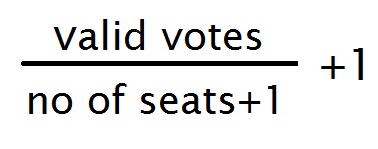
- The electorate number multiple candidates of which their are more than one for each party. They need to achieve a threshold of votes, determined using the formula above
- ADVANTAGES: - proportional - huge choice - fewer wasted votes as they are redistributed- greater chance for third parties
- DISADVANTAGES: -more complicated and confusing ballot paper - takes longer for the result to come out - could lead to alphabet voting - cuts the MP constituency link - increases the likelihood of coaltions
- SLE- Lab had 31.4% of seats and 32.2% of votes
- Higher on list meant 9.9% more votes than others
- DISADVANTAGES: -Broken MP constituency link - limited voters choice as they have no say over MP's just the party - gives greater power to MP's as they choice the order - tough for independent minded MP's -likely to leader coalitions as its harder to gain a majority
Imagens e arquivos do mapa
Informações
- Descrição
- Mapa Mental sobre ELECTORAL SYSTEMS, criado por Aisling Munnelly em 05-12-2015.
- Criado por
- Aisling Munnelly
- Visualizações
- 17
- Avaliação