
Mapa mental
Stress
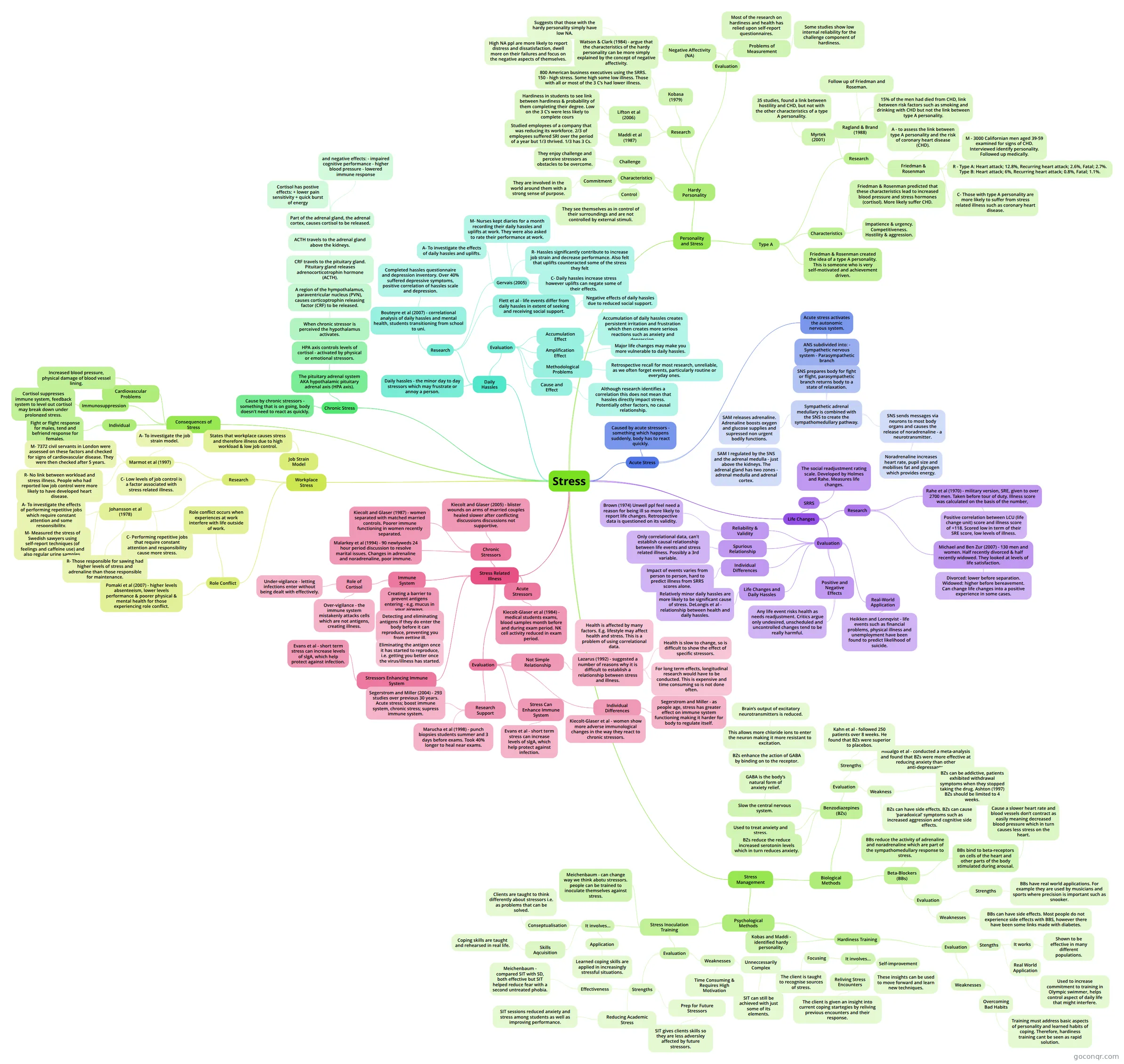
Mind map: stress
Conteúdo do mapa
Stress
Acute Stress
- Acute stress activates the autonomic nervous system.
- ANS subdivided into: - Sympathetic nervous system - Parasympathetic branch
- SNS prepares body for fight or flight, parasympathetic branch returns body to a state of relaxation.
- Sympathetic adrenal medullary is combined with the SNS to create the sympathomedullary pathway.
- SAM releases adrenaline. Adrenaline boosts oxygen and glucose supplies and supressed non urgent bodily functions.
- SAM I regulated by the SNS and the adrenal medulla - just above the kidneys. The adrenal gland has two zones - adrenal medulla and adrenal cortex.
- SNS sends messages via neurons to most body organs and causes the release of noradrenaline - a neurotransmitter.
- Noradrenaline increases heart rate, pupil size and mobilises fat and glycogen which provides energy.
- SAM releases adrenaline. Adrenaline boosts oxygen and glucose supplies and supressed non urgent bodily functions.
- Sympathetic adrenal medullary is combined with the SNS to create the sympathomedullary pathway.
- SNS prepares body for fight or flight, parasympathetic branch returns body to a state of relaxation.
- ANS subdivided into: - Sympathetic nervous system - Parasympathetic branch
- Caused by acute stressors - something which happens suddenly, body has to react quickly.
- Acute stress activates the autonomic nervous system.
Chronic Stress
- The pituitary adrenal system AKA hypothalamic pituitary adrenal axis (HPA axis).
- HPA axis controls levels of cortisol - activated by physical or emotional stressors.
- When chronic stressor is perceived the hypothalamus activates.
- A region of the hympothalamus, paraventricular nucleus (PVN), causes corticoptrophin releasing factor (CRF) to be released.
- CRF travels to the pituitary gland. Pituitary gland releases adrenocorticotrophin hormone (ACTH).
- ACTH travels to the adrenal gland above the kidneys.
- Part of the adrenal gland, the adrenal cortex, causes cortisol to be released.
- Cortisol has postive effects: + lower pain sensitivity + quick burst of energy
- and negative effects: - impaired cognitive performance - higher blood pressure - lowered immune response
- Part of the adrenal gland, the adrenal cortex, causes cortisol to be released.
- ACTH travels to the adrenal gland above the kidneys.
- CRF travels to the pituitary gland. Pituitary gland releases adrenocorticotrophin hormone (ACTH).
- A region of the hympothalamus, paraventricular nucleus (PVN), causes corticoptrophin releasing factor (CRF) to be released.
- When chronic stressor is perceived the hypothalamus activates.
- HPA axis controls levels of cortisol - activated by physical or emotional stressors.
- Cause by chronic stressors - something that is on going, body doesn't need to react as quickly.
- The pituitary adrenal system AKA hypothalamic pituitary adrenal axis (HPA axis).
Consequences of Stress
- Cardiovascular Problems
- Increased blood pressure, physical damage of blood vessel lining.
- Immunosuppression
- Cortisol suppresses immune system, feedback system to level out cortisol may break down under prolonged stress.
- Individual
- Fight or flight response for males, tend and befriend response for females.
- Cardiovascular Problems
Stress Related Illness
- Immune System
- Creating a barrier to prevent antigens entering - e.g. mucus in your airways.
- Detecting and eliminating antigens if they do enter the body before it can reproduce, preventing you from getting ill.
- Eliminating the antigen once it has started to reproduce, i.e. getting you better once the virus/illness has started.
- Detecting and eliminating antigens if they do enter the body before it can reproduce, preventing you from getting ill.
- Role of Cortisol
- Under-vigilance - letting infections enter without being dealt with effectively.
- Over-vigilance - the immune system mistakenly attacks cells which are not antigens, creating illness.
- Creating a barrier to prevent antigens entering - e.g. mucus in your airways.
- Acute Stressors
- Kiecolt-Glaser et al (1984) - medical students exams, blood samples month before and during exam period. NK cell activity reduced in exam period.
- Chronic Stressors
- Kiecolt and Glaser (2005) - blister wounds on arms of married couples healed slower after conflicting discussions discussions not supportive.
- Kiecolt and Glaser (1987) - women separated with matched married controls. Poorer immune functioning in women recently separated.
- Malarkey et al (1994) - 90 newlyweds 24 hour period discussion to resolve marital issues. Changes in adrenaline and noradrenaline, poor immune.
- Stressors Enhancing Immune System
- Evans et al - short term stress can increase levels of slgA, which help protect against infection.
- Evaluation
- Research Support
- Segerstrom and Miller (2004) - 293 studies over previous 30 years. Acute stress; boost immune system, chronic stress; supress immune system.
- Marucha et al (1998) - punch biopsies students summer and 3 days before exams. Took 40% longer to heal near exams.
- Stress Can Enhance Immune System
- Evans et al - short term stress can increase levels of slgA, which help protect against infection.
- Not Simple Relationship
- Lazarus (1992) - suggested a number of reasons why it is difficult to establish a relationship between stress and illness.
- Health is affected by many factors. E.g. lifestyle may affect health and stress. This is a problem of using correlational data.
- Health is slow to change, so is difficult to show the effect of specific stressors.
- For long term effects, longitudinal research would have to be conducted. This is expensive and time consuming so is not done often.
- Lazarus (1992) - suggested a number of reasons why it is difficult to establish a relationship between stress and illness.
- Individual Differences
- Kiecolt-Glaser et al - women show more adverse immunological changes in the way they react to chronic stressors.
- Segerstrom and Miller - as people age, stress has greater effect on immune system functioning making it harder for body to regulate itself.
- Research Support
- Immune System
Life Changes
- Research
- Rahe et al (1970) - military version, SRE, given to over 2700 men. Taken before tour of duty. Illness score was calculated on the basis of the number,
- Positive correlation between LCU (life change unit) score and illness score of +118. Scored low in term of their SRE score, low levels of illness.
- Michael and Ben Zur (2007) - 130 men and women. Half recently divorced & half recently widowed. They looked at levels of life satisfaction.
- Divorced: lower before separation. Widowed: higher before bereavement. Can change life changes into a positive experience in some cases.
- Rahe et al (1970) - military version, SRE, given to over 2700 men. Taken before tour of duty. Illness score was calculated on the basis of the number,
- Evaluation
- Spurious Relationship
- Only correlational data, can't establish causal relationship between life events and stress related illness. Possibly a 3rd variable.
- Individual Differences
- Impact of events varies from person to person, hard to predict illness from SRRS scores alone.
- Life Changes and Daily Hassles
- Relatively minor daily hassles are more likely to be significant cause of stress. DeLongis et al - relationship between health and daily hassles.
- Positive and Negative Effects
- Any life event risks health as needs readjustment. Critics argue only undesired, unscheduled and uncontrolled changes tend to be really harmful.
- Real-World Application
- Heikken and Lonnqvist - life events such as financial problems, physical illness and unemployment have been found to predict likelihood of suicide.
- Reliability & Validity
- Brown (1974) Unwell ppl feel need a reason for being ill so more likely to report life changes. Retrospective data is questioned on its validity.
- Spurious Relationship
- SRRS
- The social readjustment rating scale. Developed by Holmes and Rahe. Measures life changes.
- Research
Daily Hassles
- Research
- Bouteyre et al (2007) - correlational analysis of daily hassles and mental health, students transitioning from school to uni.
- Completed hassles questionnaire and depression inventory. Over 40% suffered depressive symptoms, positive correlation of hassles scale and depression.
- Gervais (2005)
- A- To investigate the effects of daily hassles and uplifts.
- M- Nurses kept diaries for a month recording their daily hassles and uplifts at work. They were also asked to rate their performance at work.
- R- Hassles significantly contribute to increase job strain and decrease performance. Also felt that uplifts counteracted some of the stress they felt
- C- Daily hassles increase stress however uplifts can negate some of their effects.
- Flett et al - life events differ from daily hassles in extent of seeking and receiving social support.
- Negative effects of daily hassles due to reduced social support.
- Bouteyre et al (2007) - correlational analysis of daily hassles and mental health, students transitioning from school to uni.
- Daily hassles - the minor day to day stressors which may frustrate or annoy a person.
- Evaluation
- Accumulation Effect
- Accumulation of daily hassles creates persistent irritation and frustration which then creates more serious reactions such as anxiety and depression.
- Amplification Effect
- Major life changes may make you more vulnerable to daily hassles.
- Methodological Problems
- Retrospective recall for most research, unreliable, as we often forget events, particularly routine or everyday ones.
- Cause and Effect
- Although research identifies a correlation this does not mean that hassles directly impact stress. Potentially other factors, no causal relationship.
- Accumulation Effect
- Research
Workplace Stress
- Job Strain Model
- States that workplace causes stress and therefore illness due to high workload & low job control.
- Research
- Marmot et al (1997)
- A- To investigate the job strain model.
- M- 7372 civil servants in London were assessed on these factors and checked for signs of cardiovascular disease. They were then checked after 5 years.
- R- No link between workload and stress illness. People who had reported low job control were more likely to have developed heart disease.
- C- Low levels of job control is a factor associated with stress related illness.
- Johansson et al (1978)
- A- To investigate the effects of performing repetitive jobs which require constant attention and some responsibility.
- M- Measured the stress of Swedish sawyers using self-report techniques (of feelings and caffeine use) and also regular urine samples.
- R- Those responsible for sawing had higher levels of stress and adrenaline than those responsible for maintenance.
- C- Performing repetitive jobs that require constant attention and responsibility cause more stress.
- Marmot et al (1997)
- Role Conflict
- Role conflict occurs when experiences at work interfere with life outside of work.
- Pomaki et al (2007) - higher levels absenteeism, lower levels performance & poorer physical & mental health for those experiencing role conflict.
- Job Strain Model
Personality and Stress
- Type A
- Friedman & Rosenman created the idea of a type A personality. This is someone who is very self-motivated and achievement driven.
- Characteristics
- Impatience & urgency. Competitiveness. Hostility & aggression.
- Friedman & Rosenman predicted that these characteristics lead to increased blood pressure and stress hormones (cortisol). More likely suffer CHD.
- Research
- Friedman & Rosenman
- A - to assess the link between type A personality and the risk of coronary heart disease (CHD).
- M - 3000 Californian men aged 39-59 examined for signs of CHD. Interviewed identify personality. Followed up medically.
- R - Type A: Heart attack; 12.8%, Recurring heart attack; 2.6%, Fatal; 2.7%. Type B: Heart attack; 6%, Recurring heart attack; 0.8%, Fatal; 1.1%.
- C- Those with type A personality are more likely to suffer from stress related illness such as coronary heart disease.
- Ragland & Brand (1988)
- 15% of the men had died from CHD, link between risk factors such as smoking and drinking with CHD but not the link between type A personality.
- Follow up of Friedman and Roseman.
- Myrtek (2001)
- 35 studies, found a link between hostility and CHD, but not with the other characteristics of a type A personality.
- Friedman & Rosenman
- Hardy Personality
- Characteristics
- Control
- They see themselves as in control of their surroundings and are not controlled by external stimuli.
- Commitment
- They are involved in the world around them with a strong sense of purpose.
- Challenge
- They enjoy challenge and perceive stressors as obstacles to be overcome.
- Control
- Research
- Maddi et al (1987)
- Studied employees of a company that was reducing its workforce. 2/3 of employees suffered SRI over the period of a year but 1/3 thrived. 1/3 has 3 Cs.
- Lifton et al (2006)
- Hardiness in students to see link between hardiness & probability of them completing their degree. Low on the 3 C’s were less likely to complete cours
- Kobasa (1979)
- 800 American business executives using the SRRS. 150 - high stress. Some high some low illness. Those with all or most of the 3 C’s had lower illness.
- Maddi et al (1987)
- Evaluation
- Negative Affectivity (NA)
- Watson & Clark (1984) - argue that the characteristics of the hardy personality can be more simply explained by the concept of negative affectivity.
- High NA ppl are more likely to report distress and dissatisfaction, dwell more on their failures and focus on the negative aspects of themselves.
- Suggests that those with the hardy personality simply have low NA.
- Watson & Clark (1984) - argue that the characteristics of the hardy personality can be more simply explained by the concept of negative affectivity.
- Problems of Measurement
- Most of the research on hardiness and health has relied upon self-report questionnaires.
- Some studies show low internal reliability for the challenge component of hardiness.
- Negative Affectivity (NA)
- Characteristics
- Type A
Stress Management
- Biological Methods
- Benzodiazepines (BZs)
- Used to treat anxiety and stress.
- Slow the central nervous system.
- GABA is the body’s natural form of anxiety relief.
- BZs enhance the action of GABA by binding on to the receptor.
- This allows more chloride ions to enter the neuron making it more resistant to excitation.
- Brain’s output of excitatory neurotransmitters is reduced.
- This allows more chloride ions to enter the neuron making it more resistant to excitation.
- BZs enhance the action of GABA by binding on to the receptor.
- GABA is the body’s natural form of anxiety relief.
- BZs reduce the reduce increased serotonin levels which in turn reduces anxiety.
- Evaluation
- Strengths
- Hildalgo et al - conducted a meta-analysis and found that BZs were more effective at reducing anxiety than other anti-depressants.
- Kahn et al - followed 250 patients over 8 weeks. He found that BZs were superior to placebos.
- Weakness
- BZs can be addictive, patients exhibited withdrawal symptoms when they stopped taking the drug. Ashton (1997) BZs should be limited to 4 weeks.
- BZs can have side effects. BZs can cause ‘paradoxical’ symptoms such as increased aggression and cognitive side effects.
- Strengths
- Beta-Blockers (BBs)
- BBs reduce the activity of adrenaline and noradrenaline which are part of the sympathomedullary response to stress.
- BBs bind to beta-receptors on cells of the heart and other parts of the body stimulated during arousal.
- Cause a slower heart rate and blood vessels don’t contract as easily meaning decreased blood pressure which in turn causes less stress on the heart.
- Evaluation
- Strengths
- BBs have real world applications. For example they are used by musicians and sports where precision is important such as snooker.
- Weaknesses
- BBs can have side effects. Most people do not experience side effects with BBS, however there have been some links made with diabetes.
- Strengths
- Benzodiazepines (BZs)
- Psychological Methods
- Stress Inoculation Training
- Meichenbaum - can change way we think abotu stressors. people can be trained to inoculate themselves against stress.
- It involves...
- Conseptualisation
- Clients are taught to think differently about stressors i.e. as problems that can be solved.
- Skills Aqcuisition
- Coping skills are taught and rehearsed in real life.
- Application
- Learned coping skills are applied in increasingly stressful situations.
- Conseptualisation
- Evaluation
- Strengths
- Effectiveness
- Meichenbaum - compared SIT with SD, both effective but SIT helped reduce fear with a second untreated phobia.
- Reducing Academic Stress
- SIT sessions reduced anxiety and stress among students as well as improving performance.
- Prep for Future Stressors
- SIT gives clients skills so they are less adversley affected by future stressors.
- Effectiveness
- Weaknesses
- Time Consuming & Requires High Motivation
- Unneccessarily Complex
- SIT can still be achieved with just some of its elements.
- Strengths
- Hardiness Training
- Kobas and Maddi - identified hardy personality.
- It involves...
- Focusing
- The client is taught to recognise sources of stress.
- Reliving Stress Encounters
- The client is given an insight into current coping startegies by reliving previous encounters and their response.
- Self-improvement
- These insights can be used to move forward and learn new techniques.
- Focusing
- Evaluation
- Stengths
- It works
- Shown to be effective in many different populations.
- Real World Application
- Used to increase commitment to training in Olympic swimmer, helps control aspect of daily life that might interfere.
- It works
- Weaknesses
- Overcoming Bad Habits
- Training must address basic aspects of personality and learned habits of coping. Therefore, hardiness training cant be seen as rapid solution.
- Overcoming Bad Habits
- Stengths
- Stress Inoculation Training
- Biological Methods
Informações
- Descrição
- Psychology (Stress) Mapa Mental sobre Stress, criado por smita089 em 12-04-2013.
- Criado por
- smita089
- Visualizações
- 257
- Tags
- Avaliação