
Mapa mental
Biting Flies 1
Conteúdo do mapa
Biting Flies 1
Stomoxys
- Stable Fly
- Life Cycle
- Spends most of ti's time off the host! Just settles on it's host to feed but spends most of it's time on buildings, foliage & fences. Attacks humans & animals WORLDWIDE
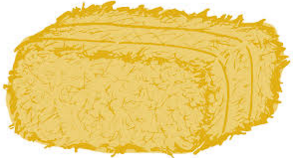
- Eggs laid on rotting straw!
- Completed in a month & then the adult only lives a month.
- How's it recognised?
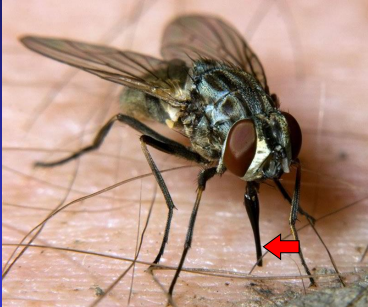
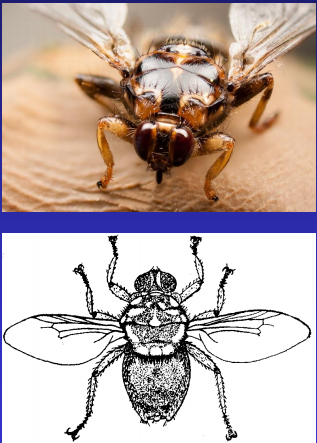
- Looks like a house fly
- KEY DIFFERENCE: Forward pointing proboscis shows that it's a biting fly
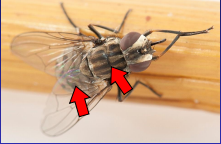
- Thorax = grey with darker grey stripes
- Abdomen = grey with black spots
- Looks like a house fly
- Pathogenic significance?
- Production losses
- Painful bite
- Can account for a 20% decrease in milk yield & weight gain!
- Disease transmission
- - Pathogenic bacteria + viruses (mechanical transmission) - Protozoa e.g. trypanosomes (mechanical transmission) - Helminths (intermediate host for Habronema)
- Production losses
- Control as you would a musca
Haematobia
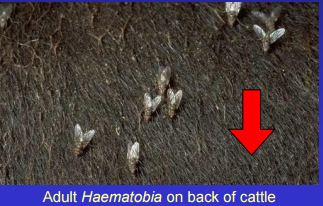
- Resident fly that spends most of it's time ON the host.
- Horn Fly
- Mostly in South England! Also Europe, USA & Australia
- Feed on places where the skin's thin!
- This can include the belly, dewlap & udder. It just rests along the back, shoulders & sides.
- Looks like a stable fly but smaller!
- The flies tend to face downwards when resting!
- Life Cycle
- Eggs laid in fresh cow poo!
- Larvae pupate in soil beneath dungpat
- Adult emerges within a week
- Larvae pupate in soil beneath dungpat
- Eggs laid in fresh cow poo!
- Pathogenic significance
- Production Losses
- Cluster around head annoying the sheep
- Bites - skin wounds - attract other muscid flies & blowflies
- Disease Transmission
- Pathogenic bacteria + viruses (mechanical transmission). Helminths (intermediate host for Stephanofilaria).
- Production Losses
- Why are horn flies easier to control than other musca species?
- They are in contact with the host more!
- Why is this also a disadvantage in terms of control?
- They develop insecticidal resistance more rapidly! As the concentration decreases over time the flies aren't killed immediately!
- Why is this also a disadvantage in terms of control?
- They are in contact with the host more!
Read the notes on the boxes!
Haematobia irritans = resident fly & stomoxys = just a visiting fly
Hippoboscidae
- Hippobosca spp.
- Loves horses & cows Old world (
- Forest Fly
- Most important species in UK = H. equina
- How is it recognised?
- It's bigger than the house fly!
- Medium sized fly
- 1cm
- Reddish-brown with yellow spots on thorax & abdomen
- Reduced wings & the veins are crowded towards the anterior margin (the front of the wing)
- They can't fly very well.
- Just jump from animal to animal.
- Biting mouthparts! The proboscis is retracted in the head except during feeding.
- They can't fly very well.
- Life Cycle
- Adult flies are about from May - October
- Mate on the host & the female deposits a SINGLE LARVAE in the soil / damp humus
- There's still an egg except it ruptures in the uterus & releases a larvae.
- The larvae pupate & adult flies emerge the following spring
- 1 YEAR
- Pathogenic significance
- Biting irritation & annoyance
- Large numbers are found on the perineum & inner thigh where there's thin skin.
- Mechanical vectors of non pathogenic Trypanosoma theileri in cattle
- Another type in sheep Don't panic it's normal!
- Biting irritation & annoyance
- Control
- Topical insecticide application (including repellant & residual action)
- Melophagus ovinus
- Sheep ked
- Sheep & goats Deer have a different species
- How is it recognised?
- Medium sized hairy fly
- 6mm long
- Biting mouthparts
- Forward pointing proboscis mounted on a short head.
- Wingless
- Strong legs & claws
- Medium sized hairy fly
- Life Cycle
- All ON THE HOST
- Although adult hosts may survive for one week off the hosts
- Female keds lay single larvae on the fleece which pupate.
- Adult ked lay single larvae on the fleece which pupate.
- The adult merges after a few weeks - months
- Temperature dependant
- The adult merges after a few weeks - months
- Adult ked lay single larvae on the fleece which pupate.
- All ON THE HOST
- Pathogenic Significance
- Most numerous when the fleece is long in autumn / winter
- Transmission = good because they're found on surface layers of the fleece
- Long wooled breeds = most susceptible.
- Anaemia if there'slots (suck blood)
- Wool damage
- Irritation
- Scratchy & results in self inflicted damage
- Staining by ked fleeces
- Irritation
- Intermediate host
- For non pathogenic Trypanosoma melophagium in sheep.
- Control
- Sheep dipping & spraying controls keds. Shearing reduces ked numbers.
- Sheep ked
- Hippobosca spp.
Imagens e arquivos do mapa
Informações
- Descrição
- Normally divided by whether they're land / water based! It shows us how to control them. Includes:Stomoxys, Haematobia, keds etc.
- Criado por
- elenifraser · fev 2016
- Atualizado
- 5 jul 2016
- Visualizações
- 28
- Avaliação