
Mapa mental
Long-Term Memory
Conteúdo do mapa
Long-Term Memory
LEVELS OF PROCESSING (LOP)
- Shallow vs. Deep Processing
- DEEP
- Involves close attention
- Focusing on meaning & relating to smth else
- SHALLOW
- Involves little attention to meaning
- Focused on superficial features
- Occurs during maintenance rehearsal
- DEEP
- 2 PREDICTIONS
- 1. Deep processing takes LONGER than Shallow
- 2. Deep processing = better memory than shallow
- Shallow vs. Deep Processing
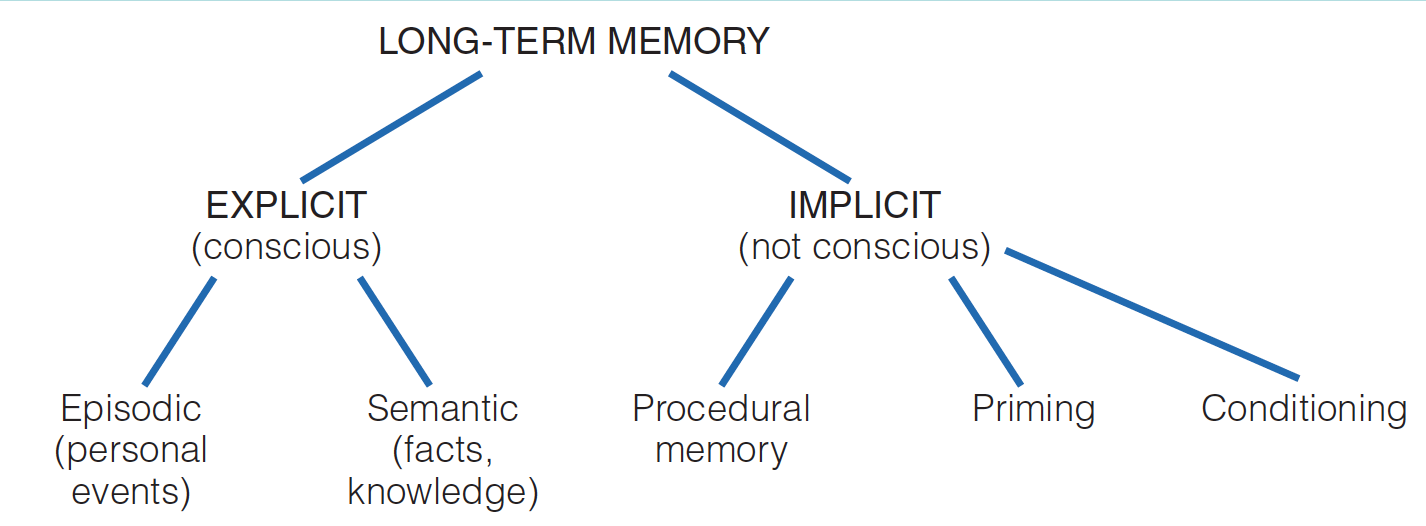
NON-DECLARATIVE / IMPLICIT
- Past experience influences our behavior, but we are not aware of the experience that is influencing our behavior
- REPETITION PRIMING
- Stem Completion Task
- Word Fragment Completion
- Incomplete Pictures
- PROPAGANDA EFFECT
- Believing that a statement read over & over again to be true
- PROCEDURAL MEMORY
- Stores info. on how to perform certain tasks
- Walking, talking, riding a bike
- Stores info. on how to perform certain tasks
DECLARATIVE
- Conscious recollection of events/facts experienced in the past
- Semantic System
- Facts, knowledge
- Episodic System
- Experience
MEMORY CONSOLIDATION
- Strengthening of neural info
- Standard Model of Consolidation
- RETRIEVAL
- depends on hippocampus during consolidation; after consolidation hippocampus is no longer needed
- REACTIVATION
- Hippocampus replays neural activity associated with memory
- RETRIEVAL
- Supports the fact that theres a consolidation process
- RETROGRADE AMNESIA
- Following a concussion
HIPPOCAMPUS
- Medial Temporal Lobe (MTL)
- Needed for forming conscious LTM
- Not needed for learning new procedures
- Important for consolidation
- Not where LTM is stored
- Not needed for Working/STM
TRANSFER APPROPRIATE PROCESSING (TAP)
- Evidence against LOP
- Deeper processing does not always lead to better memory
- ENCODING SPECIFICITY
- R/s between encoding & retrieval is crucial for memory
- Context in which learning occurs can be a retrieval cue
- Returning to (or re-creating) the context can enhance our memory for the original experience
- RETRIEVAL CUES
- E.g. In office, made a mental note not to forget my laptop. After returning to the office, where I was when I made the mental note (encoded/learned/studied) & was able to retrieve the memory.
- Free Recall vs. Cued Recall
- STATE-DEPENDENT LEARNING
- Memory is best when the person is in the same state for encoding & retrieval.
- E.g. Underwater/On Land, Noise/Quiet, Sad/Happy
- Evidence against LOP
RESEARCH & STUDYING
- ELABORATE
- Maintenance & Elaborative rehearsal
- Maintenance only good for STM
- Maintenance & Elaborative rehearsal
- ORGANIZE
- Chunking
- ASSOCIATE
- Create images
- Associate what you’re learning to what you already know
- TAKE BREAKS
- Distributed vs. Mass Practice
- Match Learning & Testing Conditions
- ELABORATE
THE INNOCENCE PROJECT
- EYEWITNESS MISIDENTIFICATION
- Single greatest cause of wrongful convictions
- Our mind is not like a tape recorder
- Single greatest cause of wrongful convictions
- BLIND ADMINISTRATION
- Administrator unaware of who the suspect is
- LINEUP COMPOSITION
- Fillers should resemble descriptions
- Suspect should not stand out
- Fillers should resemble descriptions
- INSTRUCTIONS
- Person told suspect may not be in lineup
- RECORDINGS
- Process taped for court evidence
- CONFIDENCE STATEMENTS
- After lineup, eyewitness tells his/her confidence
- SEQUENTIAL LINEUPS
- Present 1 by 1
- EYEWITNESS MISIDENTIFICATION
Imagens e arquivos do mapa
Informações
- Descrição
- Cognitive Mapa Mental sobre Long-Term Memory, criado por Zaneta Chan em 29-07-2016.
- Criado por
- Zaneta Chan
- Visualizações
- 0
- Avaliação