
Mapa mental
Life changes
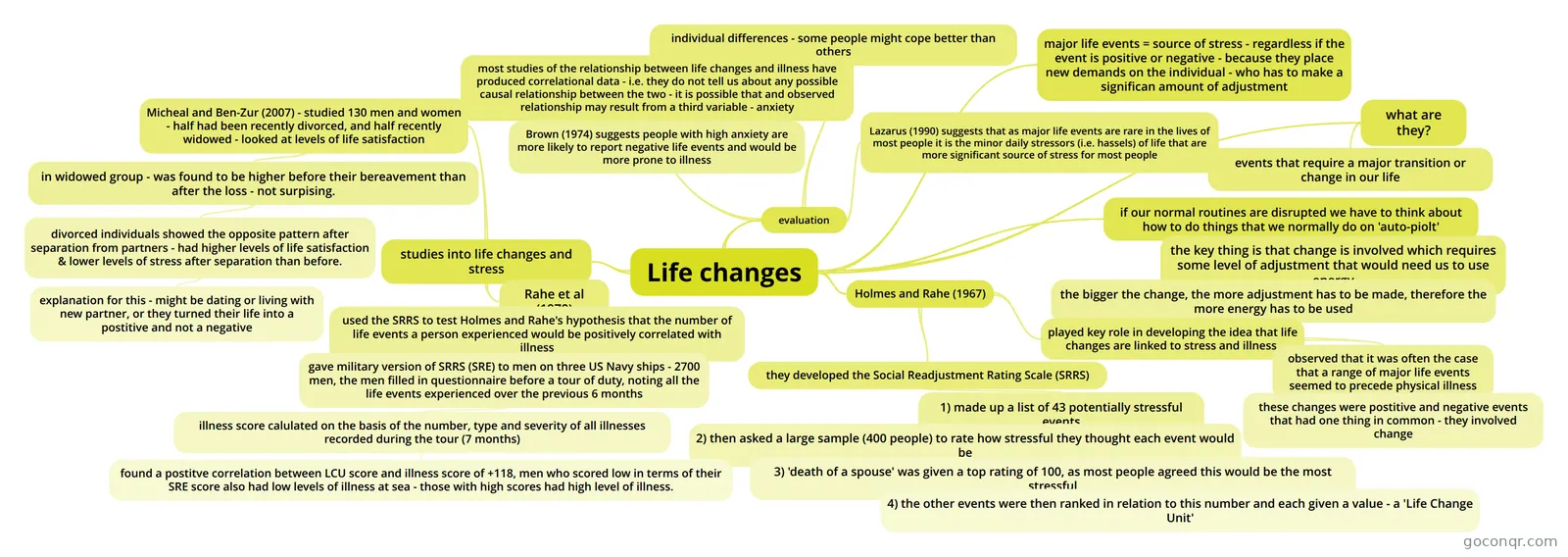
Mind map: life changes
Conteúdo do mapa
Life changes
what are they?
- events that require a major transition or change in our life
if our normal routines are disrupted we have to think about how to do things that we normally do on 'auto-piolt'
- the key thing is that change is involved which requires some level of adjustment that would need us to use energy
- the bigger the change, the more adjustment has to be made, therefore the more energy has to be used
- the key thing is that change is involved which requires some level of adjustment that would need us to use energy
major life events = source of stress - regardless if the event is positive or negative - because they place new demands on the individual - who has to make a significan amount of adjustment
Holmes and Rahe (1967)
- played key role in developing the idea that life changes are linked to stress and illness.
- observed that it was often the case that a range of major life events seemed to precede physical illness
- these changes were postitive and negative events that had one thing in common - they involved change
- observed that it was often the case that a range of major life events seemed to precede physical illness
- they developed the Social Readjustment Rating Scale (SRRS)
- 1) made up a list of 43 potentially stressful events
- 2) then asked a large sample (400 people) to rate how stressful they thought each event would be
- 3) 'death of a spouse' was given a top rating of 100, as most people agreed this would be the most stressful
- 4) the other events were then ranked in relation to this number and each given a value - a 'Life Change Unit'
- 3) 'death of a spouse' was given a top rating of 100, as most people agreed this would be the most stressful
- 2) then asked a large sample (400 people) to rate how stressful they thought each event would be
- 1) made up a list of 43 potentially stressful events
- played key role in developing the idea that life changes are linked to stress and illness.
studies into life changes and stress
- Rahe et al (1970)
- used the SRRS to test Holmes and Rahe's hypothesis that the number of life events a person experienced would be positively correlated with illness
- gave military version of SRRS (SRE) to men on three US Navy ships - 2700 men, the men filled in questionnaire before a tour of duty, noting all the life events experienced over the previous 6 months
- illness score calulated on the basis of the number, type and severity of all illnesses recorded during the tour (7 months)
- found a postitve correlation between LCU score and illness score of +118, men who scored low in terms of their SRE score also had low levels of illness at sea - those with high scores had high level of illness.
- illness score calulated on the basis of the number, type and severity of all illnesses recorded during the tour (7 months)
- gave military version of SRRS (SRE) to men on three US Navy ships - 2700 men, the men filled in questionnaire before a tour of duty, noting all the life events experienced over the previous 6 months
- used the SRRS to test Holmes and Rahe's hypothesis that the number of life events a person experienced would be positively correlated with illness
- Micheal and Ben-Zur (2007) - studied 130 men and women - half had been recently divorced, and half recently widowed - looked at levels of life satisfaction
- in widowed group - was found to be higher before their bereavement than after the loss - not surpising.
- divorced individuals showed the opposite pattern after separation from partners - had higher levels of life satisfaction & lower levels of stress after separation than before.
- explanation for this - might be dating or living with new partner, or they turned their life into a postitive and not a negative
- divorced individuals showed the opposite pattern after separation from partners - had higher levels of life satisfaction & lower levels of stress after separation than before.
- in widowed group - was found to be higher before their bereavement than after the loss - not surpising.
- Rahe et al (1970)
evaluation
- individual differences - some people might cope better than others
- most studies of the relationship between life changes and illness have produced correlational data - i.e. they do not tell us about any possible causal relationship between the two - it is possible that and observed relationship may result from a third variable - anxiety
- Brown (1974) suggests people with high anxiety are more likely to report negative life events and would be more prone to illness
- Lazarus (1990) suggests that as major life events are rare in the lives of most people it is the minor daily stressors (i.e. hassels) of life that are more significant source of stress for most people
Informações
- Descrição
- Psychology (Stress) Mapa Mental sobre Life changes, criado por samantha_x em 16-03-2014.
- Criado por
- samantha_x
- Visualizações
- 62
- Tags
- Avaliação