
Mapa mental
Lecture 2
Conteúdo do mapa
Lecture 2
PESTEL Analysis
- Political (interaction between business, society and government ) Economic (such as wage/price inflation) Socio-cultural (lifestyles and consumer tastes are always changing) Technological (emergence of new technology) Legal (covers every aspect) Ecological (marketing sustainability developed during 2000's)
- EG Political: Shell oil have a strong relationship with Nigerian government
- EG Economic: impact on machine tool industry
- EG socio-cultural- Levi Strauss struggled to attract younger generation despite being a huge market player
- EG Legal-Alcohol adverts can't be sexual or linked with courage
- Political (interaction between business, society and government ) Economic (such as wage/price inflation) Socio-cultural (lifestyles and consumer tastes are always changing) Technological (emergence of new technology) Legal (covers every aspect) Ecological (marketing sustainability developed during 2000's)
Scenario Planning (Burt, G) 2006
- not predictions or extrapolation but a description of current events and their projection into the future, it is a SOCIAL REASONING PROCESS
- COMBINING PESTEL AND SCENARIO PLANNING:
- both recognisde level of uncertainty, take into account multiple perspectives, considers range of plausible futures, implications for strategy
- EG Apple has been known to use this to keep their options open for the future and obsess over competitors actions to stay in the lead
- COMBINING PESTEL AND SCENARIO PLANNING:
- not predictions or extrapolation but a description of current events and their projection into the future, it is a SOCIAL REASONING PROCESS
Ramelt, R (1991) believes that even though industry can impact the business, it is mostly down to the individual organisations
- flaws in the industry are down to 'random distribution of especially high and low peforming businesses across industries'
- 5 forces critique: how much does industry really matter ? Rumelt's point
Porter's 5 forces (1979)
- Threat of new entry (product differentiation) threat of substitute products (threat of obsolesce) power of buyers (threaten backward vertical integration into raw materials) power of suppliers (threaten forward integration into retail) threat of rivalry (slow industry growth)
- As a rule, the stronger the 5 forces, the lower combined profitability of industry participants
- 5 forces critique:
- bias of economics over politics, less effective in unstable industries, static framework,no account of coorperation
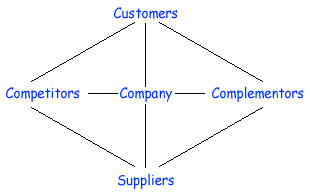
Brandenburg and Nalebuff's Value Net (1996) looks at cooperation which Porter ignores
- use game theory to show dynamic industries, once you have the 5 segments sorted then indentify all the elements in the game
- PARTS of the game: Players (construct relationships) Added values (measure what everyone brings to the game) Rules (structure of the way the game is being played) Tactics(devices to shape players' perception) Scope (limits and links of the game)
- CRITIQUES: game can become too complex, time consuming, can overestimate common interests and underestimate potential for conflict
- EG Intel invested into the application 'ProShare' in the mid-nineties which allowed people to hold video conferences online. Using the value net they found complimentary companies , telephone companies could sell faster connections to their shared customers and subsidised the cost for Proshare.
- use game theory to show dynamic industries, once you have the 5 segments sorted then indentify all the elements in the game
Imagens e arquivos do mapa
Informações
- Descrição
- Mapa Mental sobre Lecture 2, criado por Alina Mironova em 08-01-2017.
- Criado por
- Alina Mironova
- Visualizações
- 0
- Avaliação