
Mapa mental
AS Research Methods
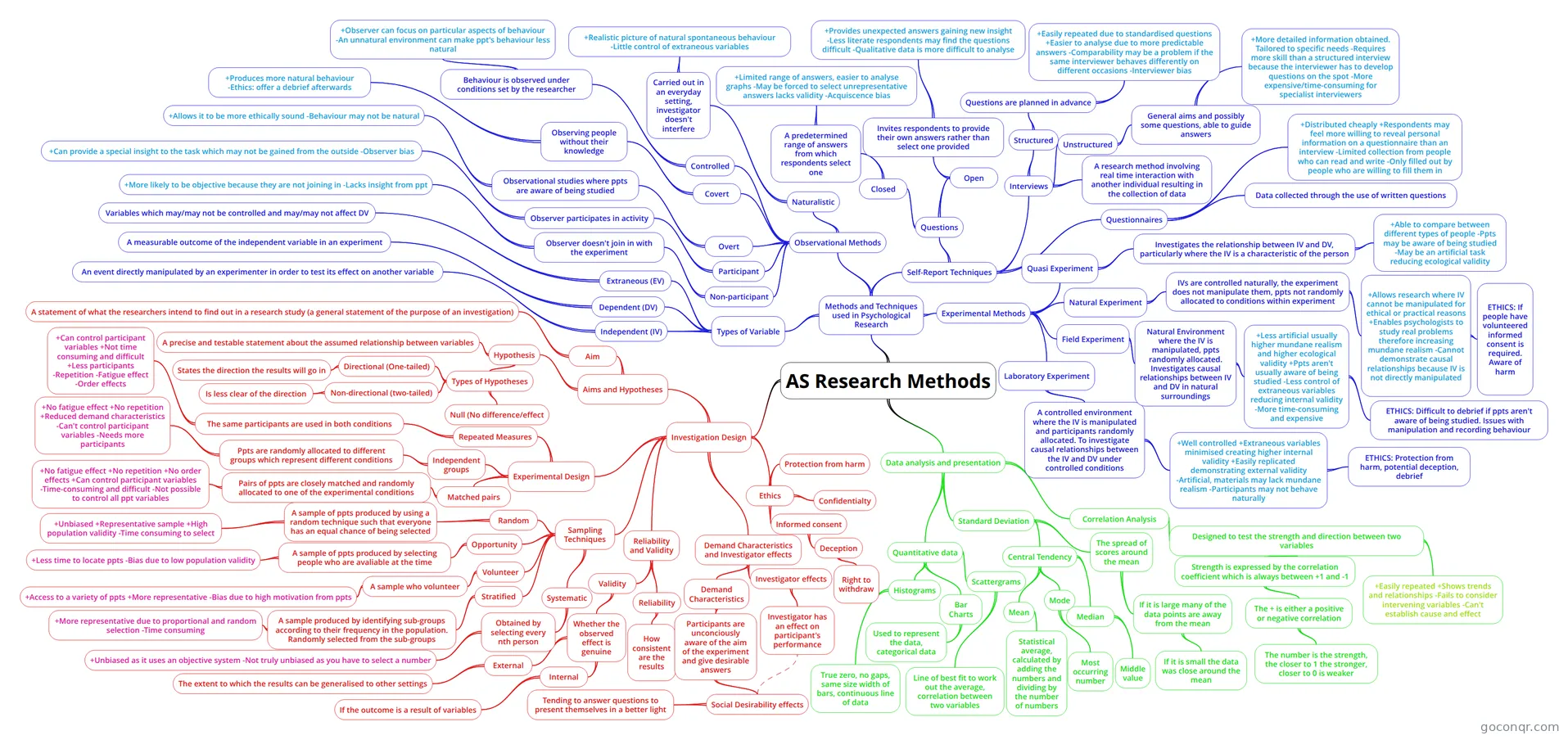
Mind map: AS Research Methods
Conteúdo do mapa
AS Research Methods
Investigation Design
- Aims and Hypotheses
- Aim
- A statement of what the researchers intend to find out in a research study (a general statement of the purpose of an investigation)
- Hypothesis
- A precise and testable statement about the assumed relationship between variables
- Types of Hypotheses
- Directional (One-tailed)
- States the direction the results will go in
- Non-directional (two-tailed)
- Is less clear of the direction
- Null (No difference/effect
- Directional (One-tailed)
- Aim
- Experimental Design
- Repeated Measures
- The same participants are used in both conditions
- +Can control participant variables +Not time consuming and difficult +Less participants -Repetition -Fatigue effect -Order effects
- The same participants are used in both conditions
- Independent groups
- Ppts are randomly allocated to different groups which represent different conditions
- +No fatigue effect +No repetition +Reduced demand characteristics -Can't control participant variables -Needs more participants
- Ppts are randomly allocated to different groups which represent different conditions
- Matched pairs
- Pairs of ppts are closely matched and randomly allocated to one of the experimental conditions
- +No fatigue effect +No repetition +No order effects +Can control participant variables -Time-consuming and difficult -Not possible to control all ppt variables
- Pairs of ppts are closely matched and randomly allocated to one of the experimental conditions
- Repeated Measures
- Sampling Techniques
- Random
- A sample of ppts produced by using a random technique such that everyone has an equal chance of being selected
- +Unbiased +Representative sample +High population validity -Time consuming to select
- A sample of ppts produced by using a random technique such that everyone has an equal chance of being selected
- Opportunity
- A sample of ppts produced by selecting people who are avaliable at the time
- +Less time to locate ppts -Bias due to low population validity
- A sample of ppts produced by selecting people who are avaliable at the time
- Volunteer
- A sample who volunteer
- +Access to a variety of ppts +More representative -Bias due to high motivation from ppts
- A sample who volunteer
- Stratified
- A sample produced by identifying sub-groups according to their frequency in the population. Randomly selected from the sub-groups
- +More representative due to proportional and random selection -Time consuming
- A sample produced by identifying sub-groups according to their frequency in the population. Randomly selected from the sub-groups
- Systematic
- Obtained by selecting every nth person
- +Unbiased as it uses an objective system -Not truly unbiased as you have to select a number
- Obtained by selecting every nth person
- Random
- Reliability and Validity
- Validity
- Whether the observed effect is genuine
- Internal
- If the outcome is a result of variables
- External
- The extent to which the results can be generalised to other settings
- Internal
- Whether the observed effect is genuine
- Reliability
- How consistent are the results
- Validity
- Demand Characteristics and Investigator effects
- Demand Characteristics
- Participants are unconciously aware of the aim of the experiment and give desirable answers
- Social Desirability effects
- Tending to answer questions to present themselves in a better light
- Social Desirability effects
- Participants are unconciously aware of the aim of the experiment and give desirable answers
- Investigator effects
- Investigator has an effect on participant's performance
- Demand Characteristics
- Ethics
- Protection from harm
- Confidentialty
- Informed consent
- Deception
- Right to withdraw
- Deception
- Aims and Hypotheses
Methods and Techniques used in Psychological Research
- Experimental Methods
- Laboratory Experiment
- A controlled environment where the IV is manipulated and participants randomly allocated. To investigate causal relationships between the IV and DV under controlled conditions
- +Well controlled +Extraneous variables minimised creating higher internal validity +Easily replicated demonstrating external validity -Artificial, materials may lack mundane realism -Participants may not behave naturally
- ETHICS: Protection from harm, potential deception, debrief
- +Well controlled +Extraneous variables minimised creating higher internal validity +Easily replicated demonstrating external validity -Artificial, materials may lack mundane realism -Participants may not behave naturally
- A controlled environment where the IV is manipulated and participants randomly allocated. To investigate causal relationships between the IV and DV under controlled conditions
- Field Experiment
- Natural Environment where the IV is manipulated, ppts randomly allocated. Investigates causal relationships between IV and DV in natural surroundings
- +Less artificial usually higher mundane realism and higher ecological validity +Ppts aren't usually aware of being studied -Less control of extraneous variables reducing internal validity -More time-consuming and expensive
- ETHICS: Difficult to debrief if ppts aren't aware of being studied. Issues with manipulation and recording behaviour
- +Less artificial usually higher mundane realism and higher ecological validity +Ppts aren't usually aware of being studied -Less control of extraneous variables reducing internal validity -More time-consuming and expensive
- Natural Environment where the IV is manipulated, ppts randomly allocated. Investigates causal relationships between IV and DV in natural surroundings
- Natural Experiment
- IVs are controlled naturally, the experiment does not manipulate them, ppts not randomly allocated to conditions within experiment
- +Allows research where IV cannot be manipulated for ethical or practical reasons +Enables psychologists to study real problems therefore increasing mundane realism -Cannot demonstrate causal relationships because IV is not directly manipulated
- ETHICS: If people have volunteered informed consent is required. Aware of harm
- +Allows research where IV cannot be manipulated for ethical or practical reasons +Enables psychologists to study real problems therefore increasing mundane realism -Cannot demonstrate causal relationships because IV is not directly manipulated
- IVs are controlled naturally, the experiment does not manipulate them, ppts not randomly allocated to conditions within experiment
- Quasi Experiment
- Investigates the relationship between IV and DV, particularly where the IV is a characteristic of the person
- +Able to compare between different types of people -Ppts may be aware of being studied -May be an artificial task reducing ecological validity
- Investigates the relationship between IV and DV, particularly where the IV is a characteristic of the person
- Laboratory Experiment
- Self-Report Techniques
- Questionnaires
- Data collected through the use of written questions
- +Distributed cheaply +Respondents may feel more willing to reveal personal information on a questionnaire than an interview -Limited collection from people who can read and write -Only filled out by people who are willing to fill them in
- Interviews
- A research method involving real time interaction with another individual resulting in the collection of data
- Unstructured
- General aims and possibly some questions, able to guide answers
- +More detailed information obtained. Tailored to specific needs -Requires more skill than a structured interview because the interviewer has to develop questions on the spot -More expensive/time-consuming for specialist interviewers
- General aims and possibly some questions, able to guide answers
- Structured
- Questions are planned in advance
- +Easily repeated due to standardised questions +Easier to analyse due to more predictable answers -Comparability may be a problem if the same interviewer behaves differently on different occasions -Interviewer bias
- Questions are planned in advance
- Questions
- Open
- Invites respondents to provide their own answers rather than select one provided
- +Provides unexpected answers gaining new insight -Less literate respondents may find the questions difficult -Qualitative data is more difficult to analyse
- Invites respondents to provide their own answers rather than select one provided
- Closed
- A predetermined range of answers from which respondents select one
- +Limited range of answers, easier to analyse graphs -May be forced to select unrepresentative answers lacks validity -Acquiscence bias
- A predetermined range of answers from which respondents select one
- Open
- Questionnaires
- Observational Methods
- Naturalistic
- Carried out in an everyday setting, investigator doesn't interfere
- +Realistic picture of natural spontaneous behaviour -Little control of extraneous variables
- Carried out in an everyday setting, investigator doesn't interfere
- Controlled
- Behaviour is observed under conditions set by the researcher
- +Observer can focus on particular aspects of behaviour -An unnatural environment can make ppt's behaviour less natural
- Behaviour is observed under conditions set by the researcher
- Covert
- Observing people without their knowledge
- +Produces more natural behaviour -Ethics: offer a debrief afterwards
- Observing people without their knowledge
- Overt
- Observational studies where ppts are aware of being studied
- +Allows it to be more ethically sound -Behaviour may not be natural
- Observational studies where ppts are aware of being studied
- Participant
- Observer participates in activity
- +Can provide a special insight to the task which may not be gained from the outside -Observer bias
- Observer participates in activity
- Non-participant
- Observer doesn't join in with the experiment
- +More likely to be objective because they are not joining in -Lacks insight from ppt
- Observer doesn't join in with the experiment
- Naturalistic
- Types of Variable
- Independent (IV)
- An event directly manipulated by an experimenter in order to test its effect on another variable
- Dependent (DV)
- A measurable outcome of the independent variable in an experiment
- Extraneous (EV)
- Variables which may/may not be controlled and may/may not affect DV
- Independent (IV)
- Experimental Methods
Data analysis and presentation
- Quantitative data
- Histograms
- True zero, no gaps, same size width of bars, continuous line of data
- Bar Charts
- Used to represent the data, categorical data
- Scattergrams
- Line of best fit to work out the average, correlation between two variables
- Histograms
- Standard Deviation
- Central Tendency
- Mean
- Statistical average, calculated by adding the numbers and dividing by the number of numbers
- Median
- Middle value
- Mode
- Most occurring number
- Mean
- The spread of scores around the mean
- If it is large many of the data points are away from the mean
- If it is small the data was close around the mean
- If it is large many of the data points are away from the mean
- Central Tendency
- Correlation Analysis
- Designed to test the strength and direction between two variables
- Strength is expressed by the correlation coefficient which is always between +1 and -1
- The + is either a positive or negative correlation
- The number is the strength, the closer to 1 the stronger, closer to 0 is weaker
- The + is either a positive or negative correlation
- +Easily repeated +Shows trends and relationships -Fails to consider intervening variables -Can't establish cause and effect
- Strength is expressed by the correlation coefficient which is always between +1 and -1
- Designed to test the strength and direction between two variables
- Quantitative data
Informações
- Descrição
- A level Psychology Mapa Mental sobre AS Research Methods, criado por Rebecca Johnson em 16-01-2017.
- Criado por
- Rebecca Johnson
- Visualizações
- 0
- Avaliação