
Mapa mental
Authentic Assessments
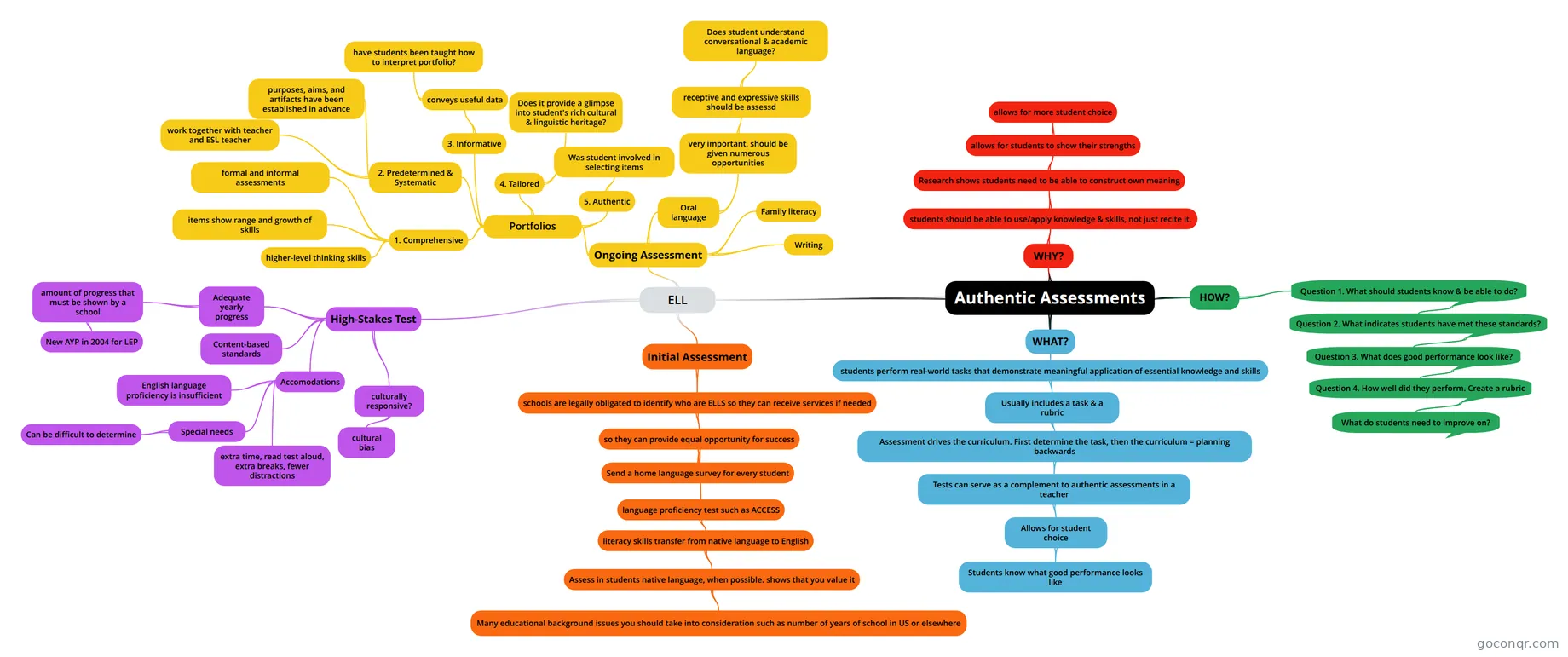
Mind map: Authentic assessments
Conteúdo do mapa
Authentic Assessments
students perform real-world tasks that demonstrate meaningful application of essential knowledge and skills
- Usually includes a task & a rubric
- Assessment drives the curriculum. First determine the task, then the curriculum = planning backwards
- Tests can serve as a complement to authentic assessments in a teacher
- Allows for student choice
- Students know what good performance looks like
- Allows for student choice
- Tests can serve as a complement to authentic assessments in a teacher
- Assessment drives the curriculum. First determine the task, then the curriculum = planning backwards
- Usually includes a task & a rubric
WHAT?
WHY?
- students should be able to use/apply knowledge & skills, not just recite it.
- Research shows students need to be able to construct own meaning
- allows for students to show their strengths
- allows for more student choice
- allows for students to show their strengths
- Research shows students need to be able to construct own meaning
- students should be able to use/apply knowledge & skills, not just recite it.
HOW?
- Question 1. What should students know & be able to do?
- Question 2. What indicates students have met these standards?
- Question 3. What does good performance look like?
- Question 4. How well did they perform. Create a rubric
- What do students need to improve on?
- Question 4. How well did they perform. Create a rubric
- Question 3. What does good performance look like?
- Question 2. What indicates students have met these standards?
- Question 1. What should students know & be able to do?
ELL
- Initial Assessment
- schools are legally obligated to identify who are ELLS so they can receive services if needed
- so they can provide equal opportunity for success
- language proficiency test such as ACCESS
- literacy skills transfer from native language to English
- Assess in students native language, when possible. shows that you value it
- Many educational background issues you should take into consideration such as number of years of school in US or elsewhere
- Assess in students native language, when possible. shows that you value it
- literacy skills transfer from native language to English
- Send a home language survey for every student
- language proficiency test such as ACCESS
- so they can provide equal opportunity for success
- schools are legally obligated to identify who are ELLS so they can receive services if needed
- Ongoing Assessment
- Portfolios
- 1. Comprehensive
- items show range and growth of skills
- higher-level thinking skills
- formal and informal assessments
- 2. Predetermined & Systematic
- purposes, aims, and artifacts have been established in advance
- work together with teacher and ESL teacher
- 3. Informative
- conveys useful data
- have students been taught how to interpret portfolio?
- conveys useful data
- 4. Tailored
- Does it provide a glimpse into student's rich cultural & linguistic heritage?
- 5. Authentic
- Was student involved in selecting items
- 1. Comprehensive
- Oral language
- very important, should be given numerous opportunities
- receptive and expressive skills should be assessd
- Does student understand conversational & academic language?
- receptive and expressive skills should be assessd
- very important, should be given numerous opportunities
- Writing
- Family literacy
- Portfolios
- High-Stakes Test
- Adequate yearly progress
- amount of progress that must be shown by a school
- New AYP in 2004 for LEP
- amount of progress that must be shown by a school
- Content-based standards
- Accomodations
- English language proficiency is insufficient
- Special needs
- Can be difficult to determine
- extra time, read test aloud, extra breaks, fewer distractions
- culturally responsive?
- cultural bias
- Adequate yearly progress
- Initial Assessment
Informações
- Descrição
- Mind map of authentic assessments for ESL students.
- Criado por
- Laura Galindo
- Visualizações
- 25
- Tags
- Avaliação