
Mapa mental
The authoritarian personality
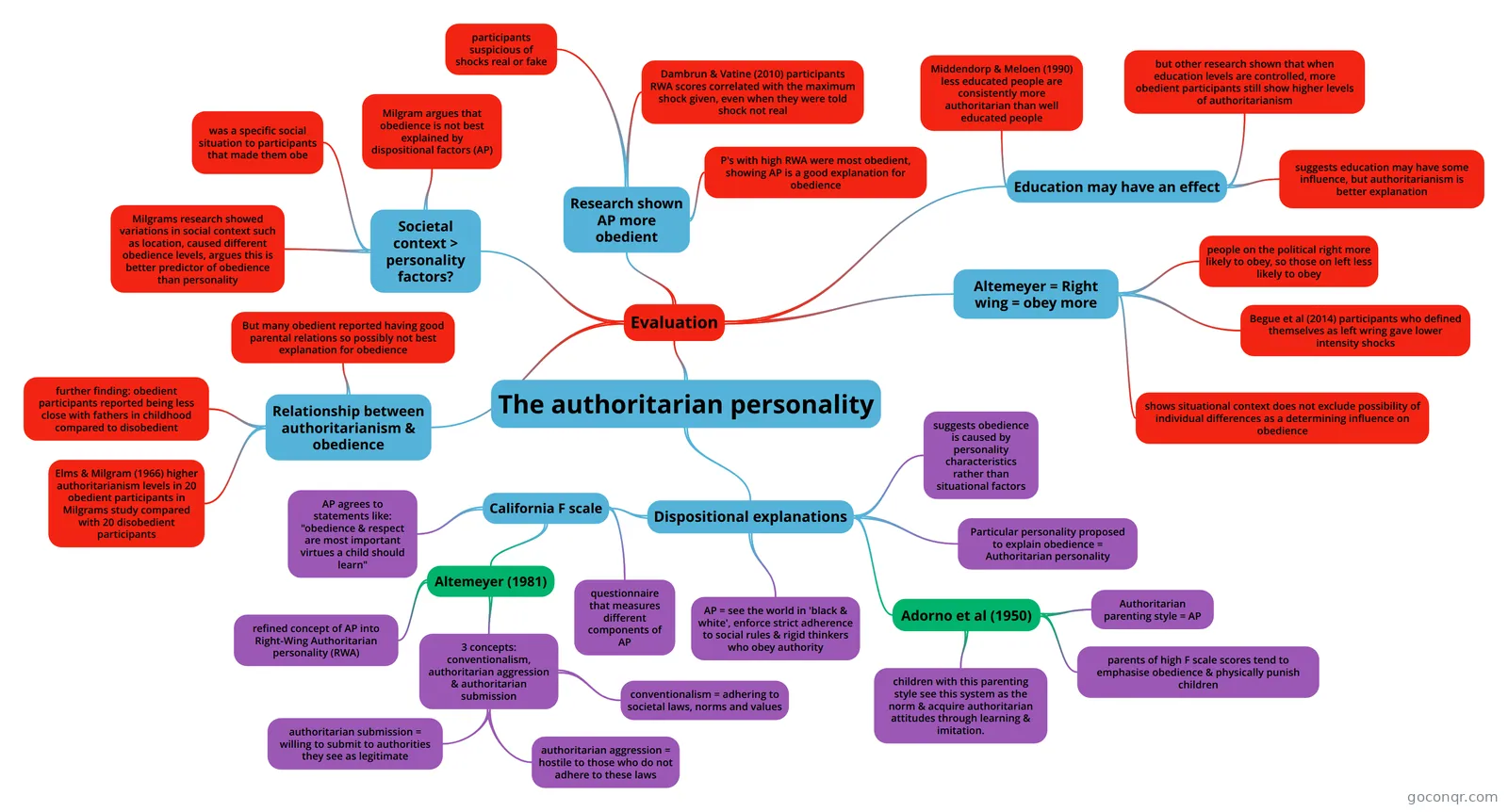
Mind map: The authoritarian personality
Conteúdo do mapa
The authoritarian personality
Dispositional explanations
- suggests obedience is caused by personality characteristics rather than situational factors
- Particular personality proposed to explain obedience = Authoritarian personality
- AP = see the world in 'black & white', enforce strict adherence to social rules & rigid thinkers who obey authority
- California F scale
- questionnaire that measures different components of AP
- AP agrees to statements like: "obedience & respect are most important virtues a child should learn"
- Altemeyer (1981)
- refined concept of AP into Right-Wing Authoritarian personality (RWA)
- 3 concepts: conventionalism, authoritarian aggression & authoritarian submission
- conventionalism = adhering to societal laws, norms and values
- authoritarian aggression = hostile to those who do not adhere to these laws
- authoritarian submission = willing to submit to authorities they see as legitimate
- Adorno et al (1950)
- Authoritarian parenting style = AP
- parents of high F scale scores tend to emphasise obedience & physically punish children
- children with this parenting style see this system as the norm & acquire authoritarian attitudes through learning & imitation.
Evaluation
- Relationship between authoritarianism & obedience
- Elms & Milgram (1966) higher authoritarianism levels in 20 obedient participants in Milgrams study compared with 20 disobedient participants
- further finding: obedient participants reported being less close with fathers in childhood compared to disobedient
- But many obedient reported having good parental relations so possibly not best explanation for obedience
- Societal context > personality factors?
- Milgrams research showed variations in social context such as location, caused different obedience levels, argues this is better predictor of obedience than personality
- was a specific social situation to participants that made them obe
- Milgram argues that obedience is not best explained by dispositional factors (AP)
- Research shown AP more obedient
- participants suspicious of shocks real or fake
- Dambrun & Vatine (2010) participants RWA scores correlated with the maximum shock given, even when they were told shock not real
- P's with high RWA were most obedient, showing AP is a good explanation for obedience
- Education may have an effect
- Middendorp & Meloen (1990) less educated people are consistently more authoritarian than well educated people
- but other research shown that when education levels are controlled, more obedient participants still show higher levels of authoritarianism
- suggests education may have some influence, but authoritarianism is better explanation
- Altemeyer = Right wing = obey more
- people on the political right more likely to obey, so those on left less likely to obey
- Begue et al (2014) participants who defined themselves as left wring gave lower intensity shocks
- shows situational context does not exclude possibility of individual differences as a determining influence on obedience
- Relationship between authoritarianism & obedience
Informações
- Descrição
- A level Psychology (Social Influence) Mapa Mental sobre The authoritarian personality, criado por Hannah Atkinson em 15-04-2017.
- Criado por
- Hannah Atkinson
- Visualizações
- 23
- Avaliação