
Mapa mental
Memory
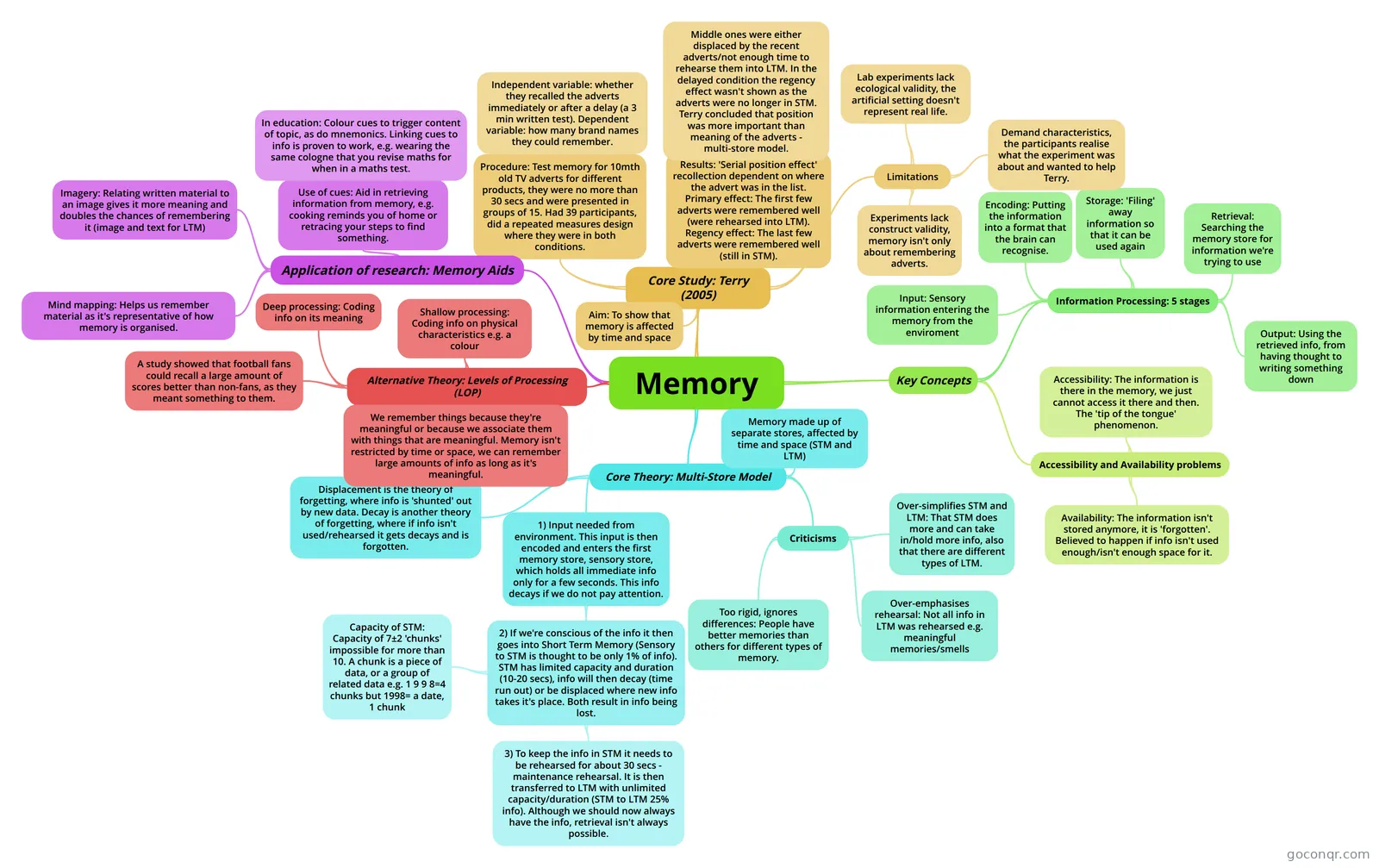
Mind map: memory multi-store model psychology
Conteúdo do mapa
Memory
Key Concepts
- Information Processing: 5 stages
- Encoding: Putting the information into a format that the brain can recognise.
- Storage: 'Filing' away information so that it can be used again
- Retrieval: Searching the memory store for information we're trying to use
- Output: Using the retrieved info, from having thought to writing something down
- Input: Sensory information entering the memory from the enviroment
- Accessibility and Availability problems
- Accessibility: The information is there in the memory, we just cannot access it there and then. The 'tip of the tongue' phenomenon.
- Availability: The information isn't stored anymore, it is 'forgotten'. Believed to happen if info isn't used enough/isn't enough space for it.
- Information Processing: 5 stages
Core Theory: Multi-Store Model
- Memory made up of separate stores, affected by time and space (STM and LTM)
- 1) Input needed from environment. This input is then encoded and enters the first memory store, sensory store, which holds all immediate info only for a few seconds. This info decays if we do not pay attention.
- 2) If we're conscious of the info it then goes into Short Term Memory (Sensory to STM is thought to be only 1% of info). STM has limited capacity and duration (10-20 secs), info will then decay (time run out) or be displaced where new info takes it's place. Both result in info being lost.
- 3) To keep the info in STM it needs to be rehearsed for about 30 secs - maintenance rehearsal. It is then transferred to LTM with unlimited capacity/duration (STM to LTM 25% info). Although we should now always have the info, retrieval isn't always possible.
- Capacity of STM: Capacity of 7±2 'chunks' impossible for more than 10. A chunk is a piece of data, or a group of related data e.g. 1 9 9 8=4 chunks but 1998= a date, 1 chunk
- 2) If we're conscious of the info it then goes into Short Term Memory (Sensory to STM is thought to be only 1% of info). STM has limited capacity and duration (10-20 secs), info will then decay (time run out) or be displaced where new info takes it's place. Both result in info being lost.
- Displacement is the theory of forgetting, where info is 'shunted' out by new data. Decay is another theory of forgetting, where if info isn't used/rehearsed it gets decays and is forgotten.
- Criticisms
- Too rigid, ignores differences: People have better memories than others for different types of memory.
- Over-simplifies STM and LTM: That STM does more and can take in/hold more info, also that there are different types of LTM.
- Over-emphasises rehearsal: Not all info in LTM was rehearsed e.g. meaningful memories/smells
Alternative Theory: Levels of Processing (LOP)
- We remember things because they're meaningful or because we associate them with things that are meaningful. Memory isn't restricted by time or space, we can remember large amounts of info as long as it's meaningful.
- Shallow processing: Coding info on physical characteristics e.g. a colour
- Deep processing: Coding info on its meaning
- A study showed that football fans could recall a large amount of scores better than non-fans, as they meant something to them.
Core Study: Terry (2005)
- Aim: To show that memory is affected by time and space
- Procedure: Test memory for 10mth old TV adverts for different products, they were no more than 30 secs and were presented in groups of 15. Had 39 participants, did a repeated measures design where they were in both conditions.
- Independent variable: whether they recalled the adverts immediately or after a delay (a 3 min written test). Dependent variable: how many brand names they could remember.
- Results: 'Serial position effect' recollection dependent on where the advert was in the list. Primary effect: The first few adverts were remembered well (were rehearsed into LTM). Regency effect: The last few adverts were remembered well (still in STM).
- Middle ones were either displaced by the recent adverts/not enough time to rehearse them into LTM. In the delayed condition the regency effect wasn't shown as the adverts were no longer in STM. Terry concluded that position was more important than meaning of the adverts - multi-store model.
- Limitations
- Lab experiments lack ecological validity, the artificial setting doesn't represent real life.
- Demand characteristics, the participants realise what the experiment was about and wanted to help Terry.
- Experiments lack construct validity, memory isn't only about remembering adverts.
Application of research: Memory Aids
- Use of cues: Aid in retrieving information from memory, e.g. cooking reminds you of home or retracing your steps to find something.
- In education: Colour cues to trigger content of topic, as do mnemonics. Linking cues to info is proven to work, e.g. wearing the same cologne that you revise maths for when in a maths test.
- Mind mapping: Helps us remember material as it's representative of how memory is organised.
- Imagery: Relating written material to an image gives it more meaning and doubles the chances of remembering it (image and text for LTM)
- Use of cues: Aid in retrieving information from memory, e.g. cooking reminds you of home or retracing your steps to find something.
Informações
- Descrição
- A Levels Psychology Mapa Mental sobre Memory, criado por Camron G em 02-06-2014.
- Criado por
- Camron G
- Visualizações
- 21
- Avaliação