
Notas
WHAP: Chapter 12- The Resurgence of Empire in East Asia
Conteúdo das notas (11)
Página 1
I Can...
Identify and Explain these features of the Song Dynasty:
Use of Confucianism
Imperial bureaucracies
Mandate of Heaven
Explain how Chinese Culture influenced areas nearby
Heian Japan
Spread of Buddhism
Split of Buddhism (Theravada, Mahayana, & Tibetan
Describe China innovation increasing its economy
Dependence on Peasants and Artisan
More production of textiles & porcelains
Expanded Trade Netwroks (Grand Canal)
Champa rice increasing food amounts
innovation with Steel & Iron production
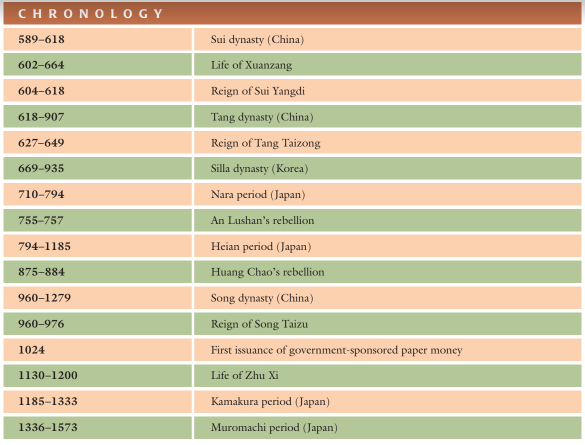
Página 2
Religions in China
Buddhism
Xuanzang (SHWEN-ZAHNG): young Buddhist Monk born in CHINA
Sought accurate info on Buddhism- traveled to INDIA (629 AD)
Emporer had mandated no one leave Chinese borders (had to sneak out)
Guide abandoned him in the Gobi Desert
Many other hardships (crossed three of the world's highest mountain ranges- Tian Shan, Hindu Kush, and Pamir)
Arrived India (630 AD), studied/lived there for >12yrs
brought books and knowledge back to China (645 AD)
Hero's welcome and meeting with Emporer
Devoted life to spreading Buddhism
Universal adoption throughout China
Foreign Religions in China:
Han Dynasty: Confucianism, Daoism and cults honoring family ancestors
Buddhism had little appeal at the time despite merchants traveling Silk Road (as early as 100 AD)
Fall of Han: introduction of other religion, including Nestorian Christianity, Manichaeism, Zoroastrianism, and Islam.
Communities (salvation religions) developed, but mostly for foreign merchants (not large following)
Mahayana Buddhism became popular
big community in Dunhang- built hundreds of cave temples w/ murals (600-1000 AD)
attracted Chinese because of high morality standards, intellectual sophistication, and promise of salvation
big community in Dunhang- built hundreds of cave temples w/ murals (600-1000 AD)
attracted Chinese because of high morality standards, intellectual sophistication, and promise of salvation
Conflict and Hostility w/ Buddhism:
Buddhism big on studying texts for metaphysics, Chinese on practical stuff, and Daoism hardly no studying
Buddhism emphasized abstanance from family and monastic lifestyle, while Chinese culture endorese fillial piety and having a family
Daoists and Confucians resented- diminished resource of following
Got gov. involed:(840 AD) Tang Emporers ordered closure of monestaries and expulsion of Buddhists, Zoroastrians, Nestorian Christians, and Manicheans
Not entirely eradicated
Buddhist missionaries altered message to Chinese audience:
"dharma" became the "dao" (daoistic 'the way') and nirvana (escape from reincarnation) "wuwei" (Daoistic noncompetition)
Chan Buddhism- Chinese school of Buddhism, focused on sudden flashes of insight in search for enlightenment (mix of Buddhism and Daoism)
Confucianism:
Zhu Xing
Neo-Confucianism: Confucianism returned, but with lots of Buddhist themes (studied metaphysics as well as political/moral thought, etc.)
Song Emperors didn't persecute Buddhists, but endoresed native Chinese cultural traditions
Influenced east Asia: shaped political, philisophical, and moral thought for half a millenium in China and surrouding areas (i.e. Korea, Vietnam, and Japan)
Página 3
Government: Sui Dynasty [Return of Centralized Imperial Rule](end of 500's AD)
Fall of Han Dynasty = war, invasion, conquest, foreign rule (disrupted Chinese Society)
Sui and Tang dynasties restored order
era of rapid economic growth
The Sui Dynasty (589-18 AD)
Yang Jian- Chinese ruler, military campaigns brought China under centralized rule
Established Sui dynasty (lasted less than 30 yrs), but centralized rule continued
started as duke of Sui (northern China)
(581 AD) claimed thrown and Mandate of Heaven for himself
(589 AD) Sui Dynasty had full control over China
Built strong centralized government
Infrastructure: ordered construction projects
Required high taxes and compulsory labor
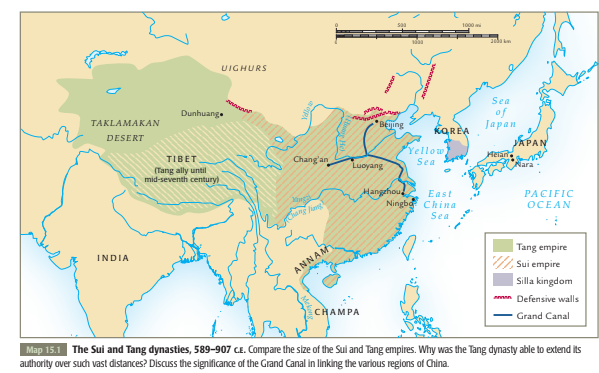
Grand Canal: series of artificial waterways that boosted trade (still functional today)
Sui Yangdi (604-618) wanted to guide trade between north. and south. China
Intended for trade of food crops from the Yangzi River valley
established economic foundation that aided political and economic unity
required millions of conscripted workers to build
People revolt ( late 610 AD) from compulsory labor & high taxes
Emporer (Sui Yangdai) assassinated (618 AD) - dynasty ended
Página 4
Overview: Sui and Tang Dynasties- Prosperity and Culture
Sui and Tang dynasties= economic growth & stability
Interactions with other nations
Culture Spread
Korea, Vietnam, and Japan
Página 5
Government: Tang Dynasty [Return of Centralized Imperial Rule]
The Tang Dynasty: (618-907 AD)
Rebel leader seized power after the death of Sui Yangdai- established Tang Dynasty
organized China-powerful, productive, and prosperous society
Tang Taizong (627-649 AD)-
Ruthless- murdered brothers for thone
Established era of prosperity and stability- No banditry, low taxes, low cost of rice
saw himself a Confucian Ruler
Capital city of Chang'an, secondary capital of Luoyan
Policies-
Trade/communication Networks:
inns, postal stations and stables along main routes
Couriers, foot runners, and relay teams (information, news, and fresh food)
Equal-Field System: governed allocation of agricultural land
allotted according to land fertility and needs of a family
created stability and prosperity in Chinese countryside
Worked for until early 700's AD -> collapsed because of pressure caused by population growth, corruption of nobles cheating the system, and Buddhist monasteries using big parcels
Bureaucracy based on merit
recruited gov. officials based on intellectual ability in Confucian Educational System
Workers were thus loyal and hard-working
Concept survived beyond Tang dynasty (Qing dynasty)
Military Expansion
biggest territorial empire in Chinese history
Expanded- brought Silla Kingdom (Korea), northern Vietnam, high plateau of Tibet, and areas as far as the Aral Sea under control
Established order: Tribute System (from Han Dynasty)
Foreign Relations
Chinese Politcal Theory: China was the Middle Kingdom- must conquer/bring under control other lands (tributary states)
Neighbors (tributary states) had to recognize authority of Chinese emperors, give regular gifts, and perform kowtow
Kowtow: ritual prostration; knelt before the emperor, foreheads on the ground
Compliance= rulers of tributary states could remain 'in power'
tentative rule, but stabalized trade, cultural exchanges, and diplomacy
Decline:
careless emperor -> An Lushan (military commander) led a rebellion, capturing the capital and secondary capital (755 AD)
Tang forces recaptured capital (763 AD) by asking help of Turkish people (Uighurs)
Uihgurs demanded rights to Chinese capital and Luoyang
Tang house degraded- invasions of Turkish peoples, military commanders technically became leaders
Last Tang Emperor abdicated throne (907 AD)
Página 6
Government: Song Dynasty [Return of Centralized Imperial Rule]
The Song Dynasty (960-1279 AD)
Rule:
Warlords ruled until Song Dynasty imposed imperial rule (late 900's)
Not a very strong state
Mistrusted military leaders- focus on civil administration, industry, education, and the arts
Song Taizu (reigned 960-976 AD)
Military officer- honest & effective; proclaimed emperor by his troops
used his army- Subjected warlords to authority & spread control of Song dynasty
tried organizing central administration- military forces under tight supervision
rulers expanded bureaucracy; easier access to Confucian education, civil service examinations, more people, higher wages
Downfall
Finance- high salaries/more gov. = higher costs = higher taxes
Bureaucratic scholars not good leading Military
Confined to southern China (early 1100's AD) when Jurchen (nomads) captured capital of Kaifeng
Mongols ended empire (1279 AD)
Página 7
Economics: Tang and Song China [Land of Economic Prosperity]
Agricultural Development:
Fast-Ripening Rice: two crops per year
New Agricultural Techniques
Heavy iron plows, harnessed oxen (north) and water buffaloes (south), manure, compost
Extensive irrigation, and terraced mountainsides
Urbanization
population growth- From 45 million (600 AD) to 115 million (1200 AD)
Chang'an was world's mo. populated city of the time
Market Economy:
Commercial Market- inexpensive produce, exporting throughout and outside the empire
Gov. played important role- regulated dist. and production of military sensitive industries (e.g. iron)
Foreign demand for chinese products
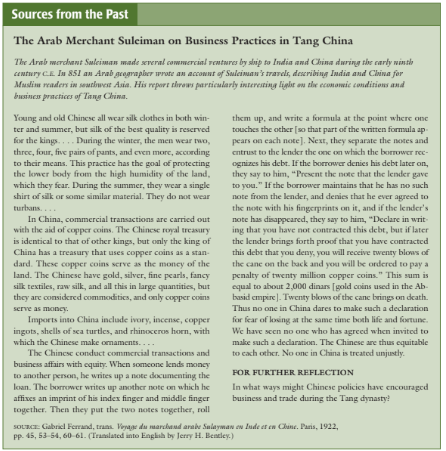
Financial Instruments: used copper coins; shortage = introduced use of "letters to credit," then later some promissory notes, checks, and paper money
Disorder when people wouldn't follow through on promises on temporary notes: mandated only government could print paper money (11th cent. AD)
Accountability: see SOURCES FROM THE PAST below
Cosmopolitan Society: trade by land and sea attracted merchants- Abbasid empire (Muslim), (central) Asia, Byzantine, Arab, Persian, Indian, Malay, etc.
Chinese developed taste for exotic goods
Página 8
Culture and Technological Developments: Tang and Song Dynasty
Social Structures:
respect of family ancestors: Sense of identity/connectedness in family
patriarchal
Foot-binding: tightly wrapping girls feet with cloth to prevent growth
couldn't walk- only used by wealthy families
Technological and Industrial Development:
Abundant food= pursuit of other things
Porcelain: pottery better adapted to versatile use, lighter, and thinner- high demand by wealthy and other countries
reputation: became known as chinaware
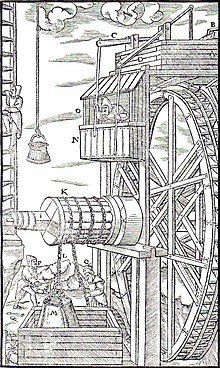
Metallurgy: resulted in surge of iron and steel production- went into weaponry and tools
Gunpowder: discovered highly flammable, military used in bamboo 'fire lances' (kind of flamethrower) and continued experimenting with potential use
Fireworks, called "Chinese Flowers" (7th century )and use of rockets in military
Seismograph
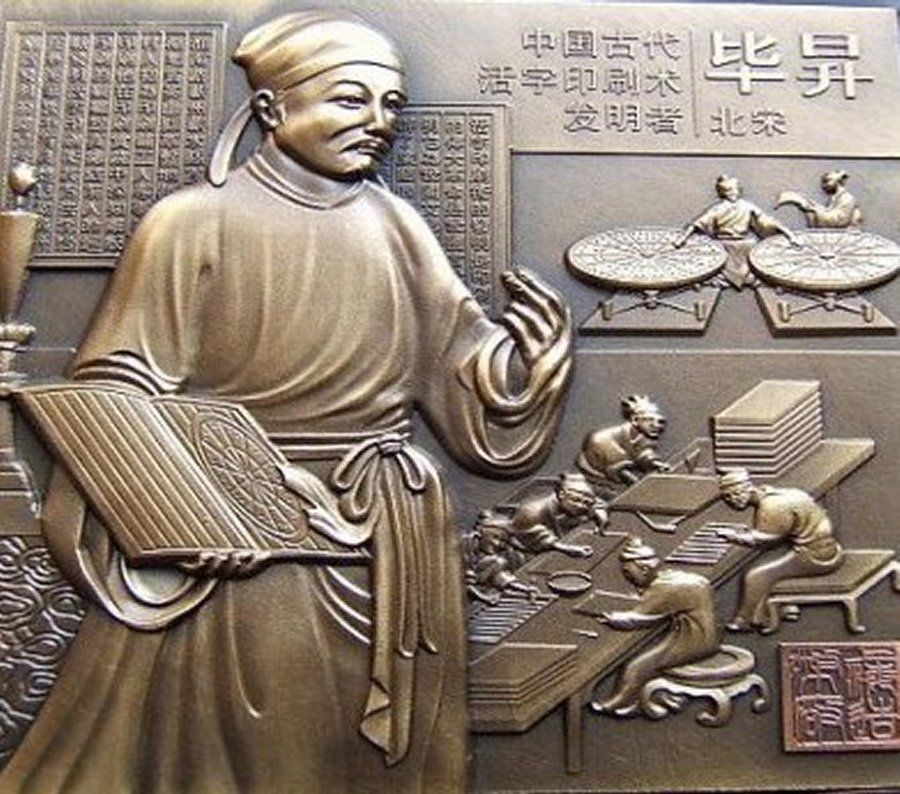
Printing: first used block-printing, developed until using reusable, movable type (mid 1000's AD
Allowed mass production of Buddhist texts, Confucuan works, calendars, agricultural treatises, and popular works
Popular in China, esp. SW
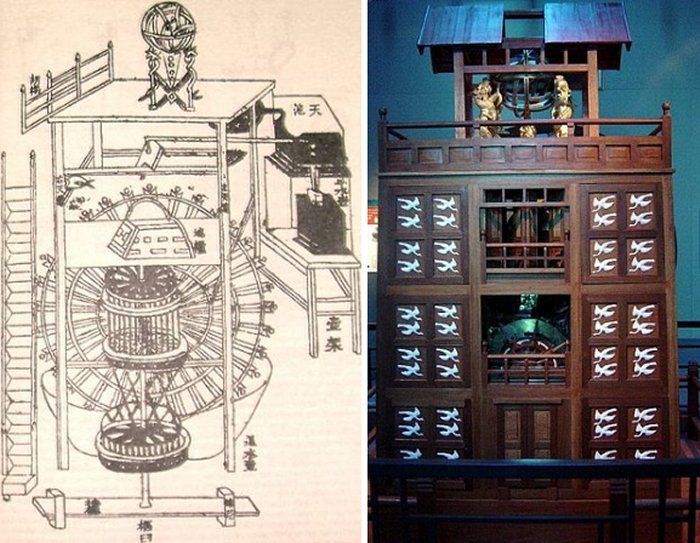
Naval Technology : aided in far nautical travel; magnetic compass,
Mariners used to stay close to land, but b/c of interest in spices/ecotic products from SE Asian Islands prompted innovations
Página 9
Chinese Influence in East Asia:
Chinese government/administration shaped public life in Korea, Vietnam, and Japan (inspiration)
large scale expansion by Tang into Korea and Vietnam
Silla Dynasty- chinese forces withdrew, Silla king recognized Tang emperor as overlord (tributary relationship)
Gifts, performance of kowtow, etc. bought them gifts from China and allowed merchants to trade
Korean interest in Chinese culture: began to model court after Chinese, scholars studied in China, Confucianism tradition, Buddhism
gov. sponsorerd Chinese schools and Confucian examination system
Vietnam: Tang armies tried to assimilate Viets into Chinese system. Adopted agriculture, irrigation, chinese schools, and administrative techniques, and entered tributary relationship
Viets resented Chinese authority
Women had more prominent role than in China: business ventures, markets, etc.
Early Japan: not invade by China, but culture still influenced.
Earliest inhabitants- nomads from NE Asia (ice age land bridges)
Agricultural society- small States (500 AD)
Nara Japan (710-794 AD): one state claimed imperial authority (influenced by China) and sought to centralize power in Japan with an imperial house
bureacracy, equal-field system, and official support for Confucianism and Buddhism
Made capitol of Nara (710 AD)
maintained Shinto (indigenous religon) ancestors, and nature spirits/deities
Heian Japan (794-1185 AD): local rulers on island of Honshu recognized emperor as supreme authority
Emperors: ceremonial figure (didn't really rule)
Fujiwara Family had power- controlled rule in background
longevity of house of emperors b/c no power= not deposed during turmoil
literature/official business written in Chinese
Decline: (late 1,000's AD) Heian court ended, equal-field system degraded, aristrocratic clans got mo. of land (estates)
Two clans mo. powerful- Taira and Minamoto engaged in war
Minamoto won (1185 AD) - claimed to rule in name of emperor (like Fujiwara family had)
Shogun: military governor ruling in place of the emperor
capitol at Kamakura
Medieval Japan: the Kamukara (1185-1333 AD) and Muromachi (1336-1573 AD) periods- middle era between chinese influence/court domination and modern age
Political decentralization: provincial lords had local authority (land and economic affairs)
Valued military talent and discipline over prev. ettiquite and courtesy-
Samurai: professional warriors- had role in politics and military, specialized in force and arts of fighting (riding, archery, hunting, and martial arts)
helped lords with enforce authority/territories, lords supported with food and labor service of peasants
Still ultimately influenced long term by what they'd borrowed from China (Confucian values, Buddhism, system of writing, and centralized imperial rule)
Página 10
Summary: The Resurgence of Empire in East Asia
revival of centralized rule affected most of east Asia and eastern hemisphere
Sui and Tang dynasties laid foundation of strong rule that allowed for industrial/technological innovation, rapid economic development
Countries in region interconnected by trade routes- Silk Road, and Sea Lanes
Religions traded- Nestorian Christianity, Zoroastrianism, Manichaens, Muslims, and most especially, Buddhism
Página 11
In-Class Notes: Building on Chapter 12
Millennium Series:
The Century of the Sword (1000's AD):
Modern China v. America government
Federal System: government and states have power
Chinese communism: government controls production
American capitalism and balance of power: people control production, government keeps one another in check
Informações
- Descrição
- -Restoration of Centralized Rule in China -The Economic Development of Tang And Song in China -Cultural Change in Tang and Song China -Chinese Influence in East Asia
- Criado por
- Elaine Paolo · set 2019
- Atualizado
- 14 out 2019
- Visualizações
- 65
- Tags
- Avaliação