
Notas
The Kidneys
Conteúdo das notas (3)
Página 1
The Kidneys Excrete Waste and Regulate Blood Water Potential
One of the main functions of the kidneys is to excrete waste products, such as urea.
The kidneys also regulate the water potential of the blood.
As the blood passes through the capillaries in the cortex (outer layer) of the kidneys, substances are filtered out of the blood into long tubules that surround the capillaries. This process is called ultrafiltration.
Useful substances, such as glucose and the right amount of water are then reabsorbed back into the blood. This process is called selective reabsorption.
The remaining unwanted substances pass along to the bladder and are excreted as urine.
Página 2
Blood is Filtered at the Start of the Nephrons
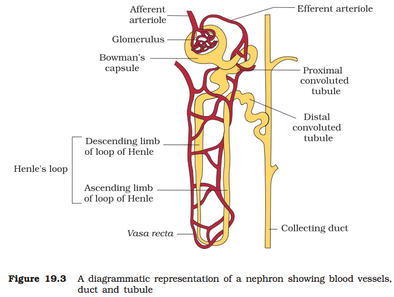
The long tubules along with the bundle of capillaries where the blood is filtered are called nephrons - there are around one million nephrons in each kidney.
Blood from the renal artery enters smaller arterioles in the cortex of the kidney.
Each arteriole splits into a structure called a glomerulus (plural, glomeruli) - a bundle of capillaries looped inside a hollow ball called a Bowman's Capsule.
This is where ultrafiltration takes place.
The arteriole that takes blood into each glomerulus is called the afferent arteriole, and the arteriole that takes the filtered blood away from the glomerulus is called the efferent arteriole.
The efferent arteriole is smaller in diameter than the afferent arteriole, so the blood in the glomerulus is under high pressure.
The high pressure forces liquid and small molecules in the blood out of the capillary through fenestrations (tiny pores) and into the Bowman's Capsule.
The liquid and small molecules pass through three layers to get into the Bowman's Capsule and enter the nephron's tubules - the capillary wall, a membrane (called the basement membrane) and the epithelium of the Bowman's Capsule.
Larger molecules like proteins and blood cells can't pass through, so stay in the blood. The substances that enter the Bowman's Capsule are known as the glomerular filtrate.
The golmerular filtrate passes along the rest of the nephron and useful substances are reabsorbed along the way.
Finally, the filtrate flows through the collecting duct and passes of the the kidney along the ureter.
Página 3
Useful Substances are Reabsorbed Along the Nephron Tubules
Selective reabsorption takes place as the glomerular filtrate flows along the proximal convoluted tubule (PCT) through the Loop of Henle, and along the distal convoluted tubule (DCT).
Useful substances leave the tubules of the nephrons and enter the capillary network that's wrapped around them (vasa recta).
The epithelium of the wall of the PCT has microvilli to provide a large surface area for the reabsorption of useful materials from the gomerular filtrate (in the tubules) into the blood (in the capillaries).
Useful solutes, like glucose, are reabsorbed along the PCT by active transport and facilitated diffusion.
Water enters the blood by osmosis because the water potential of the blood is lower than that of the filtrate. Water is reabsorbed from the PCT, Loop of Henle, DCT and the collecting duct.
The filtrate that remains is urine, which passes along the ureter to the bladder.
Urine is usually made up of:
Water and dissolved salts,
Urea,
Other substances such as hormones and excess vitamins.
Urine doesn't usually contain:
Proteins and blood cells - they're too big to be filtered out of the blood.
Glucose because it's actively reabsorbed back into the blood.
Informações
- Descrição
- A2 Biology (Homeostasis) Notas sobre The Kidneys, criado por Lucy Nove em 11-03-2017.
- Criado por
- Lucy Nove · mar 2017
- Atualizado
- 13 mar 2017
- Visualizações
- 7
- Avaliação