
2. Viruses
Slides do conjunto (19)
-
- Explain why the virus is not a life form
- Describe general features of viral replication
- Use hepatitis C, human immunodeficiency virus (HIV) and influenza viruses to illustrate specific aspects of virus replication
- Use terminology correctly
- Compare bacteria and viruses
- Outline challenges in fighting infectious disease
-
- Viruses and prions are non-living organisms- prions do not have genetic info and are thought to consist of single protein:
- Small- need e microscope to visualise- makes research harder= less antiviral drugs
- Varied shapes- filamentous, icosahedron (symmetrical, 20 faces that each consist of proteins that self-assemble, not a life form)
- Obligate intracellular parasites- uses host cell, virus must be infectious to endure nature (maintain itself and have selection pressure)
- Depend on biochemical machinery of host cell to replicate- use host processes to produce their components
- Can't make energy or proteins independent of host- non-living
- Replication is by self-assembly of individual viral components: NA, capsid
- Genome is DNA or RNA
-
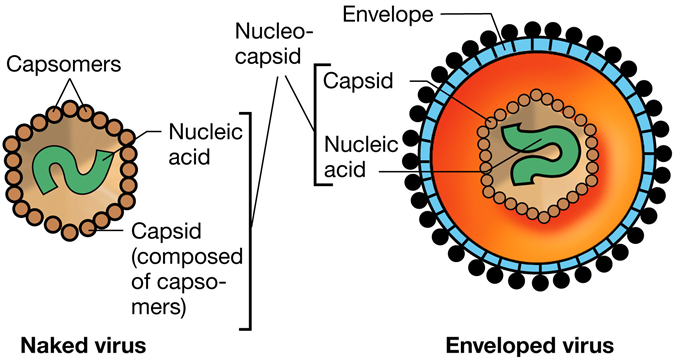
- Naked virus:
- Viral genome: DNA/RNA, ss/ds
- Capsid: composed of capsomeres#
- Nucleocapsid= capsid + genetic info
- Enveloped virus:
- Nucleocapsid surrounded by envelope derived from host cell when virus buds off
- Spike proteins (glycoproteins) involved in contact with host cell
- Virion- infective viral particle:
- Enveloped= nucleocapsid + envelope
- Non-enveloped= nucleocapsid is virion
-
- Naked: eg Polio
- More stable when under environmental stress- more problematic as don't have to remain wet to be stable due to no membrane
- Spreads more easily
- Survives gut, poor water treatment
- Enveloped: Influenza, HIV, ebola
- Must be wet to stay infectious- lipids not stable when dry out, airborne transmission less likely
- Very sensitive to detergents
- Spread through large droplets (coughing)
- Doesn't need to kill cell to spread (buds off instead)
-
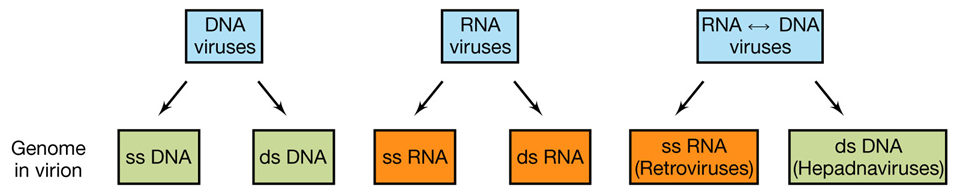
- Legenda: How virus is replicated depends on the identity of the NA and strategy of genome replication (lifecycle)
-
- Assembly of new viral particles requires:
- Copies of the viral genome
- Viral proteins- make mRNA (+RNA) to be translated, DNA -> mRNA -> protein (mRNA/+RNA is made from DNA or -RNA)
- Viral genome must code proteins for all processes not provided by host:
- Proteins for progeny viral particles (capsid, spikes)
- Enzymes for genome replication
- Proteins for interference with host immune defence (immunomodulatory)
-
Making mRNA for Translation into Protein
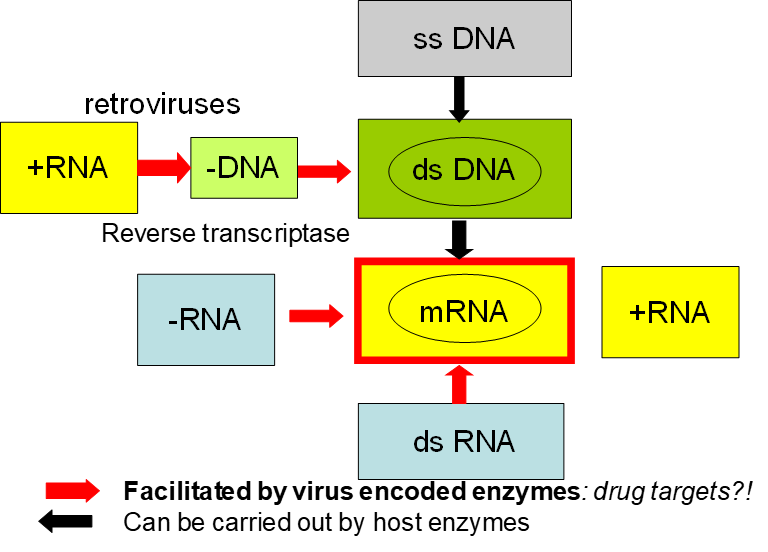
- dsDNA= transcription to mRNA
- +RNA= ready for translation (already mRNA)
- -RNA= virus encoded enzyme that copies to complementary stand
- Retrovirus= already has +RNA in capsid but has evolved to go through DNA phase +RNA -> -DNA -> dsDNA -> mRNA
- Red arrows= viral protein needed
-
Making new Viral Genome Copies
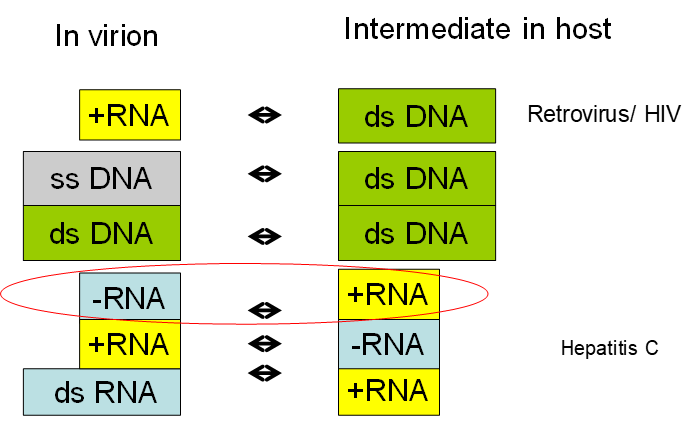
- Has to go through complementary intermediate phase in host
-
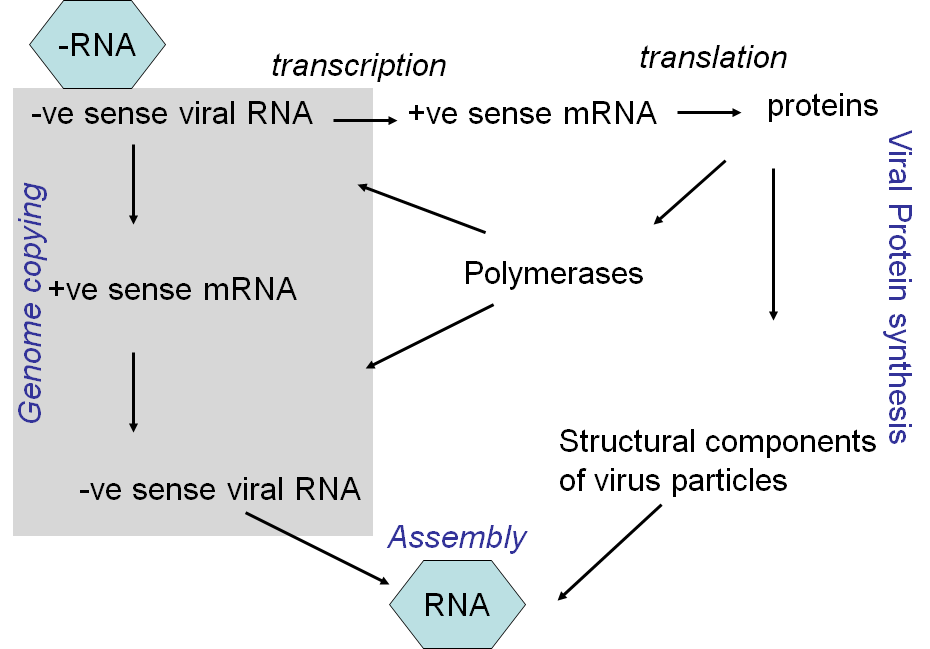
Making the Viral Particle for ssRNA(-)
- Start= -RNA (intermediate = +RNA)
- Making genome copies= -RNA-> +RNA -> -RNA
- Making proteins= -RNA -> +mRNA (transcription) -> protein (translation)
- Polymerases made to make genetic info
- Once all components are made= self-assembly
-
Stages of Infectious (Productive) Cycle
- Find host cell with specific receptors to attach to (tissue specificity)
- Penetration of cell
- Uncoating of virus particle
- Replication (gene expression)- location specific to each virus (nucleus or not)
- Assembly
- Release- budding/lysis
-
Penetration/Entry for a Enveloped Virus
- 1st Strategy: immediate membrane fusion
- Fusion of virus envelope with host cell membrane and insert nucleocapsid
- Site of virus entry formed by receptor( and coreceptor for some eg HIV)
- 2nd Strategy(active): Initial entry of complete virus
- Initial entry by endocytosis
- Followed by escape involving fusion with endosomal membrane
- All virus have in common: virus particle is assembled intracellularly
-
Variable Yield+Speed of Viral Replication
- Host cell properties and viral properties combined define how many and how fast new particles are released:
- Attachment to host cell surface- right interaction
- Replication- host cell metabolic activity
- Affects lab experiments- data dependent on animal/tissue model system may delay research of some viruses
-
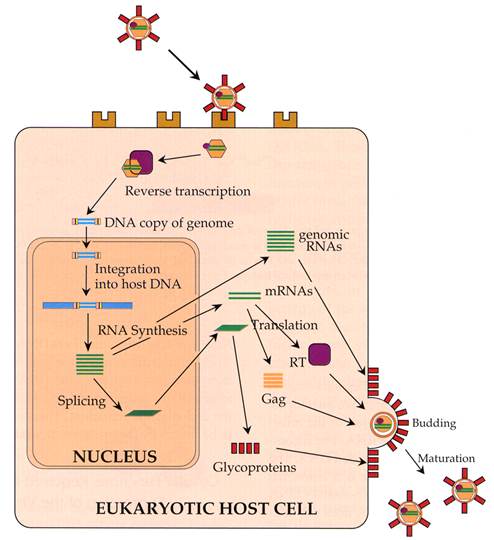
- Attachment, co-receptor binding, fusion...
- Upon fusion, viral RNA released from capsid
- Genome is RNA- requires viral enzyme reverse transcriptase to make DNA
- Viral genome integrates into host cell chromosomal DNA via integrase= persistent infection (cant get out without damaging DNA)
- Transcribed into mRNA and transported from nucleus to cytoplasm
- Translation to polypeptide which is cleaved to produce functional viral proteins
- Assemble at cell membrane and budding
-
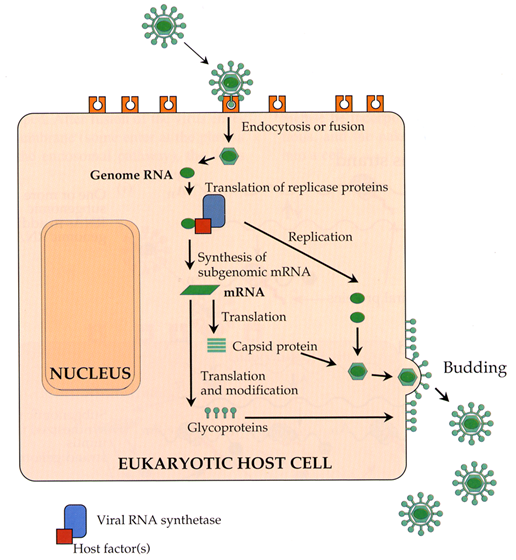
+RNA Virus: Hepatitis C (+ssRNA infects)
- Entire life cycle is extra-nuclear:
- Host receptors bind glycoproteins, membrane fusion, release of nucleocapsid
- +RNA immediately translated to polypetide and cleaved to make viral proteins (including viral polymerase)
- Viral polymerase participates in trasncription of -RNA (acts as template to make +RNA copies)
- Self-assembly and fusion of membrane, budding
- Blood-borne virus that causes liver disease
-
-RNA Virus: Ebola, Influenza -ssRNA infects
- Carry unique enzymes in capsids that facilitate replication (to kickstart process)
- Entire lifecycle is extra-nuclear but influenza transcription occurs in the nucleus
- Virus released by budding
- Influenza spike glycoproteins:
- HA= Hemagglutinin - recognised and binds siaalic acid containing receptor on host cell (erythrocytes + upper respiratory tract cells)
- NA= Neuraminidase- exosialidase, cleaves sialic acid from adjacent sugar residue in glycoprotein and is involved with release of virus from cell
-
- Helps the virus approach target cells= cleavage of sialic acids from respiratory tract mucins
- Assists in fusion of viral and cell membranes
- Facilitates budding of new virions by preventing their aggregation HA of one of interacting with sialylated glycans of the second one
- Structure of the neuraminidase active site is strictly conserved and inhibitors are used as drugs
-
- Influenza: HA and NA are susceptible to antigenic drift (mutation) and shift (recombination)
- New strains and subtypes of influenza emerge
- Pandemics/ epidemics as a result
- Eg H7N9 HA evolved mutations to make it similar to human proteins= immune camouflage
- HIV: viral reverse transcriptase is highly error prone
- Many genomic variants made every time RNA is reverse transcribed to DNA
- All HIV particles are slightly different, can get some more effective than others so selection pressure leads to rapid evolution
- Few effective anti-viral drugs are available:
- Viruses use our machinery so we can target few things: entry, uncoating, genome regulation
-
Why viral infections are problematic
- Few drugs available and drug resistance
- High mutagenic rates
- Emerging infectious disease
- Latent and persistent infections
- latent = virus doesnt lead to disease but can be re-awakened eg coldsore
- Chronic= results in chronic illness
- Can initiate cancer- integrates into genome and makes oncogenes
- Re-emerging infectious diseases (polio)
- Public health issues/ transmission: clean water, upheaval, education
-
Transmission routes: Virus specific
- Food and water bourne
- Human to human: air/aerosols eg sneezing, oral/fecal, exhcange bodily fluids
- Vector eg mosquito
- Foodbourne bacterial pathogens:
- EHEC- transmission from cow to human host
- Listeria monocytogenes- transmission from animal to human via milk and dairy, meat or transmission from plants to human (effects pregnant women, immunocompromised, children, elderly)
- Waterbourne bacterial pathogen:
- Vibrio cholera- unclean water (chitin) to human