
Flashcards
Psychoacoustics Flashcards
Flashcards do conjunto (105)
- 1What type of wave is a Sound Wave and What does this mean?Longitudinal wave, meaning that the motion of particles is along the direction of propagation
- 2What is the difference between a sound and light wave?Sound wave is longitudinal, whereas a light wave is transverse. So it moves perpendicular to the direction of propagation
- 3What are the 6 properties of waves?1. Shape
2. Phase
3. Frequency
4. Amplitude
5. Intensity
6. Speed - 4Define WavelengthThe distance between 2 successive crests
- 5Define FrequencyHow many cycles pass by per second
Hertz = cycles oer second - 6Define AmplitudeThe maximum extent of a vibration or oscillation, measured from the position of equilibrium
- 7What is Sound Intensity?Power carried by sound waves and characterised by Decibels (dB)
Every increase of 20dB, means the pressure wave is 10 times greater than the amplitude - 8What are Complex Sounds?A sound composed of a number of sounds of different frequencies
- 9How are complex sounds analysed?Using Fourier Trsnsform/Theorem
- 10What are the 4 different types of boundary behaviour of sound?1. Reflection
2. Transmission
3. Refraction
4. Diffraction - 11What is meant by Reflection?Sound bounces of a surface
- 12What is meant by Transmission?Sound goes through a surface
- 13What is meant by Refraction?Sound goes through a surface but changes speed and angle
- 14What is meant by Diffraction?Sound spreads around the obstacle
- 15What is the Doppler Effect? When does it occur?The shift in frequency caused by motion. Occurs when a sound is moving at speeds less than the speed of sound
- 16What is the difference between Subsonic and Supersonic?Subsonic is when an object is moving slower than the speed of sound.
Supersonic is when an object is moving faster than the speed of sound - 17What happens when an object is moving at Supersonic speeds?Shockwaves form where the wave fronts pile up. The pressure change across the shockwave causes a Sonic Boom
- 18What are the 2 important functions of the ear?1. Enable us to hear
2. Sensory organ of balance or equilibrium - 19What is the Outer Ear made up of?- Pinna/Auricle
- Auditory Canal/External Acoustic Meatus
- Tympanic Membrane/Ear Drum - 20What is the purpose of the outer ear?Collects sound, causes spectral changes and an increase in sound level
Concha and canal are perfect size to cause a gain in acoustic pressure - 21What is Cerumen and what are its purposes?Ear Wax
- Repel Water
- Trap dust, sand, micro organisms, ect
- Moisturise epithelium
- Odour discourage insects
- Antibiotic, antiviral and antifungal
- Cleanse ear canal - 22What is the Middle ear made up of?- Ossicles : Malleus, Incus, Stapes
- Eustachian Tube
- Round and Oval Window - 23What is the function of the Middle Ear?- Transducer: converts acoustic energy > mechanical energy > hydraulic energy
- Amplifier: low-impedance airborne sounds to the higher-impedance fluid of the inner ear & boosts pressure up to x200 - 24What is the Eustachian Tube?Operates like a valve to equalise pressure on either side of eardrum
- 25What is the the purpose of the Oval window?Membrane covering the entrance to the cochlea. When the eardrum vibrates, the sound waves travel via the ossicles on to the oval window. Causing fluids of inner ear to move and start neural hearing process
- 26What is the purpose of the Round window?Vibrates in opposite phase to vibrations entering inner ear through the oval window. Allowing fluid in cochlea to move
- 27What are the Middle Ear muscles?1. Tensor Tympani: attached to Malleus
2. Stapedius: attached to stapes - 28What is the purpose of the Middle ear muscles?1. Help maintain ossicles in proper position
2. Protect inner ear from excessive sound levels - 29What makes up the Inner ear?1. Semicircular canals: Superior, Posterior & Lateral
2. Vestibule
3. Cochlea - 30What is the Inner Ear?Fluid filled organ which converts hydraulic waves to neural impulses that can be recognised by the brain
- Posture & balance
-Hearing - 31What is the Cochlea's main function?Translate hydraulic motion caused by the stapes and the inner ear into neural responses in the auditory branch of the VIIIth cranial nerve
- 32What 3 fluid filled canals of the Cochlea? What type of fluid is contained in them?1. Scala tympani: perlymph more Na+
2. Scala media
3. Scala vestibuli: endolymph more K+ - 33What is the purpose of the Organ of Corti?Transducing mechanical motion into electrical activity, and nerve fibers which transmit the electrical activity to the brain where it is perceived as auditory signals
- 34What are the sequence of events from Cochlea to Brain after Sound enters ear canal? T.O.A.O.F.O.T TOA-OFOT1. Tympanic membrane vibrates
2. Ossicles vibrate
3. Intensity of vibration is amplified
4. Oval window vibrates
5. Vibrations are conducted through fluid
6. Hair cells in the Organ of Corti are stimulated
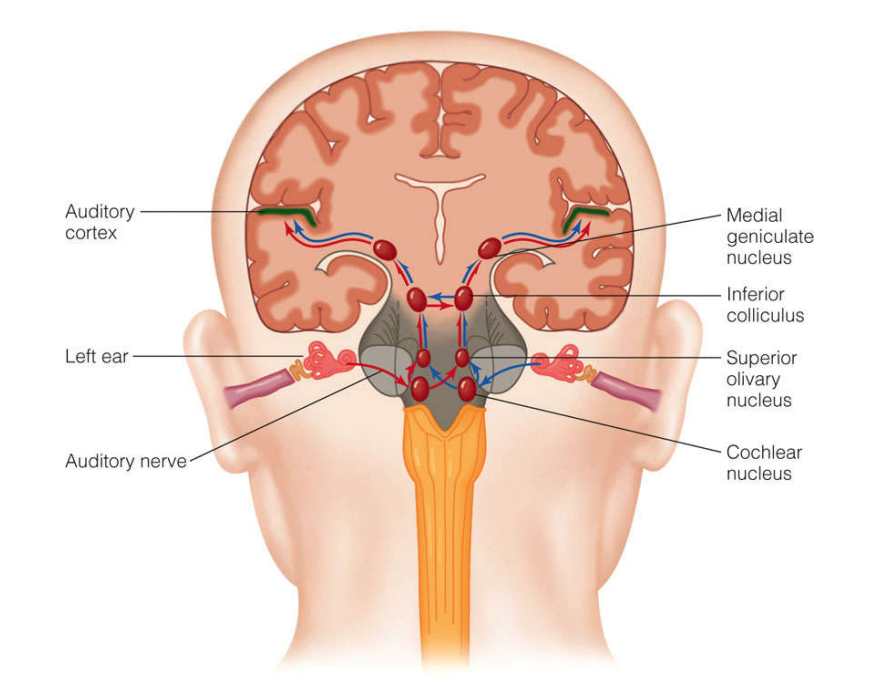
7. Cochlear nerve transmits to brain - 35What are the basic steps in the Auditory Central Nervous System? A.C.S.I.M.A1. Action potentials from Cochlear branch of auditory nerve
2. Cochlear Nucleus signal goes to SO on both sides
3. Superior Olive (SO)
4. Inferior Colliculus
5. Medial Geniculate Body
6. Auditory Cortex - 36What is Tonotopy?The spatial arrangement of where sounds of different frequency are processed in the brain
- 37What are the 3 planes of Sound Localisation?1. Horizontal Plane/Azimuth
2. Verticale Plane
3. Distance Plane - 38What 3 cues help determine where sound is coming from?1. Interaural Time Difference
2. Interaural Level Difference
3. Head-Related Transfer Function - 39What is meant by Interaural Time Difference?Difference between times sound reaches the ears
- Varies with frequency: become smaller with higher frequencies - 40What is meant by Interaural Level Difference?- Directional filtering properties of external ears and shadowing effect of head produce interaural difference in sound pressure levels
- Capture the difference in the level of sound intensity (pressure level) that a sounf reaches left and right ears - 41What is meant by Head-Related Transfer Function?Describes how torso, head and pinna affect amplitude, frequency and phase which also aid in localising sound
- 42How does distance relate to loudness?- Sound energy from source declines with distance
- Sound level declines by 6dB for each doubling of distance - 43Sound distance and Frequency?The quality of sound (frequency) is modified by the atmosphere
- 44Sound distance and Movement Parallax?The nearby sound moves more quickly that the far away sound
- 45Sound distance and Direct Sound vs. Reflected Sound?- Nearby sound tends to be direct, distant sounds tends to be indirect
- Reflections from walls, objects ect affect spectral cues and interaural level difference in idiosyncratic ways - 46How is Pitch determined?Hair cells on the basilar membrane
- 47What is meant by the Paradox of Pitch?The fundamental frequency does not determine pitch, so if you take the f0 out, the pitch is still the same
- 48How can Loudness by measured?Intensity (Sound energy transmitted per second through medium); dB
- 49What does the Perception of Loudness depend on?- Frequency and duration of the sound
- Increase in sound level: increased basilar membrane movement - leads to increased firing rate in the neurons of the auditory nerve
- Spread of activity to adjacent neurons
- Louder sounds result in increased cortical activation - 50What is meant by Timbre?Perceptual attribute which sets 2 different sounds apart which are equal in pitch and loudness
- The character or quality of a musical sound or voice - 51What are the four principles of object analysis?1. Analysis of info that corresponds to things in sensory world
2. Separation of info related to the object and related to rest of sensory world
3. Abstraction of sensory info so that info about an object can be generalised between modalities and experience
4. Generalisation between senss - 52What is Auditory Scene Analysis (ASA)?The analysis of the mixture of auditory objects which arrive at our ears simultaneously
- 53What is Gestalt psychology?Perceive objects in their entirety before perceiving their individual parts
- 54What Grouping Principles underlie ASA?- Simultaneous grouping cues (across frequency): errors lead to blending of sounds that sound be separate
- Simultaneous grouping cues (across time): errors leading to separating sounds that should be one object - 55What Cues are used to solve the problem of grouping/segregating waveforms?1. Common onsets
2. Fundamental frequency and harmonicity
3. Common inter-aural differences - 56What are the Gerstalt principles in regards to audition?- Proximity: small intervals in pitch & time
- Similarity: constant timbre
- Closure: hearing missing or inaudible tones
- Good Continuation: rising pattern continues to rise - 57What is Tonotopy?Conversion from frequency to position that originates on the basilar membrane is maintained all the way up to the auditory cortex
- 58What is the "What" stream of hearing responsible for and where does it start?What or Ventral stream: responsible for identifying sounds - starts in anterior portion of the core and belt and extends to the prefrontal cortex
- 59What is the "Where" stream of hearing responsible for and where does it start?Where or Dorsal stream: responsible for locating sounds - starts in posterior core and belt and extends to the parietal and prefrontal cortex
- 60What is Echolocation?Biological sonar - involves emitting calls and listening to the echoes of those calls that return form various objects near them
- 61What are the 3 main problems bats have to solve?1. Auditory Scene Analysis - separate echoes that return from multiple targets
2. Sensorimotor Transformations - convert sensory info into motor actions
3. Spatial memory & Navigation - finding own pups, roosting spot inside cave and for some long-rang migration - 62What are the 2 major differences between reptiles and mammals auditory bone structure?1. Reptiles have at least 4 bones in the lower jaw while mammals have only 1
2. Reptiles have only one main middle ear bone (stapes), while mammals have 3 - 63Define Language?System for representing and communicating complex conceptual structures, irrespective of modality
- 64Define Speech?That particular auditory/vocal medium typically used by humans to convey language
- 65What changes were required for Speech?1. Peripheral mechanisms - relating to vocal acoustics and anatomy
2. Central neural mechanism - those that underlie vocal control and imitation - 66What is the purpose of the Larynx?- Protection for the inside structure and the trachea
- Closes at the Epiglottis and Glottis during swallowing to protect the lungs from receiving unwanted artifacts - 67What is the purpose of the Vocal Chords?- Modulating airflow from the lungs and determining its resonant frequency
- 68Define Paresis?Weakness of one or both vocal folds, causing inefficient opening and closing
- 69How are Polyps and Nodules causedOveruse and cigarette smoke will change the quality of the voice, leading to hoarseness, diplophonia and pain
- 70What produces the articulators that make intelligible sounds out of the raw sound wave produced in the Larynx?- Pharynx
- Velum (soft palate)
- Oral cavity
- Nasal cavity - 71What is the purpose of the Velum (soft palate)?Separate the oral cavity from the nasal cavity in order to produce speech sounds
- 72What is the purpose of the Hard Palate?The interaction between the tongue and the hard palate is essential in the formation of certain speech sounds. t/d/c/s
- 73Why is Voice Perception important?- Carries speech
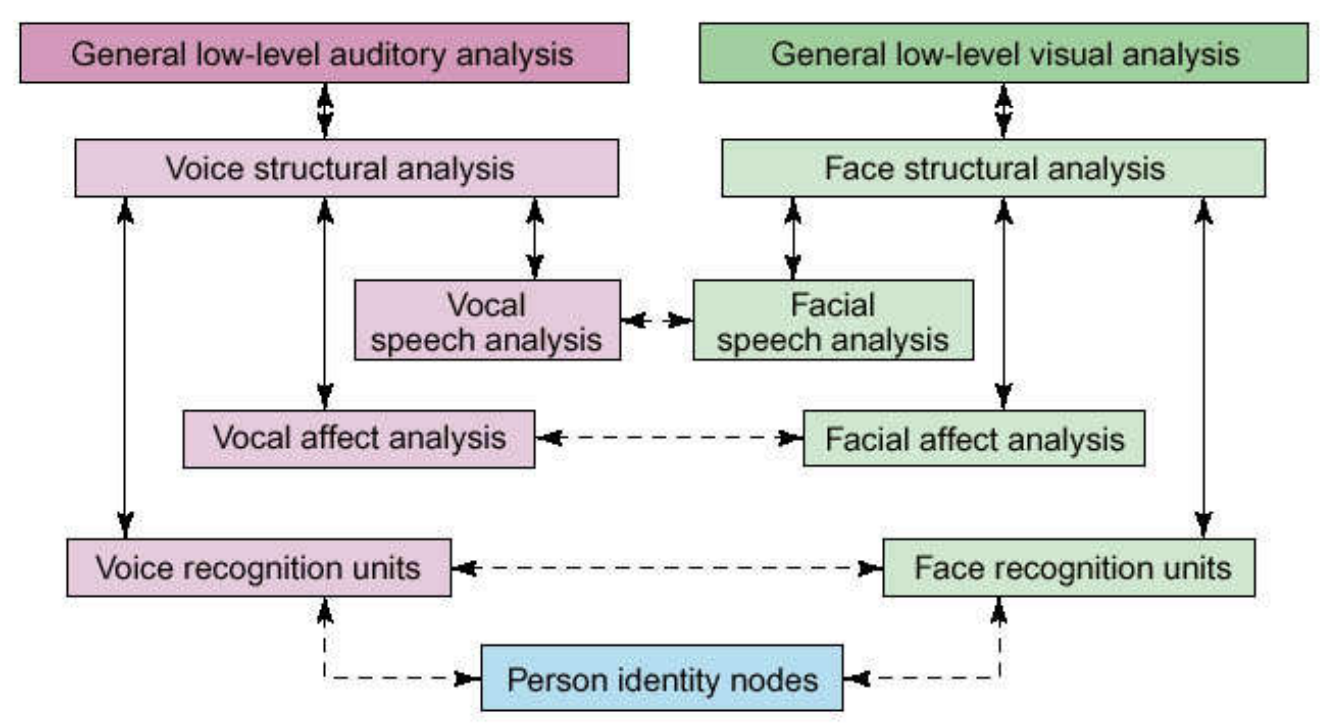
- Conveys: emotional state, age, identity, health, gender, attractiveness - 74Outline Voice to Ear = Face to Eye
- 75What are the most important regions of the Face perception network?- Occipital face area: structural processing of faces
- Fusiform face area: higher-level processing
- Superior temporal sulcus: involved in both - 76What is the "Halo Effect"?Cognitive bias in which our judgements of a person is influences by the physical appearance
- 77What are the main contributors to what makes an "Attractive Face"?1. Averageness - Galton
2. Symmetry
3. Distance
4. Sexual Dimorphism
5. Social Factors - 78What is the Perceptual Bias Account?The wiring of our visual system means we can easily process symmetric stimuli of any kind
- Bias makes symmetric stimuli seem attractive
- Enhanced cortical sensitivity for symmetric patterns - 79What is the Evolutionary Advantage View?Symmetric characteristics signal developmental stability (health)
- 80What makes a voice more attractive?1. Averageness
2. Smoothness
3. Distance
4. Sexual dimorphism - 81Sexual dimorphism in regards to voice attractiveness?- Voices lower in pitch for men and higher in pitch for women are considered more attractive by the opposite sex
- 82What are the basic components to emotion?1. Cognitive appraisal of arousing event
2. Physiological changes (HR, breathing)
3. Increased readiness to act
4. Subjective "sense of feeling" - 83What is Prosody?Rhythm, stress and intonation of speech
- Conveyed as modulations in amplitude, timing, fundamental frequency and voice quality - 84What hemisphere deals with emotional tone in speech?Right Hemisphere
- 85What are the 3 stages of the working model of affective prosody
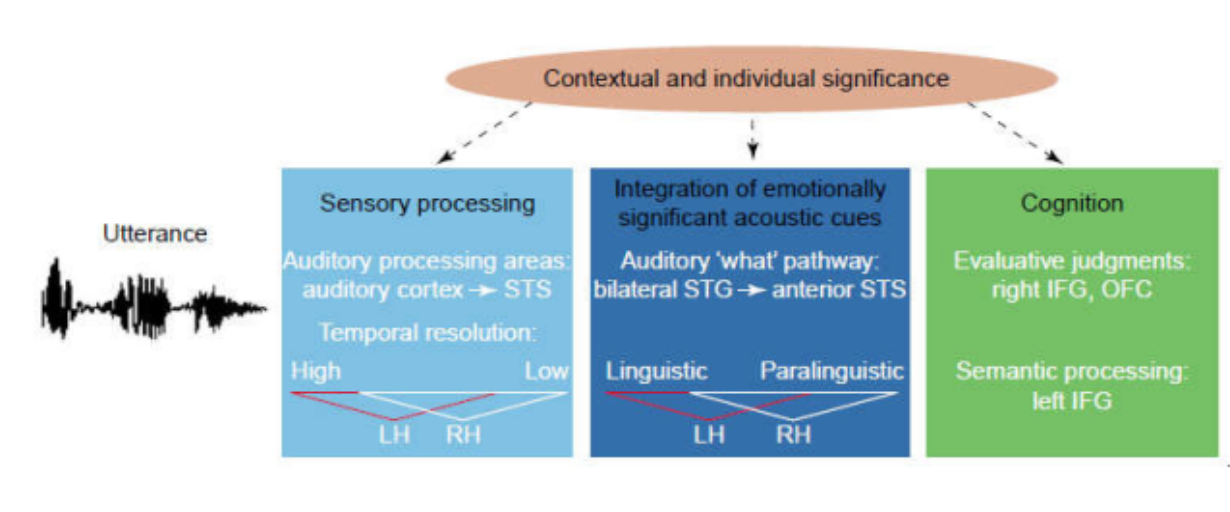
- 86What are the building blocks of Music?- Pitch
- Timbre
- Loudness
- Contour
- Tempo
- Rhythm
- Meter
- Spatial Location - 87What 4 Grouping strategies are there for grouping sound?1. Perceptual Fusion and Separation of Spectral Components
2. Auditory Continuity Effects
3. Grouping of Rapid Sequences of Tones
4. Grouping of Tone Sequences from Different Spatial Locations - 88What is meant by Perceptual fusion and separation of spectral components?Similarities in sounds spectrum causes us to fuse them to form one sound "image". Differences cause us to separate them and form multiple images
- Harmonicity
- Onset and time-varying synchronicity - 89What is meant by Auditory continuity effects?Ability to perceptually reconstruct and mask out sounds that don't belong to the current auditory image. i.e coughs
- 90What is meant by Grouping of rapid sequences of tones?Influence of several relationships used to form configurations
- Grouping by pitch proximity
- Grouping by timbre
- Grouping by temporal proximity - 91What is meant by Spatial location?Typically we group the sounds that come from one location rather than different locations
- 92What must Language and Music both depend on?- Executive functions
- Maturity level of temporal lobes
- Basic sound processing ability - 93NEED TO KNOW WHAT EACH ONE IS, WHERE IT IS, AND WHERE FIBRES CROSS!!!
- 94What are the different types of Hearing Loss?- Conductive: outer and middle ear problem
- Senorineural: Inner ear
- Mixed: Combo of the two - 95What happens during clinical assessment of the degree of deafness?Whispered speech test
- 96What are the 2 types of turning fork tests?1. Rinne's test
2. Weber's test - 97What happens during a Rinne's turning fork test?Turning fork places on temporal bone, behind ear
Normal hearing: air and bone conduction should be similar (within 10dB) and within normal range
Conductive HL: bone conduction in normal range; air conduction below normal
Senorineural HL: both below normal - 98What happens during a Weber's turning fork test?Turning fork place on forehead or upper lip; to determine side of HL
Normal: same loudness either ear
Problem: different loundess - 99What is an Audiometry?Techniques for the quantitative measure of auditory acuity
- 100Audiogram - Conductive hearing loss
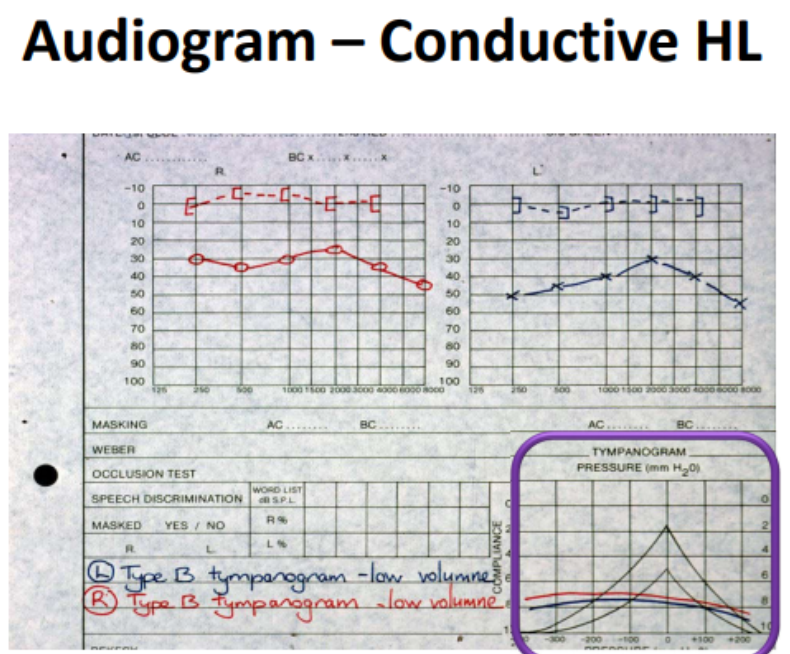
- 101Audiogram - Sensorineural hearing loss
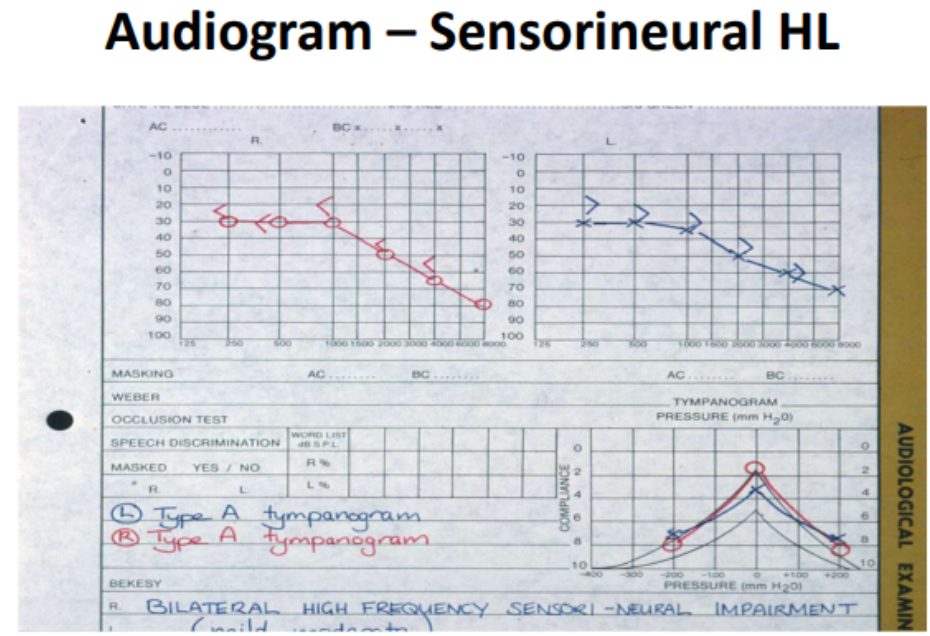
- 102How is hearing loss categorised in terms of Decibel range?> 0 - 25 = normal
> 25 - 40 = mild
> 40 - 55 = moderate
> 55 - 70 = moderately severe
> 70 - 90 = severe
> 90+ = profound - 103What is the difference between Objective and Subjective Tinnitus?Objective - can be result of hypertension or blood flow changes
Subjective - can be a cause of conductive hearing loss, hyperactive hair cells, abnormalities of the cochlea or auditory cortex - 104What is Broca's Aphasia?Lesion to left Inferior Frontal Gyrus: good comprehension but poor production
- 105What is Wernicke's Aphasia?Lesion to left posterior Superior Temporal Gyrus: poor comprehension and fleunt but non-sensical production
Informações
- Descrição
- - Psychoacoustics FlashCards sobre Psychoacoustics Flashcards , criado por Karis Allen em 03-01-2018.
- Criado por
- Karis Allen
- Visualizações
- 38
- Tags
- Avaliação