
Flashcards
AS Psychology - Memory
Flashcards do conjunto (82)
- 1What is Code, Capacity, Duration & Chuncking?• Coding - The format in which information is stored in the various memory stores
• Capacity - The amount of information that can be held in a memory store
• Duration - The length of time information can be held in memory
• Chuncking- Grouping sets of digits or letters into units or chunks - 2Describe the Research on Coding (Baddeley).• Baddeley (1966a, 1966b) gave different lists of words to four groups of participants to remember
• Group 1 (acoustically similar): eg. cat, cab, can
• Group 2 (acoustically dissimilar): eg. pit, few, cow
• Group 3 (semantically similar): eg. great, large, big
• Group 4 (semantically dissimilar): eg. good, huge, hot
• Participants were shown originial words & asked to recall in the correct order, they had to recall task immediately after hearing it (STM recall) - 3Describe the Findings on Coding (Baddeley).• Participants tend to do worse with acoustically similar words
• If ppts were asked to recall the word list after a time interval of 20 minutes (LTM recall), they did worse with the semantically similar words
• This suggests that information is coded semantically in LTM - 4Describe the Research & Findings of Digit Span (Capacity).• Jacobs, 1887, developed a technique to measure digit span
• The researcher gives (eg) 4 digits & the ppt is asked to recall these in the correct order out loud
• If the recall is correct, the researcher reads out 5 digits & so on until the ppt cannot recall the order correctly - this determines the individual's digit span
• Jacobs found that the mean span for digits actoss all ppts was 9.3 items, whilst the mean span for letters was 7.3 - 5Describe the Research & Findings of Span of Memory & Chunking (Capacity).• Miller, 1956, made observations of everyday practice, eg, he noted that things come in 7s: there are 7 days of the week, 7 deadly sins etc
• This suggests that the span (or capacity) of STM is about 7 items (plus or mins 2)
• However, Miller also noted that people can recall 5 words as well as 5 letters, they do this by chuncking - 6Describe the Research & Findings of Duration of STM.• Peterson & Peterson (1959) tested 24 undergraduate students, each student took part in 8 trials, on each trial the ppt was given a consonant syllable (aka triagram, eg. YCG) to remember as well as a 3-digit number
• Ppt was told to count backwards from tbe number until told to stop, the counting prevented mental rehearsal of the syllable
• On each trial they were told to stop at a diff. time - 3, 6, 9, 12, 15 or 18s (this is called the retention interval)
• This suggests that STM may have a very short duration, unless we repeat something over & over again (eg. verbal rehearsal) - 7Describe the Research & Findings of Duration of LTM.• Bahrick et al., 1975, studied 392 ppts from the Ohio aged 17-74
• Recall was tested by (1) photo-recognition test of 50 photos (some from the ppt's yearbook), (2) free recall test where ppts recalled the names of their graduating class
• Ppts who were tested within 15y of graduation were around 90% in photo-recognition, after 48y, recall declined to 70%
• Free recall was less good than photo-recognition, after 15y this was around 60%, dropping to 30% after 48y
• This suggestes that LTM can last a very long time - 8Evaluate the Research on Coding.• Limitation of Baddeley's study was that it used quite artificial stimuli rather than meaningful material
• The word liss had no personal meaning to ppts, this means we should be cautious about generalising the findings to different kinds of memory tasks, eg. when processing more meaningful info, people may use semantic coding even for STM tasks
• This suggests that the findings from this study have limited application - 9Evaluate the Research on Capacity.• Limitation of Jacob's study - it was conducted a long time ago & early research in psychology often lacked adequate control, eg. some ppts may have been distracted whilst being tested so they didn't perform as well. This means results may not be valid as there are cofounding variables that weren't controlled, however results of this study were confirmed in other research supporting its validity
• Limitation of Miller's research is that he may have overestimated that capacity of STM, eg. Cowan (2001) reviewed other research & concluded that the capacity of STM was on about 4 chunks. This suggests that the lower end of Miller's estimate (5 items) is more appropriate than 7 items - 10Evaluate the Research on Duration (STM).•
- 11Evaluate the Research on Duration (LTM).•
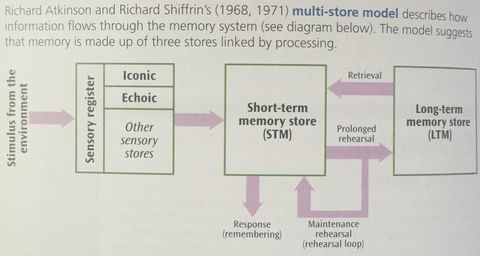
- 12Describe the Multi-Store Model (MSM).
- 13Describe the Sensory Register Store.•
- 14Describe the Short-Term Memory (STM) Store.•
- 15Describe the Long-Term Memory (LTM) Store.•
- 16Evaluate the Supporting Research Evidence for MSM.•
- 17Evaluate 'There is More then One Type of STM'.•
- 18Evaluate 'There is More than One Type of Rehearsal'.•
- 19What are the 3 Different Types of Long Term Memory?• Episodic Memory
• Semantic Memory
• Procedural Memory - 20Describe Episodic Memory.•
- 21Describe Semantic Memory.•
- 22Describe Procedural Memory.•
- 23Evaluate Clinical Evidence (for Types of LTM).•
- 24Evaluate Neuroimaging Evidence (for Types of LTM).•
- 25Evaluate Real-Life Applications (for Types of LTM).•
- 26What is the Working Memory Model (WMM)?•
- 27Draw a Diagram to Show the Working Memory Model.
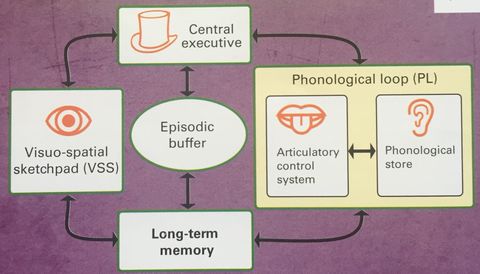
- 28What are the 4 Units of the Working Memory Model?• Central Executive
• Phonological Loop
• Visuo-spatial Sketchpad
• Episodic Buffer - 29Descibe the Central Executive.• The central executive is essentially an attentional process that monitors incoming data, makes decisions & allocates slave systems to tasks. The central executivr has a very limited storage capactiy.
- 30Describe the Phonological Loop.• It deals with auditory info (eg. coding is acoustic) & preserves the order in which info arrives - it's subdivided into:
• The phonological store, which stores the words you hear
• The articulatory process , which allows maintenance rehearsal (repeating sounds/words in a 'loolp' to keep them in the WMM while they are needed)
• The capacity of this 'loop' is believed to be two seconds' worth of what you can say - 31Describe the Visuo-spatial Sketchpad.• The VSS stores visual and/or spatial info when required, eg. map reading
• It also has a limited capacity, which according to Baddeley (2003) is about 3/4 objects, Logie (1995) subdivided the VVS into:
• The visual cache, which stores visual data
• The inner scribe, which records the arrangement of objects in the visual field - 32Describe the Episodic Buffer.• Added by Baddeley in 2000
• It's a temporary store for info , integrating the visual, spatial & verbal information processed by other stores & maintaining a sense of time sequencing - basically recording events (episodes) that are happening
• Can be seen as the storage component of the central executive & has a limited capacity of around 4 chunks (Baddeley, 2012) - it links working memory to LTM & wider cognitive processes such as perception - 33Evaluate Clinical Evidence (for the WMM).•
- 34Evaluate Dual Task Performance (for the WMM).•
- 35Evaluate the Lack of Clarity over the Central Executive (for the WMM).•
- 36What is Inteference?• Forgetting because one memory blocks another, causing one or both memories to be distorted or forgotten
- 37What is Proactive Interference?• Forgetting occurs when older memories, already stored, disrupt the recall of newer memories
• The degree of forgetting is greater when the memories are similar - 38What is Retroactive Interference?• Forgetting occurs when newer memories disrupt the recall of older memories already stored.
• The degree of forgetting is greater when the memories are similar - 39Describe McGeoch & McDonald's Study (Procedure).•
- 40Describe McGeoch & McDonald's Study (Findings).•
- 41Evaluate the Evidence from Lab Studies (Interference).•
- 42Evaluate Artificial Material (Interference).•
- 43Evaluate Real-Life Studies (Interference).•
- 44What are 2 Explanations of Forgetting?• Interference
• Retrieval Failure - 45What is Retrieval Failure?• A form of forgetting
• It occurs when we don't have the necessary cues to access memory. - 46What is a Cue?• A 'trigger' of info that allows us to access a memory. Such cues may be meaningful or may be indirectly linked by being encoded at the time of learning.
• Eg. cues may be external (environmental context) or internal (mood or degree of drunkness) - 47Describe the Encoding Specificity Principle (ESP) - (Retrieval Failure Theory).•
- 48Describe the Procedure & Findings for Context-Dependent Forgetting (Retrieval Failure Theory).•
- 49Describe the Procedure & Findings for State-Dependent Forgetting (Retrieval Failure Theory).•
- 50Evaluate the Supporting Evidence (for the Retrieval Failure Theory).•
- 51Evaluate the Questioning Context Effects (for the Retrieval Failure Theory).•
- 52Evaluate Recall vs Recognition (for thr Retrieval Failure Theory).•
- 53What is Eyewitness Testimony (EWT)?• The ability of people to rememeber the details of events, such as accidents & crimes, which they themselves have observed
• Accuracy of EWT can be affected by factors such as misleading information, leading questions & anxiety - 54What is Misleading Information?• Incorrect info given to the eyewitness usully after the even (hence often called 'post-event info')
• It can take many forms, such as leading questions & post-event discussion between co-witnesses &/or other people - 55What is a Leading Question?• A question which, because of the way it is phrased, suggests a certain answer. Eg. 'Was the knife in the accused's left hand?'
• This suggests that the answer is 'left hand' - 56Whats is Post-Event Discussion (PED)?• PED occurs when there is more than one witness to an even. Witnesses may discuss what they have seen with co-witnesses or with other prople. This may influence the accuracy of each witness' recall of the even
- 57Describe the Procedure of Leading Questions.•
- 58Describe the Findings of Leading Questions.•
- 59Describe the Procedure of Post-Event Discussion.•
- 60Describe the Findings of Post-Event Discussion.•
- 61Describe Useful Real-Life Application (Misleading Questions).•
- 62Evaluate the Fact that the Tasks are Artificial (Leading Questions).•
- 63Evaluate Individual Differences (EWT).•
- 64What is Anxiety?• A state of emotional & physical arousal. The emotions include having worried thoughts & feelings of tension. Physical chabges include an increased heart rate & sweatiness.
• Anxiety is a normal reaction to stressful situations, but can affect the accuracy & detail of eyewitness testimony - 65Describe the Procedure of Anxiety Having a Negative Effect on Recall (The Effects of Anxiety).•
- 66Describe the Findings of Anxiety Having a Negative Effect on Recall (The Effects of Anxiety).•
- 67Describe the Procedure of Anxiety Having a Positive Effect on Recall (The Effects of Anxiety).•
- 68Describe the Findings of Anxiety Having a Positive Effect on Recall (The Effects of Anxiety).•
- 69Explain the Contradictory Findings (The Effects of Anxiety).•
- 70Evaluate how the Weapon Focus Effect may not be Relevant (The Effects of Anxiety).•
- 71Evaluate how Field Studies Sometimes Lack Control (The Effects of Anxiety).•
- 72Evaluate that There are Ethical Issues (The Effects of Anxiety).•
- 73What is a Cognitive Interview?• A method of interviewing eyewitnesses to help them retrieve more accurate memories. It uses 4 main techniques, all based on well-established psychological knowledge of human memory.
- 74What are the 4 Main Techniques used in a Cognitive Interview?• Report Everything
• Reinstate the Context
• Reverse the Order
• Change Perspective - 75Describe 'Report Everything' (Cognitive Interview).•
- 76Describe 'Reinstate the Context' (Cognitive Interview).•
- 77Describe 'Reverse the Order' (Cognitive Interview).•
- 78Describe 'Change Perspective' (Cognitive Interview).•
- 79Describe the Enhanced Cognitive Interview.•
- 80Evaluate the Fact that the Cognitive Interview is Time-Consuming.•
- 81Evaluate that Some Elements maybe be more Valuable than Others (Cognitive Interview).•
- 82Evaluate the Support for the Effectiveness of the Enhanced Cognitive Interview.•
Informações
- Descrição
- AS - Level Psychology (Paper 1) FlashCards sobre AS Psychology - Memory , criado por irenamileva em 22-04-2016.
- Criado por
- irenamileva
- Visualizações
- 98
- Tags
- Avaliação