
Flashcards
Topic 11 GiU - Terminology
Flashcards do conjunto (17)
- 1Information packaging= ‘thematic systems’
→ Similar meaning: message is the same but way in which it’s presented changes - 2Unmarked word order→ SVOCA = canonical/unmarked word order
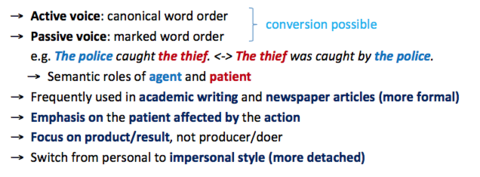
Active voice: canonical word order - 3Marked word orderPassive voice: marked word order
- 4Active→ SVOCA = canonical/unmarked word order
Active voice: canonical word order - 5Passive where used? emphasis? focus? style?
- 6End-weight Discontinuous NP?
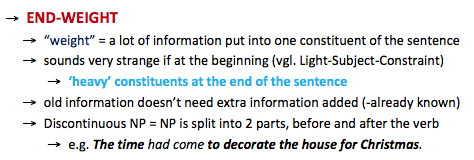
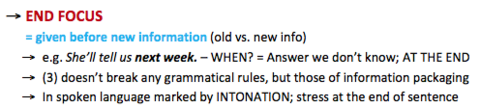
- 7Given-before-new= End Focus Principle
(next flashcard) - 8End-focus
- 9Topic - Comment

- 10Types of PassiveShort passive
Long passive
Prepositional passive
Get-passive
Verbal (be) passive
Adjectival passive - 11Short passive= ‘getting rid’ of the actor in active sentence
e.g. His wife betrayed him. <-> He was betrayed. - 12Long passive= keeping actor of active sentence; often occurs with ditransitive verbs
e.g. My mother gave Joseph a book. <-> A book was given to Joseph by my mother. - 13Prepositional passivee.g. The police is looking into the matter.
<-> The matter is being looked into. → With STRANDED preposition
→ CAUTION: you have to keep the time/tense of the original sentence! - 14Get-passive→ Very often in spoken language
→ Often foregrounds a dynamic process
→ Tends to colligate with verbs with negative meaning
→ Hints at increased responsibility of the subject
e.g. They were involved in the murder. <-> They got involved in the murder. - 15Verbal (be) passive→ More dynamic meaning
→ Focus on the action
→ Often agent given
e.g. The door was damaged by Tony. - 16Adjectival passive→ More stative meaning
→ Often agent omitted (past participle behaves like adjective)
→ Grading possible (e.g. very, quite, ...)
e.g. The door was (already) damaged. - 17The Use of Passive→ Given before new
→ Topic-comment
→ Omission of agent = when agent can be omitted, because we already know him → Avoidance of first-person pronouns in academic texts to de-personalize
→ Allocation of different semantic roles = who the agent/patient is
Informações
- Descrição
- Grammar in Use (Terminology) FlashCards sobre Topic 11 GiU - Terminology, criado por Lisza Neumeier em 18-01-2017.
- Criado por
- Lisza Neumeier
- Visualizações
- 24
- Avaliação