
Quiz
OCE Exam 3
This quiz has question types that open in the usual player.
Questions in this quiz (115)
1Which is false regarding evolution & natural selection?
- AThere's no biological predetermination
- BOrganisms don't want to evolve
- CIndividuals evolve
2What is a mutation?
- Aa mechanism for how things change with the passage of time
- Ban inheritable change in a organisms genes
- Caccumulation of beneficial inheritable structural or behavior traits
3All of Earth's life forms are related and share a common origin
- ATrue
- BFalse
4Earliest life existed 3.5bya
- ATrue
- BFalse
5What can change in evolution?
- AShape
- BSize
- CColor
- DBiochemistry
6Most mutations are favorable
- ATrue
- BFalse
7A [blank_start]species[blank_end] is a group of interbreeding organisms that are reproductively isolated from all other living forms
- Aspecies
8[blank_start]Adaptations[blank_end] are accumulations of beneficial inheritable structural or behavior traits
- AAdaptations
- BMutations
- CEvolution
91. In any group of organisms, [blank_start]more offspring[blank_end] are produced than can survive to reproductive age
2. [blank_start]Random variations[blank_end] occur in all organisms. Some are inheritable and can be passed on to offspring
3. Some inheritable traits make an organism [blank_start]better suited[blank_end] to its environment
4. Bearers of favorable traits are more likely to survive and are more likely to reproduce successfully ... Thus [blank_start]favorable[blank_end] traits accumulate in the population (selected)
5. The physical & biological (natural) environment [blank_start]does the selection[blank_end]- Amore offspring
- BRandom variations
- Cbetter suited
- Ddoes the selection
- Efavorable
10New species formation is often from [blank_start]physical isolation[blank_end]
- Aphysical isolation
11Define Convergent Evolution: marine animals with [blank_start]similar lifestyles[blank_end] but different evolutionary heritages eventually [blank_start]look the same[blank_end]
- Asimilar lifestyles
- Blook the same
12Convergent traits are [blank_start]independently[blank_end] selected by environmental conditions
- Aindependently
- Bdependently
13[blank_start]Taxonomy[blank_end]: the study of biological classification
[blank_start]Artificial system of classification[blank_end]: classification based on external similarities
[blank_start]Natural system of classification[blank_end]: using evolutionary history and developmental characteristics to classify organisms- ATaxonomy
- BArtificial system of classification
- CNatural system of classification
14Who grouped organisms based on hierarchy?
- ACharles Darwin
- BSteve Irwin
- CJeff Corwin
- DCarolus Linnaeus
15Name the three domains:
1. [blank_start]Bacteria[blank_end]
2. [blank_start]Archaea[blank_end]
3. [blank_start]Eukarya[blank_end]- ABacteria
- BArchaea
- CEukarya
16[blank_start]Prokaryotes[blank_end]: single-celled organisms without nuclei or organelles
[blank_start]Eukaryotes[blank_end]: cells with nuclei & organelle- AProkaryotes
- BEukaryotes
17Who fits into Eukaryotes?
- AFungi
- BProtists
- CAnimals
- DPlants
- EBacteria
- FArachaea
- GViruses
18What distinguishes life from non-life?
ability to capture, store, and transmit [blank_start]energy[blank_end] and the ability to [blank_start]reproduce[blank_end]- Aenergy
- Breproduce
19[blank_start]Photosynthesis[blank_end]: converting sun’s energy to food energy [blank_start]Chemosynthesis[blank_end]: production of food from inorganic molecules in the environment
- APhotosynthesis
- BChemosynthesis
20What synthesizes organic molecules from inorganic substances by photosynthesis or chemosynthesis?
- ABacteria
- BConsumers
- CPrimary producers
21Label the reactants and products of photosynthesis (use chemical formulas):
CO2 + [blank_start]H2O[blank_end] + [blank_start]light energy[blank_end] = [blank_start]CH2O[blank_end] + O2- AH2O
- Blight energy
- CCH2O
22Label the reactants and products of chemosynthesis (use chemical formulas):
[blank_start]CO2[blank_end] + [blank_start]H2S[blank_end] + [blank_start]broken bonds[blank_end] = [blank_start]CH2O[blank_end] + [blank_start]SO4[blank_end]- ACO2
- BH2S
- Cbroken bonds
- DCH2O
- ESO4
- FH2S
- GCO2
- Hbroken bonds
- ICH2O
- JSO4
- Kbroken bonds
- Llight energy
- MCH2O
- NO2
- OCO2
- PH2O
- QSO4
- RO2
- SH2O
- TNH4
23How many chemicals make up 99% of the mass of living things?
- A6
- B7
- C23
- D4
24What are the four chemical elements that make up 99% of life?
- ACarbon
- BHydrogen
- COxygen
- DNitrogen
- EPhosphorus
- FSulfur
- GIron
- HMagnesium
25The four main elements in living organisms combine to form carbs, lipids, proteins, and nucleic acids
- ATrue
- BFalse
26Biogeochemical cycles are [blank_start]movement of atoms[blank_end] and small molecules between the [blank_start]living and nonliving[blank_end] realms
- Amovement of atoms
- Bliving and nonliving
27What is the largest biogeochemical cycle?
- ACarbon cycle
- BNitrogen cycle
- CPhosphorus cycle
28Label the carbon cycle
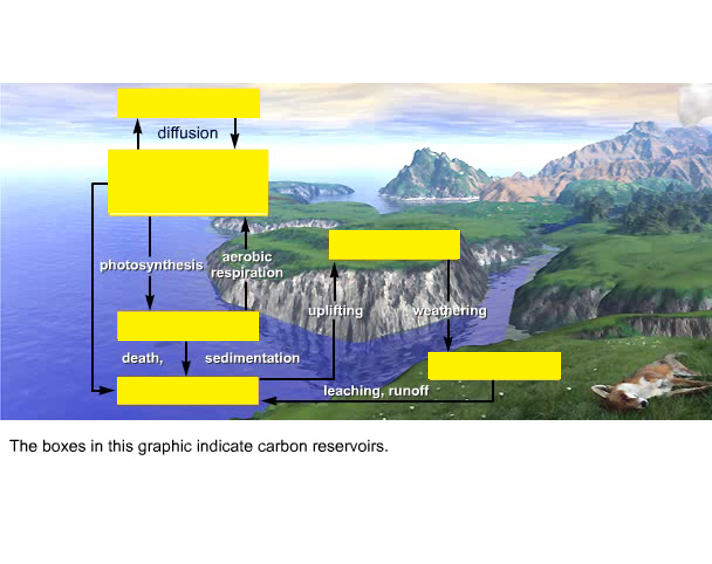
- AAtmosphere
- BBicarbonate and carbonate dissolved
- CMarine food webs
- DMarine sediments
- ETerrestrial rocks
- Fsoil water
29Most organisms can use free nitrogen
- ATrue
- BFalse
30What fixes nitrogen into a biologically active form?
- ABacteria and cyanobacteria
- BZooplankton
- CMarine viruses
31[blank_start]Nitrogen[blank_end] is recycled as animals consume and excrete ammonium and urea
- ANitrogen
32How does phosphorus enter the ocean?
- ARivers
- BRain
- CDead/dying organisms
33[blank_start]Limiting factor[blank_end]: environmental factor that can be harmful if present in quantities that are too large or too small
[blank_start]Physical factor[blank_end]: light, dissolved gases, temperature, salinity, acid-base balance, hydrostatic pressure nutrients
[blank_start]Biological factors[blank_end]: feeding relationships, competition for space, metabolic wastes, defense of territory- ALimiting factor
- BPhysical factor
- CBiological factors
34Label the light zones
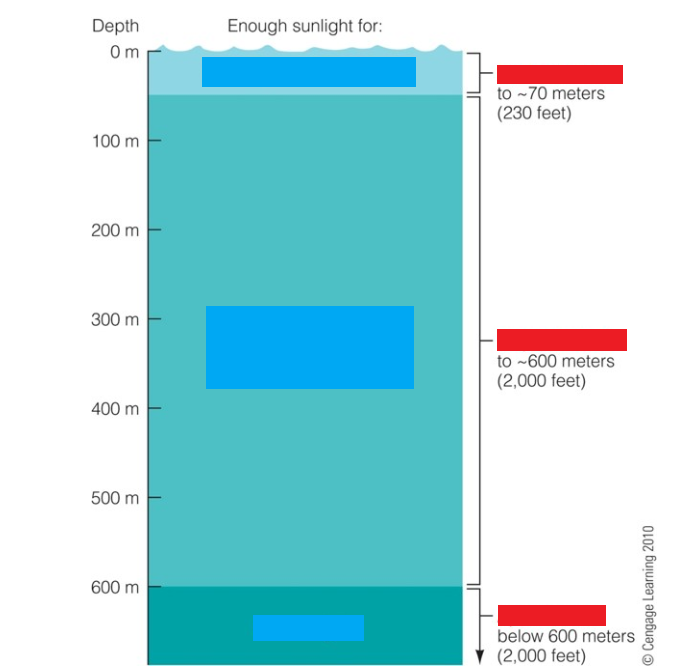
- APhotosynthesis and vision
- BVision only
- Cno light
- Dphotosynthesis and vision
- Evision only
- Fno light
- Gvision only
- Hno light
- Iphotosynthesis and vision
- JEuphotic zone
- Kdisphotic zone
- Laphotic zone
- Maphotic zone
- Neuphotic zone
- Odisphotic zone
- Peuphotic zone
- Qaphotic zone
- Rdisphotic zone
35[blank_start]Light[blank_end]: the depth to which light penetrates is limited by the number & characteristics of particles in water
[blank_start]Temperature[blank_end]: varies with depth and latitude. Affects chemical reactions in organisms
[blank_start]Nutrients[blank_end]: compounds required for production of organic matter- ALight
- BTemperature
- CNutrients
- DTemperature
- ENutrients
- FLight
- GTemperature
- HNutrients
- ILight
36[blank_start]Ectothermic[blank_end]: “cold blooded”, internal temperature that stays close to surrounding
[blank_start]Endothermic[blank_end]: “warm blooded”, have a stable high internal temperature- AEctothermic
- BEndothermic
37Metabolic rate doubles with a 10C increase
- ATrue
- BFalse
38Oxygen readily dissolves in water
- ATrue
- BFalse
39CO2 is more soluable than O2 by 1,000 times
- ATrue
- BFalse
40How much more CO2 does the ocean hold over the atmosphere?
- A20
- B70
- C1000
- D60
41Salinity: influences the function of [blank_start]cell membranes[blank_end]
- Acell membranes
42Change in [blank_start]salinity[blank_end] can damage cell membranes and alter [blank_start]protein structure[blank_end]
- Asalinity
- Bprotein structure
43Solution with the same concentration
- AHypertonic
- BHypotonic
- CIsotonic
44A cell placed in a salty solution will shrink
- AHypotonic
- BHypertonic
- CIsotonic
45A cell placed in a lower concentration solution will swell
- AIsotonic
- BHypotonic
- CHypertonic
46This fish constantly drinks water to regulate the water constantly leaving their body
- AMarine
- BFreshwater
47This fish pees all the time as they gain water by osmosis
- AMarine
- BFreshwater
48Streamlined bodies [blank_start]offers least resistance to fluid flow[blank_end]
- Aoffers least resistance to fluid flow
49Marine organisms with large eyes [blank_start]help with prey capure[blank_end]
- Ahelp with prey capure
50Organisms that are nearly transparent use it to [blank_start]elude predators[blank_end] and [blank_start]stalk prey[blank_end]
- Aelude predators
- Bstalk prey
51[blank_start]Deep scattering layer (DSL)[blank_end]: false bottom or group of organisms created by vertical migration to darker parts of the ocean
- ADeep scattering layer (DSL)
- BShallow layer
- CVertical migration
52What helps animals cope with pressure?
- ALacking compressible air pockets
- BReducing heavy oils
- CAdjustable swim bladders
53Water pressure increased [blank_start]1[blank_end] atmosphere with every [blank_start]10 meters[blank_end]
- A1
- B3
- C4
- D10 meters
- E20 meters
- F33 meters
54[blank_start]Benthos[blank_end]- bottom dwellers
[blank_start]Epifauna[blank_end]: live on the surface of the sea floor
[blank_start]Infauna[blank_end]: live buried in the sediments
[blank_start]Nektobenthos[blank_end]: swim or crawl through water above the seafllor- ABenthos
- BEpifauna
- CInfauna
- DNektobenthos
55[blank_start]Pelagic zone[blank_end]: open water
[blank_start]Neritic zone:[blank_end] nearshore over the continental shelf
[blank_start]Oceanic zone[blank_end]: deep-water, beyond the continental shelf- APelagic zone
- BNeritic Zone
- COceanic
- DNeritic zone
- EBenthic zone
- Fsublittoral
- GOceanic zone
- HHadal zone
- Iabyssal zone
56[blank_start]Benthic zone[blank_end]: bottom divisions
[blank_start]Littoral zone[blank_end]: intertidal, the band of coast covered & uncovered by tidal action
[blank_start]Sublittoral zone:[blank_end] continental shelf below the intertidal
[blank_start]Bathyal zone[blank_end]: covers the seabed on the slopes
[blank_start]Abyssal zone[blank_end]: deep sea floor
[blank_start]Hadal zone[blank_end]: trench walls and floors- ABenthic zone
- BAbyssal zone
- CEuphotic
- DLittoral zone
- EBathyal zone
- FAphotic zone
- GSublittoral zone
- HAbyssal zone
- IHadal zone
- JBathyal zone
- KNeritic Zone
- LDisphotic zone
- MAbyssal zone
- NTwilight Zone
- OMidnight Zone
- PHadal zone
- QTrench zone
- RFun Zone
57Epipelagic zone: [blank_start]shallowest zone[blank_end]
Mesopelagic zone: [blank_start]twilight[blank_end]
Bathypelagic: [blank_start]midnight[blank_end]
AByssopelagic: [blank_start]lower midnight[blank_end]
Hadopelagic: [blank_start]water in trenches[blank_end]- Ashallowest zone
- Btwilight
- Cmidnight
- Dlower midnight
- Ewater in trenches
58Label the oceanic zones
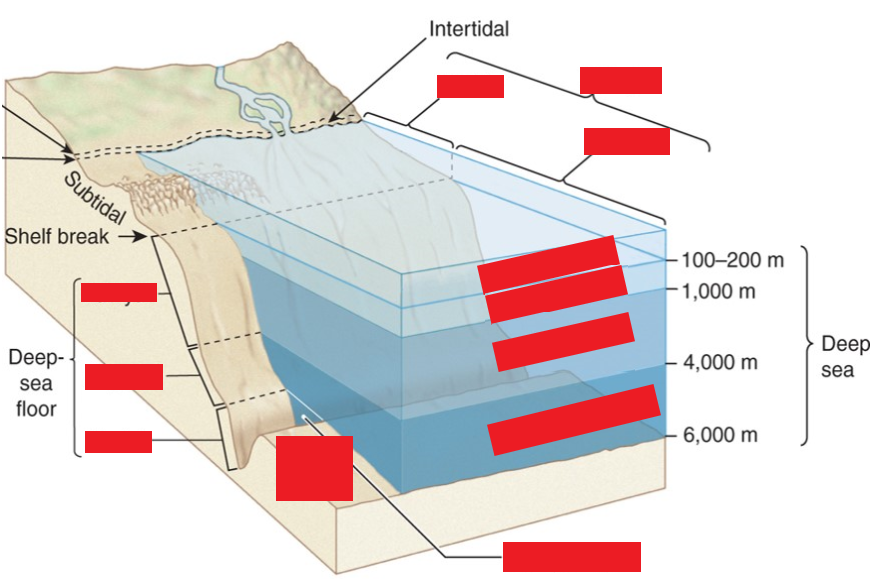
- ABathyl
- BAbyssal
- CHadal
- DAbyssal zone
- EHadopelagic
- FAbyssopelagic
- GBathypelagic
- HMesopelagic
- IEpipelagic
- JOceanic
- KPelagic
- LNeritic
59[blank_start]Mass extinctions[blank_end] are where large number of species died off simultaneously
- AMass extinctions
60[blank_start]6[blank_end] mass extinctions have occured in the last 4.5 billion years
- A6
- B5
- C4
61[blank_start]99.9%[blank_end] of ocean’s biomass relies directly or indirectly on photosynthesis for food.
- A99.9%
- B100%
- C70%
62[blank_start]Primary Productivity[blank_end]: rate at which energy is stored in organic matter
- APrimary Productivity
63How would you measure primary production?
- AMeasure radioactive carbon in seawater
- BCapture plankton in plankton nets
- CAsk the ocean nicely
- DMonitor ocean color with satellites
- ECount the number of predators of primary producers
64[blank_start]SeaWiFS[blank_end] (Sea-viewing Wide Field of View Sensor) satellite sensor collected ocean color data 1997–2010
- ASeaWiFS
- BMODIS
65[blank_start]MODIS[blank_end] (Moderate Resolution Imaging Spectroradiometer) – current
- AMODIS
66Factors affecting one degree of production are [blank_start]nutrient availability[blank_end] and [blank_start]solar radiation[blank_end]
- Anutrient availability
- Bsolar radiation
67What is the depth at which photosynthesis becomes zero? [blank_start]compensation depth for photosynthesis[blank_end]
- Acompensation depth for photosynthesis
68What light goes the deepest?
- ARed
- BGreen
- CBlue
69What measures the photosynthetic pigment?
- ASecchi desk
- BYSI multimeter
- CTurbidity tube
70Color in the ocean
Light green: [blank_start]eutrophic[blank_end]
Dark blue: [blank_start]oceanic[blank_end]- Aeutrophic
- Boceanic
71Plankton are [blank_start]pelagic[blank_end] organisms that live suspended in seawater. They drift or swim weakly, going where the ocean goes.
- Apelagic
- BBenthic
72Nekton [blank_start]actively swim[blank_end]
- Aactively swim
73[blank_start]Plankton nets[blank_end] are conical nets made of fine mesh nylon used to trap organisms that are flushed into the top and collected for analysis
- APlankton nets
- BBongo Nets
- CNewston Nets
74Phytoplankton: autotrophic plankton that generate [blank_start]glucose[blank_end] by photosynthesis
- Aglucose
75Phytoplankton are important because...
- AForm the base of the food web
- BProduce majority of oxygen
- CCreate the pigment of the ocean
- DAllow for red tides
76Write the main types of phytoplankton
- [blank_start]Picoplankton[blank_end]: extremely small plankton
- [blank_start]Diatoms[blank_end]: dominate, productive photosynthetic plankton
- [blank_start]Dinoflagellates[blank_end]: widely distributed single-celled phytoplankton
- [blank_start]Coccolithophores[blank_end]: small single-celled autotrophs- APicoplankton
- BDiatoms
- CDinoflagellates
- DCoccolithophores
77Main types of cyanbacteria pigment
[blank_start]Phycocyanin[blank_end]: blue pigment
[blank_start]Phycoerythrin[blank_end]: red pigment- APhycocyanin
- BPhycoerythrin
78What are the fossilized, calcareous mounds deposited by cyanobacteria?
- ATrilobites
- BStromatolites
- CStalagmites
79What were the first photosynthetic organisms on earth?
- ASeaweed
- BAlgae
- CCyanobacteria
80The base of the microbial loop is [blank_start]picoplankton[blank_end]
- Apicoplankton
81[blank_start]Microbial loop[blank_end]: trophic pathway where dissolved organic matter (DOM) is returned to higher trophic levels
- AMicrobial loop
- BFood web
- CPredator-prey relationships
82Bacteriophages: [blank_start]viruses that infect bacteria[blank_end]
- Aviruses that infect bacteria
83How many viruses are in one drop of seawater?
- A1 trillion
- B10 million
- C20,000
- D12
84Diatoms [blank_start]silica test[blank_end] falls to seafloor forming a siliceous ooze
- Asilica test
- Bexoskeleton
- Ctube feet
85What assists diatoms in flotation?
- Aenergy stored as fatty acids & oils
- Bswim bladdar
- Cair pocket such as a lung
86what is are fustules?
- Arigid cell wall made of silica
- Brigid cell wall made of carbonate
- Cflexible cell wall made of silica
87[blank_start]Zooxanthellae[blank_end]: live within tissues of other organisms
- AZooxanthellae
88[blank_start]Bioluminescence[blank_end]: energy from a chemical reaction is transformed into light energy
- ABioluminescence
89What happens when some species of dinoflagellates become so numerous?
Answer: [blank_start]red tides[blank_end]- Ared tide
90What causes the brevetoxins associated with FL red tides?
Answer: [blank_start]Karenia brevis[blank_end]- AKarenia brevis
91[blank_start]Neurotoxic Shellfish Poisoning[blank_end]: produces brevetoxins & short term illness
[blank_start]Paralytic Shellfish Poisoning[blank_end]: Produces saxitoxin & is life threatening
[blank_start]Ciguatera Fish Poisoning[blank_end]: Caused by Gambierdiscus toxicus wiht no cure- ANeurotoxic Shellfish Poisoning
- BParalytic Shellfish Poisoning
- CCiguatera Fish Poisoning
92Small, single-celled autotrophs covered with disks of calcium carbonate fixed to cell wall
- ACoccolithophores
- BDiatoms
- CZooplankton
93What organisms remains are responsible for the White Cliffs of Dover?
- ACoccolithophores
- BWhales
- CCyanobacteria
94Types of Zooplankton
[blank_start]Holoplankton[blank_end]: rganisms that spend their whole lives in the plankton
[blank_start]Microflagellates & microcilliates[blank_end] are most abundant
[blank_start]Copepods[blank_end] dominate the larger consumers
[blank_start]Macroplankton[blank_end]: larger than 1 cm
[blank_start]Meroplankton:[blank_end] temporary visitors to the plankton that will later adopt a benthic or nektonic lifestyle
[blank_start]Foraminifera[blank_end]: planktonic “amoebas”- AHoloplankton
- BMicroflagellates & microcilliates
- CCopepods
- DMacroplankton
- EMeroplankton
- FForaminifera
95Seaweed are [blank_start]nonvascular[blank_end]
- Anonvascular
- Bvascular
96Label the seaweed
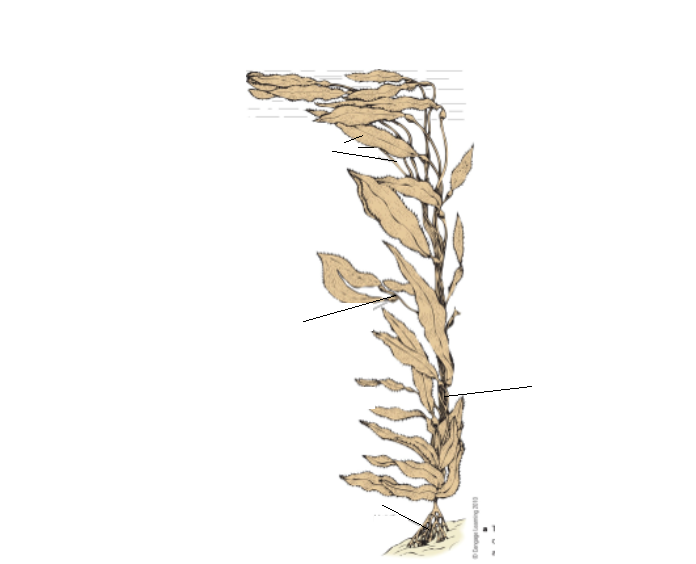
- AStipe
- BPneumatocysts
- CThallus
- DHoldfast
- EBlades
97How are seaweeds classified?
- AColor pigments in tissue
- BBlade shape
- CGenetic linkages
98[blank_start]Accessory pigments[blank_end]: light-absorbing compounds closely associated with chlorophyll molecules
- AAccessory pigments
- BPrimary pigments
- CPhotosynthetic pigments
99Types of seaweed
-[blank_start]Chlorophyta[blank_end]: green algae
-[blank_start]Phaeophyta[blank_end]: brown algae
-[blank_start]Rhodophyta[blank_end]: red algae- AChlorophyta
- BPhaeophyta
- CRhodophyta
100Green algae: [blank_start]sea lettuce[blank_end]
Brown algae: [blank_start]saragassum[blank_end]
Red algae: [blank_start]coralline algae[blank_end]- Asea lettuce
- Bsaragassum
- Ccoralline algae
- Dsaragassum
- Esea lettuce
- Fcoralline algae
- Gcoralline algae
- Hsaragassum
- Isea lettuce
101Marine plants are [blank_start]vascular[blank_end]
- Avascular
- Bnon vascular
102What is the only true marine flowing plants?
[blank_start]Seagrass[blank_end]- ASeagrass
103[blank_start]Rhizomes[blank_end]: horizontal stems growth beneath the sediment
- ARhizomes
104Thalassia testudinum:[blank_start]Turtle grass[blank_end]
Halodule wrightii: [blank_start]Shoal grass[blank_end]- ATurtle grass
- BShoal grass
- CShoal grass
- DManatee grass
105Cardgrasses are not really a marine species, but tolerate salt making them [blank_start]halophytes[blank_end]
- Ahalophytes
106Why are cordgrasses muey importante?
- AProvide habitat and breeding grounds
- BProtection again erosion
- CNatural water purification systems
- DPeople eat them
- EGrazing livestock
107What are mangroves?
- Atrees and shrubs adapted to live along tropical and subtropical shores
- Btrue trees
- COnly true marine flowing plants
108Why are mangroves important?
- ARoots trap & hold sediment
- BMangrove seeds eventually create new land
109Why are mangroves important?
- AMangrove seeds eventually create new land
- BRoots trap & hold sediment
- CAesthetically pleasing
110The first animal-like organisms were...
- ASingle celled
- BMulti-cellular
111What is a phylum?
A group of animals that shares similar [blank_start]architecture[blank_end], level of [blank_start]complexity[blank_end], & evolutionary [blank_start]history[blank_end]- Aarchitecture
- Bcomplexity
- Chistory
112Characteristics of invertebrates
- ASoft bodied
- BLack a rigid skeleton for muscle attachment
- CMany have a hard protective covering
- DOnly single celled
- ECan only be found in benthic environments
113Match the phyla with the representatives:
Porifera: [blank_start]sponges[blank_end]
[blank_start]Cnidaria[blank_end]: jellies, corals, sea anemones
Polychaeta: [blank_start]worms[blank_end]
Mollusca: [blank_start]clams, snails, ocotupuses, squid[blank_end]
[blank_start]Gastropoda[blank_end]: snails, nudibranchs
Bivalvia: [blank_start]clams, mussels, oysters[blank_end]
Arthropoda: [blank_start]lobster, shrimp, barnacles[blank_end]
[blank_start]Echinodermata[blank_end]: sea stars, urchins
[blank_start]Chordata[blank_end]: salps, lancelets, mammals- Asponges
- BCnidaria
- Cworms
- Dclams, snails, ocotupuses, squid
- EGastropoda
- Fclams, mussels, oysters
- Globster, shrimp, barnacles
- HEchinodermata
- IChordata
114Name the four chardate characteristics:
1. [blank_start]Notochord[blank_end]
2. [blank_start]Dorsal hollow nerve chord[blank_end]
3. [blank_start]Gill slits[blank_end]
4. [blank_start]Post anal tail[blank_end]- ANotochord
- BDorsal hollow nerve chord
- CGill slits
- DPost anal tail
115Name the only animal with both a medusa and polyp stage
- AJellies
- BCorals
- CSea squirts
- DHydrozoans
Information
- Description
- Exam 3 Oceanography Quiz on OCE Exam 3, created by Brook Olin on 09/11/2019.
- Author
- Brook Olin
- Language
- English
- Views
- 10
- Tags
- Rating
- No ratings yet Rate this quiz